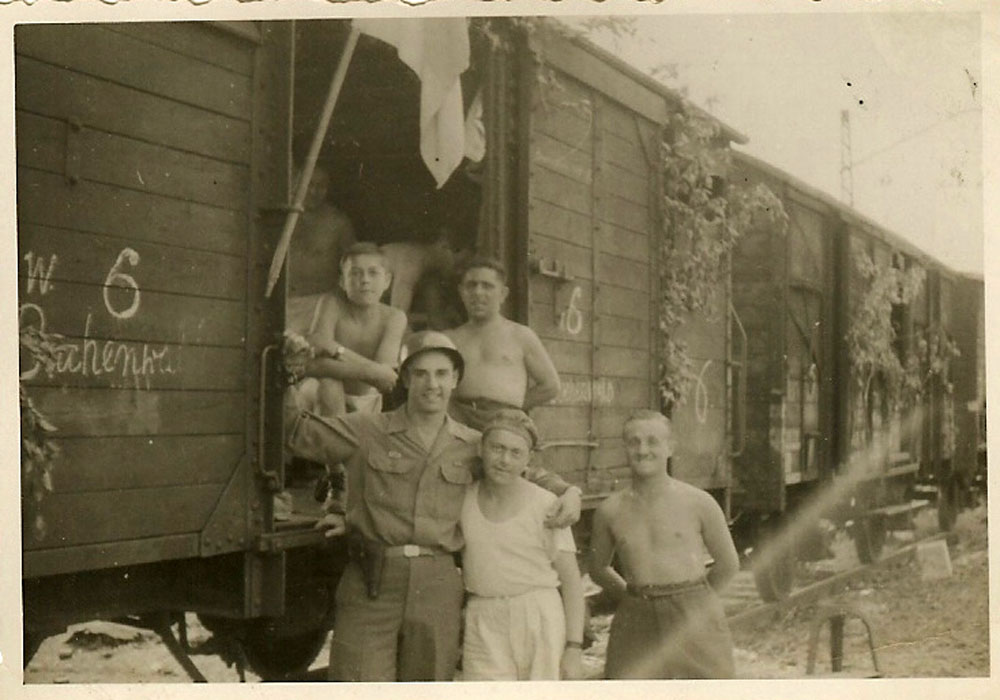
I have done a blog before on Arthur Kahn, a 21-year-old Jewish German medical student, who had enrolled at the University of Edinburgh in Scotland. He had returned to Germany to retrieve his student records from the University of Würzburg. Arthur was the first to be murdered during the Holocaust.
However, this blog is about this brother, Lothar Kahn. Born in 1924 in Gemünden am Main, Germany, Lothar Kahn’s early life was defined by the rising tide of Nazi persecution. Tragedy struck his family early; his brother Arthur was murdered by the Gestapo in 1933 in Dachau, and his father was later arrested during Kristallnacht and sent to Buchenwald. Following his father’s release, the family narrowly escaped, following another brother to London via Kindertransport in 1939 before finally reaching the U.S. on the eve of Passover in 1940. While Lothar found safety, his sister and her child remained behind and were murdered in 1942. Returning to Europe as a U.S. Army draftee in 1943, Lothar served in France and Germany, eventually using his linguistic skills as an interpreter to assist survivors in Bamberg at the war’s end.
Lothar’s father, Levi Kahn, was forced to pay a fee to retrieve his son’s body from Dachau so that he could be given a proper Jewish burial. Soon after, Arthur’s mother insisted that his sister, Fanni—who was working as an au pair in England—return to Germany immediately. Fanni later married, but she and her seven-year-old son were eventually murdered in Minsk.
The rest of the family managed to flee. With the help of relatives in the United States, they secured visas and emigrated to New York just four weeks before the outbreak of war. By then, the family had already lost two children.
Lothar went to work to support the family — and, like his brother Herbert, was drafted into the military in 1943.
Lothar Kahn’s life mirrors a Hollywood script: a Jewish refugee fleeing Nazi Germany only to return in the vanguard of the D-Day invasion. While films like Inglourious Basterds have turned this premise into a marketable spectacle, the reality of Kahn’s journey is far more complex. His story is not one of cinematic revenge, but a somber intersection of the 20th century’s two most defining narratives: the devastation of the Holocaust and the liberation of Europe.
On D-Day, T/3 Kahn headed toward the Normandy shore in an LCM carrying twenty-eight seasick men from the 146th Engineer Combat Battalion and a Naval Combat Demolition Unit. Their objective was “Easy Green” at low tide. Their orders were grimly straightforward: neutralize the beach obstacles—including Belgian Gates, Teller mines, and steel hedgehogs—to create the essential breaches for the following infantry waves.
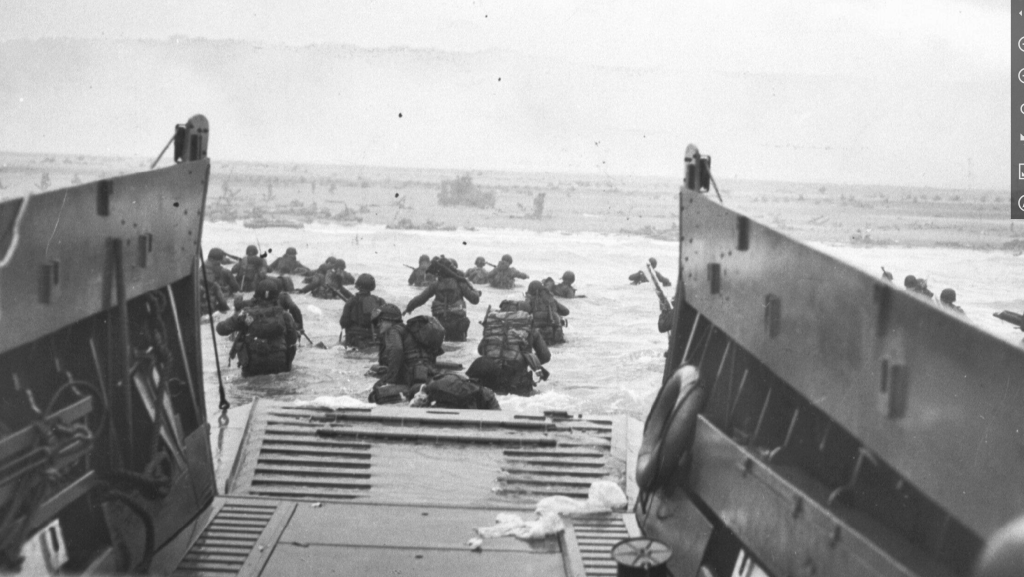
The 146th Engineer Combat Battalion hit Omaha Beach in the opening minutes of D-Day. Their task was a desperate sprint against the tide: they had less than an hour to clear the beach before the Atlantic rose to hide the German traps.
As the dust from the pre-invasion bombardment settled, the “catastrophe” began. Kahn jumped into a crossfire of German machine guns. At 19, he was carrying nearly his own body weight in gear—including 50 pounds of plastic explosives—as he scrambled for the cover of a cliff.
Only 19 years old, Lothar was a silhouette of burden, weighed down by a rifle, gas mask, and 50 pounds of C2 explosives. After stumbling through the surf, he collapsed against a sea wall near a cluster of shell-shocked soldiers. Seeing men sprawled in the sand, Kahn naively remarked, “Boy, these guys must be tired.” The reality was immediate and crushing: “Tired? These are dead people.” In that moment, the boy from Gemünden am Main realized he was surrounded by a carnage he had never before witnessed.
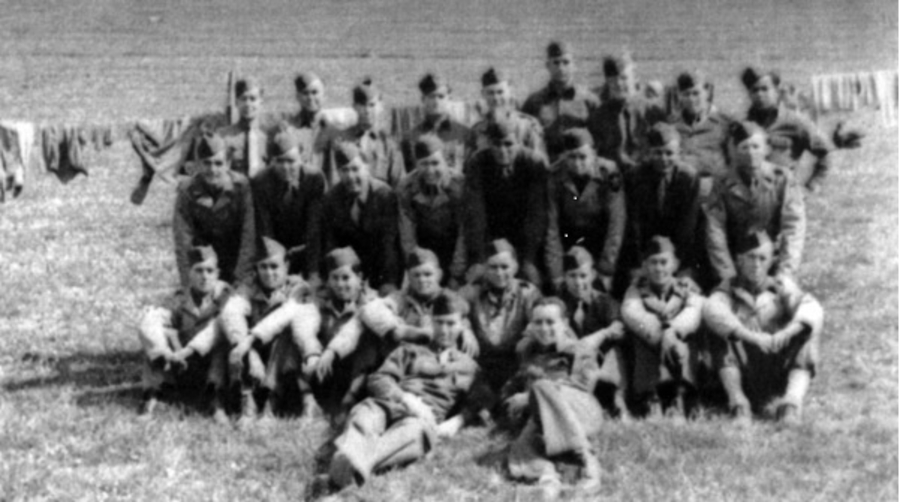
“The engineers knew very well that they would have only 30 to 40 minutes to destroy the obstacles before the rising tide covered them.”
As the smoke and dust from the massive Allied bombardment—ended only minutes earlier—slowly settled, Omaha Beach came into view. What it did not reveal, however, was the catastrophe awaiting the men about to land.
“The minute we jumped out of the boats, the shooting started,” Kahn later recalled. “Two or three German machine guns were firing, overlapping and raking the beach. All you heard was, ‘Get off the beach—you’re gonna be dead ducks.’ And then I was on my own.”
Nineteen years old, the combat engineer struggled forward under a crushing load: a rifle and helmet, a Hagensen pack filled with wire cutters, a gas mask, cartridges, an inflatable life belt, and a canteen. His drenched fatigues clung to him as he carried another fifty pounds of C2 plastic explosives, along with hooks and rope. Somehow, he reached the shore in one piece, beside a small cluster of soaked and terrified Americans.
“I got up against a cliff with six or eight people, and there were guys lying around. I said to someone, ‘Boy, these guys must be tired.’
‘Tired? These are dead people.’
When I heard that, I jumped up—but the guy pulled me down and yelled, ‘Don’t jump up—you’ll get shot.’ I had never seen a dead person before, and they were all around me.”
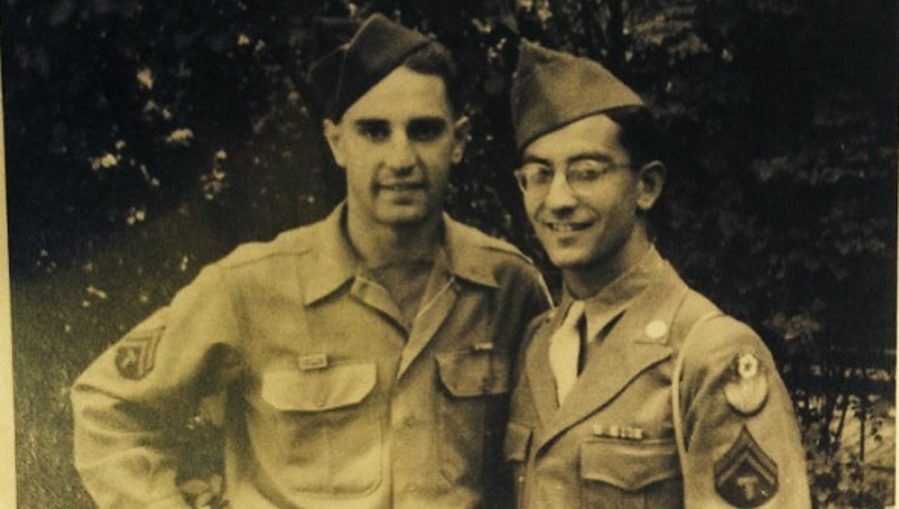
The idea that one brother was the first Jew murdered under Nazi policy, while his baby brother landed at H-Hour in what could be considered a pivotal moment in Hitler’s defeat, is strikingly ironic. Some might call it poetic justice. Yet Kahn’s Gap Assault Team No. 7 was unable to function once they left the landing crafts, as infantrymen took cover behind the obstacles they were meant to destroy. The first thirty minutes of the invasion were a total disaster. Hundreds of bodies—combat engineers, tankers, sailors, and infantrymen—littered nearly three miles of the flat expanse of Omaha Beach. Wounded men drifting in the rising tide were too weak to fight the current and drowned, while German artillery and small-arms fire decimated wave after wave of attackers.
“All I could hear was, ‘Help me, help me,’” Kahn recalled. “We couldn’t blow anything because Americans were behind us and would have been killed. The floating tanks were picked off like ducks, and the Rangers couldn’t get through either. All I could do was try to stay alive until the infantry could suppress the small-arms fire.”
Now 101 Kahn lives in Lincolnwood, Illinois, still speaking with a slight German accent. His D-Day account reads like that of any other American veteran who stormed Omaha Beach at H-Hour. By 1944, he was fully a “citizen soldier”—a term the late historian Stephen E. Ambrose applied to Americans who, as he dramatically asserted, “wanted to throw baseballs, not grenades; shoot a .22 rifle, not an M-1.” While evocative, Ambrose’s characterization was not entirely accurate.
Questions of revenge naturally arise when hearing the stories of veterans like Kahn, who had long suffered under Nazism before fleeing Germany. “I knew they killed my brother. That I knew. Revenge? Certainly—but I didn’t want to get killed either. In those moments, especially on D-Day, it’s a matter of preserving life. In fact, the day after the invasion, they had me interview some German prisoners—machine gunners—who told me, ‘We killed them, and they kept coming. There was nothing we could do.’”
sources
https://www.huffpost.com/entry/dday-veterans-brother-was_b_5440492?hp_auth_done=1
https://stevenmkarras.substack.com/p/the-d-day-story-i-cant-stop-telling
Please support us so we can continue our important work.
Donation
Your readership is what makes my site a success, and I am truly passionate about providing you with valuable content. I have been doing this at no cost and will continue to do so. Your voluntary donation of $2 or more, if you are able, would be a significant contribution to the continuation of my work. However, I fully understand if you’re not in a position to do so. Your support, in any form, is greatly appreciated. Thank you. To donate, click on the credit/debit card icon of the card you will use. If you want to donate more than $2, just add a higher number in the box left from the PayPal link. Your generosity is greatly appreciated. Many thanks.
$2.00
 History of Sorts
Leave a comment