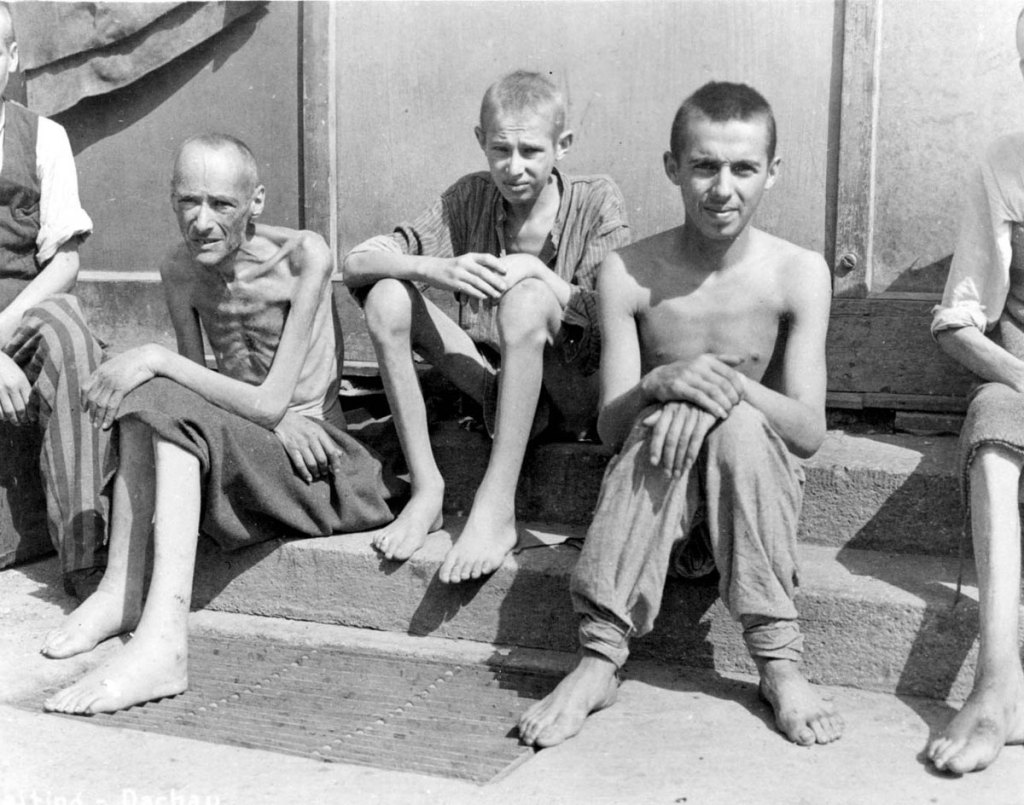
Buchenwald concentration camp was established in 1937. Thousands of people were imprisoned there, primarily political prisoners and those classified as “asocial.” Following Kristallnacht in November 1938, approximately 10,000 Jewish men were sent to Buchenwald, most of whom were released after about one month.
By 1943, many prisoners were forced to work in nearby munitions factories under harsh conditions.
In January 1945, following the evacuation of Auschwitz and other eastern camps, thousands of Jewish prisoners were transferred to Buchenwald. On April 6, the Germans began evacuating the camp, during which approximately 25,000 inmates were murdered or died. Buchenwald was liberated on April 11, 1945.
Over the course of its operation, approximately 239,000 people were interned at Buchenwald, and an estimated 43,000 perished.
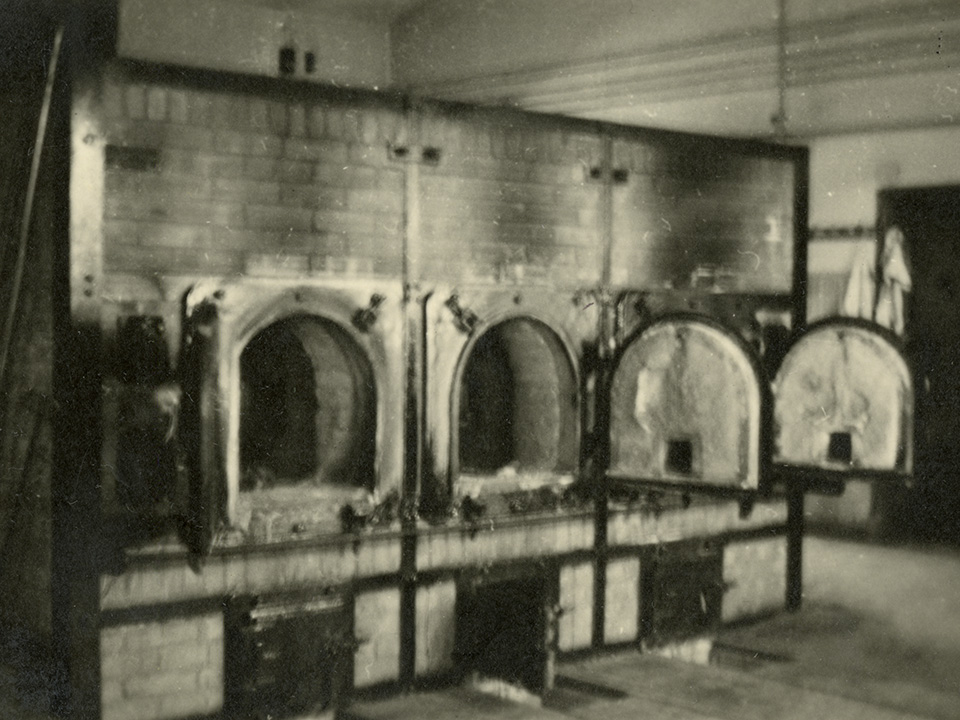
“You couldn’t grasp it all,” said Andrew Kiniry when asked about his time at the recently liberated Buchenwald concentration camp in the spring of 1945. Spoken during his oral history with The National WWII Museum, Kiniry’s words convey a simple, stark truth. A member of the 45th Evacuation Hospital attached to General George S. Patton’s Third Army, Kiniry was not among the first to enter Buchenwald. Yet what he witnessed on the camp grounds between April 28 and May 11, 1945, seared his memory. “I can’t really describe it, to tell you how horrendous it was to see these people treated like animals. Even worse than that.”
Kiniry recalled the bodies—human beings entirely bereft of life—piled in trenches or on carts, and the unbearable stench. “I don’t think they told us what we were getting into,” he said. Once there, the 45th acted with urgency and dedication. Tuberculosis tests were administered, and soup was provided to emaciated former inmates suffering from shrunken stomachs. Maintaining hygiene, however, was difficult; many freed individuals initially refused to shower, remembering the SS’s use of shower facilities for torture and execution. To aid their work, Kiniry and his unit supervised Germans brought in from nearby Weimar to clean the camp—men who could not feign ignorance in the face of the smell of death.
On April 11, 17 days before Kiniry arrived, Patton’s Third Army had reached Buchenwald. Commanded by Major General Robert W. Grow, the “Super Sixth” Division had been in the field since July 1944, pushing into Thuringia and seizing Mühlhausen on April 4. Even seasoned soldiers, veterans of five campaigns, were horrified by what they encountered at the Buchenwald Konzentrationslager that afternoon.
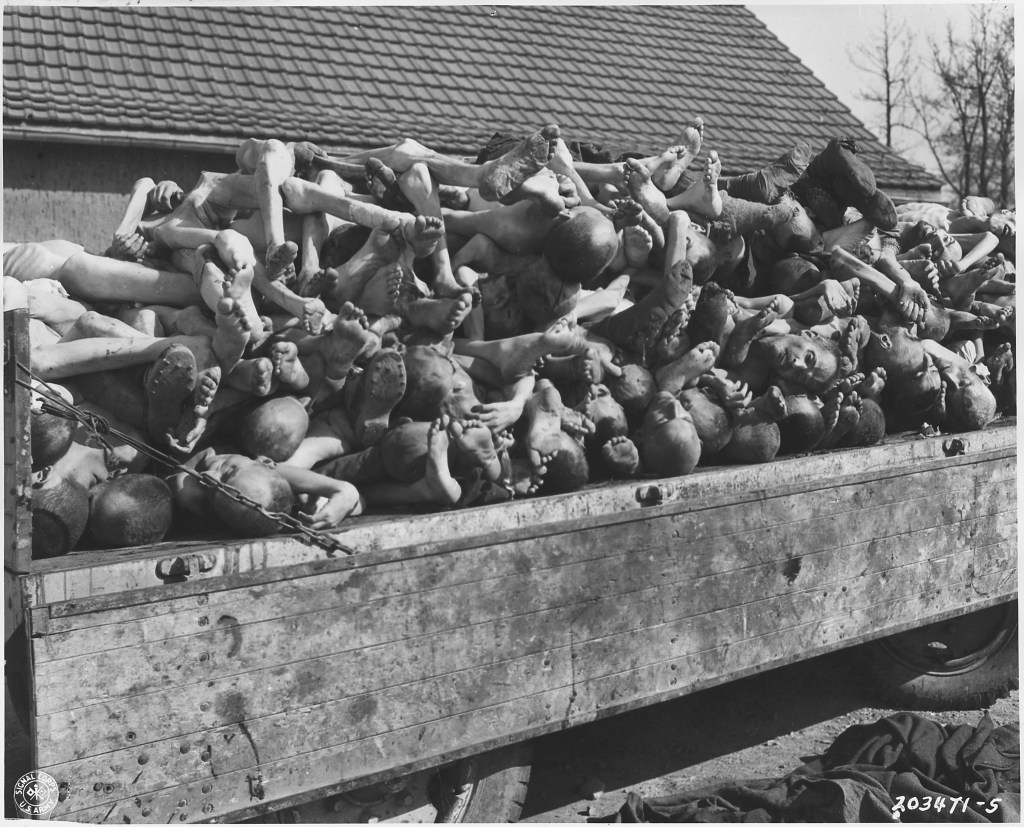
A week earlier, on April 4, troops from the 89th Infantry Division, 4th Armored Division, and the 602nd Tank Destroyer Battalion had overrun Ohrdruf, a subcamp of Buchenwald. Though most of Ohrdruf’s nearly 12,000 inmates had been moved, the hundreds of corpses found there, in varying stages of decomposition, bore grim testimony to the brutality of Nazism. The inspection of Ohrdruf on April 12 by Dwight D. Eisenhower, Omar Bradley, and Patton became a defining moment in American memory of liberation. Eisenhower remarked, “We are told that the American soldier does not know what he is fighting for. Now, at least, he will know what he is fighting against.”
Buchenwald, the first major concentration camp of Greater Germany to be liberated, was established in 1937 on the northern side of the Ettersberg, a forested hill near the Thuringian city of Weimar, home to Goethe and Schiller. During a visit in June 1998, the surrounding beauty contrasted starkly with the horror nearby, where 56,000 men, women, and children had perished from maltreatment, starvation, or disease.
Originally designed to isolate political opponents, Buchenwald began receiving Jews after Kristallnacht in November 1938. Roma, Jehovah’s Witnesses, convicts, Polish and Soviet POWs, resistance fighters, and forced laborers soon swelled the camp population. In winter 1944–45, as the Red Army advanced, Auschwitz inmates were transported there, creating severe overcrowding and a humanitarian crisis.
Before the Americans arrived, the SS evacuated approximately 23,000–28,000 inmates to other camps, leaving behind about 21,000, including 4,000 Jews, 850 of them children. Within the camp, an International Camp Committee, led by communists, had prepared to welcome U.S. forces. As the SS fled on April 11, prisoners seized control of watchtowers and distributed hidden weapons, with Camp Elder Hans Eiden assuming temporary leadership. Despite starvation and outbreaks of typhus and dysentery, the inmates organized themselves to secure the camp.
American personnel arriving afterward confronted the full extent of Nazi atrocities. They documented sites of medical experiments, execution blocks, and crematoria containing human remains. CBS journalist Edward R. Murrow arrived on April 12, broadcasting to the U.S. a harrowing account of his visit, describing emaciated survivors, corpses stacked “like cordwood,” and the grave conditions of the infirmary. He implored listeners to believe what he had reported, admitting, “For most of it I have no words.”
sources
https://www.nationalww2museum.org/war/articles/american-forces-enter-buchenwald-1945
https://en.wikipedia.org/wiki/Buchenwald_concentration_camp
https://www.auschwitz.org/en/history/evacuation/in-the-wake-of-death-march/
https://www.yadvashem.org/holocaust/this-month/april/1945-4.html
Donation
Your readership is what makes my site a success, and I am truly passionate about providing you with valuable content. I have been doing this at no cost and will continue to do so. Your voluntary donation of $2 or more, if you are able, would be a significant contribution to the continuation of my work. However, I fully understand if you’re not in a position to do so. Your support, in any form, is greatly appreciated. Thank you. To donate, click on the credit/debit card icon of the card you will use. If you want to donate more than $2, just add a higher number in the box left from the PayPal link. Your generosity is greatly appreciated. Many thanks.
$2.00
 History of Sorts
Leave a comment