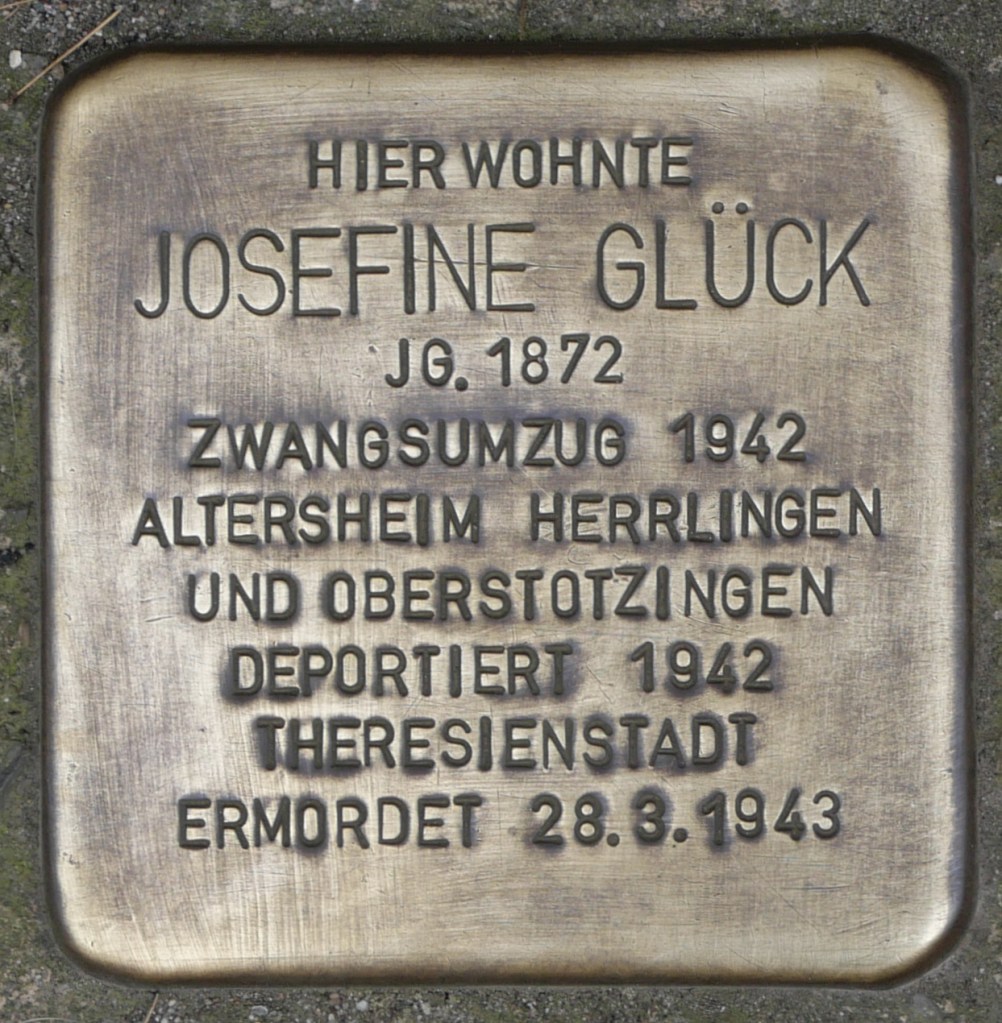
Josefine Glück’s life began in the vibrant culture of 1872 Vienna, but it would end in the cold deprivation of a concentration camp. Born to Jewish parents with Hungarian roots. Orphaned at the age of fourteen, she later pursued a career as an actress and remained unmarried throughout her life. Her son, Hermann Philippus Glück, was born out of a relationship with Otto de Lemos (born March 6, 1878, in Schleswig).
To Hermann, Josefine was more than a mother; she was his greatest advocate. He would later recount the “greatest sacrifices” she made to ensure his future. Their lives remained beautifully intertwined well into his adulthood; from 1930, Josefine lived at the center of Hermann’s world in Stuttgart, sharing a home with him, his wife Eugenie, and her beloved granddaughter, Ingeborg.
In 1929, Josefine sought spiritual refuge in the New Apostolic Church, but the rising tide of National Socialism cared nothing for her Christian faith. To the regime, she was merely a target. The indignities were designed to exhaust both body and soul. Forced to wear the “Jewish star,” the nearly 70-year-old woman was barred from the very trams that passed her door. She was forced to walk ten kilometers round-trip just to buy meager rations at a designated “Jewish shop”—a grueling trek for a woman of her years.
The final fracture of their home came on May 8, 1942. Josefine was torn from the Heusteigstraße apartment and cast into a series of “old people’s homes” that were little more than waiting rooms for death. From the cramped quarters of Herrlingen to the decaying halls of Oberstotzingen Castle, she was stripped of her dignity and her family. Finally, on August 22, 1942, she was deported to the Theresienstadt .
She had been healthy and spirited when she was taken from her son. Less than a year later, on March 28, 1943, Josefine died alone in the ghetto, a victim of a world that tried—and failed—to erase her humanity.
Hermann Glück: A Legacy of Scars
Hermann Glück inherited his mother’s resilience, but he could not escape the shadow of the Reich’s racial obsession. Despite his deep roots in Stuttgart and his service as a pastor, he was labeled a “first-degree Mischling.” This cold, bureaucratic term became the instrument used to dismantle his life piece by piece.
He was a man of recognized character—diligent, reliable, and respected—yet he was systematically stripped of his career at the Chamber of Commerce. Even as high-ranking colleagues tried to protect him, the machinery of hate was too strong. He lost his livelihood, his social standing, and eventually, his freedom.
By the winter of 1944, the persecution turned physical. Despite a failing heart, Hermann was forced into the brutal labor of the Organisation Todt. In the Wolfenbüttel labor camp, the combination of starvation and exhaustion finally broke him. After his heart failed, he suffered a devastating workplace accident—a physical manifestation of a system trying to grind him into the dust.
Hermann lived to see the liberation, but he never truly “survived” the war. The man who returned to his family was a ghost of his former self. His remaining years were a grueling battle against chronic arthritis, heart disease, and the slow rot of tuberculosis—the permanent biological signature of the camps.
He died at 67, his health and potential stolen by the years of labor and grief. Yet, in his final reflections, he chose not to dwell on the hate of his oppressors, but on the quiet, defiant kindness of his church community, who provided the “material and spiritual support” that kept his family’s flickering flame alive during their darkest hours.
sources
https://de.wikipedia.org/wiki/Liste_der_Stolpersteine_in_Stuttgart


Leave a comment