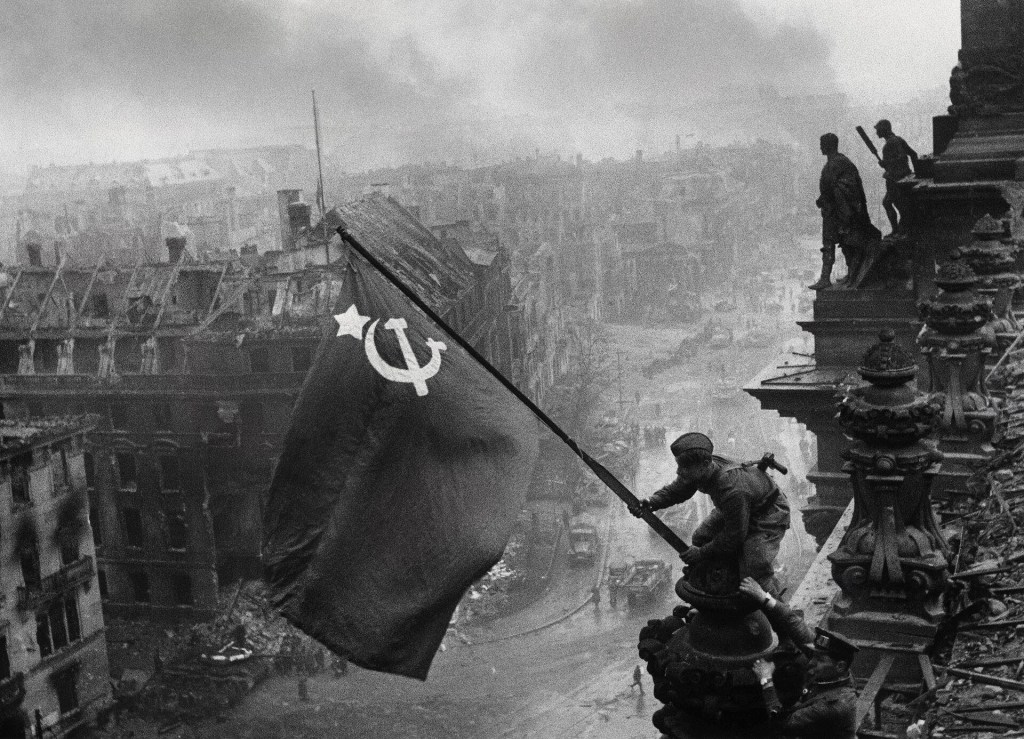
Some of you may know that I’m a rock fan, and one of my favourite bands is Queensrÿche(with Geoff Tate). One song in particular has always stayed with me: “Home Again.” The song explores the emotional toll of war from two perspectives — a father on the battlefield and his daughter waiting for him at home.
There’s one line in the song that always brings to mind the iconic photograph above:
“For me it wasn’t easy to raise the flag and leave.”
This is the story behind that photograph.
The image is one of the most recognizable icons of the 20th century: a lone Soviet soldier bracing himself against a stone plinth, thrusting the Hammer and Sickle into the smoky Berlin sky. While the photograph—Raising a Flag over the Reichstag—became the definitive visual period piece for the end of World War II, the story of its creation and its debut in the magazine Ogoniok is a fascinating blend of raw courage, artistic staging, and Cold War “Photoshop” before the digital age.
The Moment: May 2, 1945
By the time photographer Yevgeny Khaldei arrived at the Reichstag, the building had technically already been captured. In fact, several flags had been raised during the chaotic fighting on April 30, but under the cover of night and smoke, no photographer had been there to witness it.Khaldei, a seasoned war correspondent for TASS, knew that history required a visual. He arrived with a large Soviet flag sewn together from three red tablecloths by his friend, tailor Israel Kishitser.The CompositionKhaldei found three soldiers—Aleksei Kovalev, Abdulkhakim Ismailov, and Leonid Gorychev—and climbed to the roof. The scene was far from peaceful; smoke still billowed from the city below, and sporadic gunfire echoed through the streets. Khaldei shot two rolls of 35mm film, capturing the soldiers from various angles. The result was a masterpiece of composition, using the jagged architecture of the Reichstag to frame the triumph of the Red Army.
The Edit: Diplomacy and Details
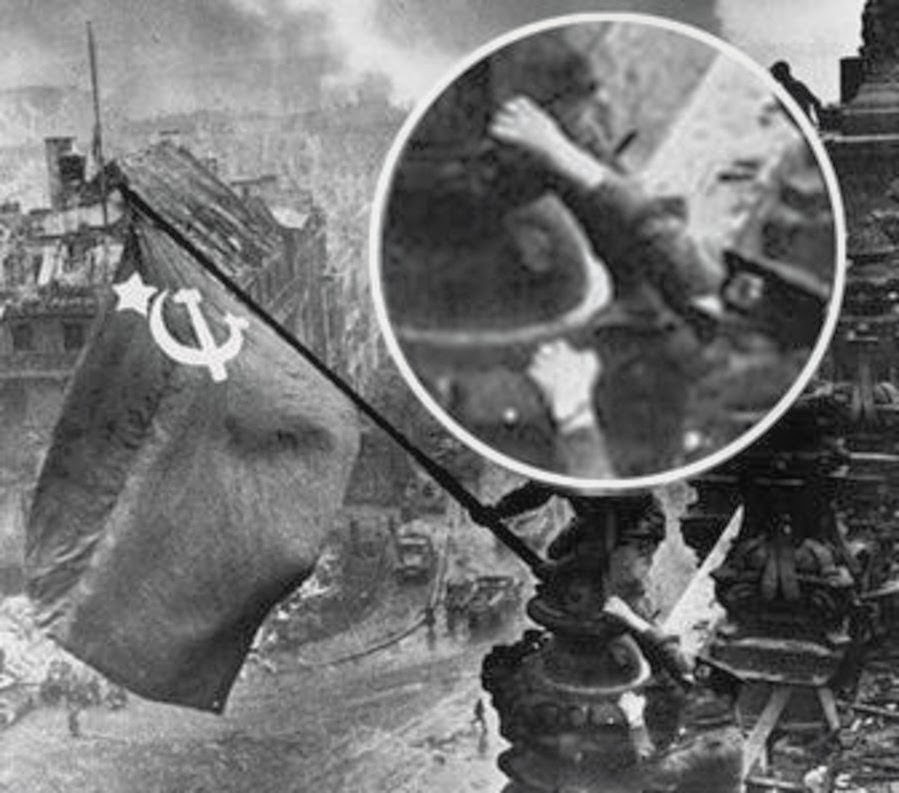
Before the image could be published in the prestigious weekly magazine Ogoniok, it underwent a crucial transformation.When Khaldei returned to Moscow and developed the film, he noticed a problematic detail. On the wrists of the soldier supporting the flag-bearer (Ismailov), there appeared to be two watches—one on each arm. In the sensitive political climate of 1945, this suggested looting, an image the Soviet high command was desperate to avoid.The Correction: Using a needle, Khaldei painstakingly scratched out the watch on the right wrist of the negative.
The Drama:
To heighten the emotional impact, he also darkened the smoke in the background to make the scene look more like the height of battle rather than the aftermath.Publication in OgoniokThe May 1945 issue of Ogoniok served as the victory edition for the Soviet Union. When the photograph was published, it wasn’t just news; it was a national catharsis.For the readers of Ogoniok, the photo represented the ultimate payment for the 27 million Soviet lives lost during the war. The magazine’s high-quality printing (for the time) allowed the grainy, dramatic textures of the Reichstag’s ruins to contrast sharply with the bright, defiant red of the flag.”This is what I was waiting for for 1,400 days,” Khaldei later remarked.The Legacy of a “Staged” RealityFor decades, the West criticized the photo for being “staged” and “edited.” However, in the context of 1940s photojournalism, Khaldei viewed himself as a “director of history.” To him, the truth of the victory was more important than the literal split-second documentation of it.
Key Players in the Frame:
PhotographerYevgeny KhaldeiUsed a Leica III rangefinder to capture the shot.
Flag BearerAleksei Kovalev: The 19-year-old soldier actually holding the staff.
Supporting Soldier: Abdulkhakim IsmailovThe man whose “extra watch” caused the editing controversy.
Publication: OgoniokThe Soviet equivalent of LIFE magazine, cementing the image’s fame, on May 13 1945.
To finish up, the aforementioned ‘Home Again’
sources
https://en.wikipedia.org/wiki/Raising_a_Flag_over_the_Reichstag
https://berlinexperiences.com/who-really-raised-the-soviet-flag-on-the-reichstag-mythbusting-berlin


Leave a Reply