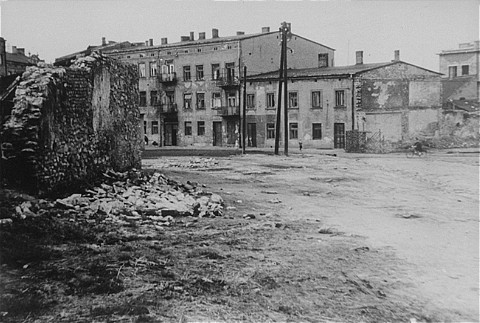
When we reflect upon Jewish resistance during the Holocaust, the towering specter of the Warsaw Ghetto Uprising understandably dominates collective memory. It has become the defining symbol of armed Jewish defiance against Nazi tyranny. Yet the history of resistance was never confined to Warsaw alone. Across occupied Poland—in cramped ghettos, isolated towns, and heavily fortified industrial labor camps—smaller but equally courageous acts of rebellion erupted against impossible odds. Among the fiercest, most tragic, and most frequently overlooked of these revolts was the Częstochowa Ghetto Uprising of June 1943.
To understand the uprising in Częstochowa, one must first understand the brutal environment from which it emerged. Częstochowa, an ancient Polish city renowned for its religious significance and the revered Jasna Góra Monastery, became a landscape of terror almost immediately after the German invasion of Poland in September 1939. Within days, Nazi occupation authorities unleashed waves of violence against the Jewish population. One particularly savage episode, later remembered as “Bloody Monday,” saw mass executions, public humiliations, and indiscriminate brutality carried out in the streets.
What followed was a systematic campaign of segregation and dehumanization. The city’s Jewish residents were gradually forced into an overcrowded and unsanitary ghetto, where more than 48,000 men, women, and children were compressed into conditions designed to strip them of dignity, health, and hope. Disease spread rapidly. Food was scarce. Fear became a permanent feature of daily existence.
From Exploitation to Extermination
Unlike some ghettos that functioned primarily as transit centers or holding zones, Częstochowa occupied a unique position within the Nazi war economy. The Germans transformed the city into an important industrial hub, seizing local foundries and factories for military production. Most notably, the German armaments company HASAG established extensive munitions operations that relied heavily on Jewish slave labor.
For a brief and agonizing period, this industrial importance created a fragile illusion of security among many prisoners. The logic seemed cruelly simple: as long as Jewish workers remained economically useful to the German war machine, they might be spared immediate annihilation. Labor became synonymous with survival.
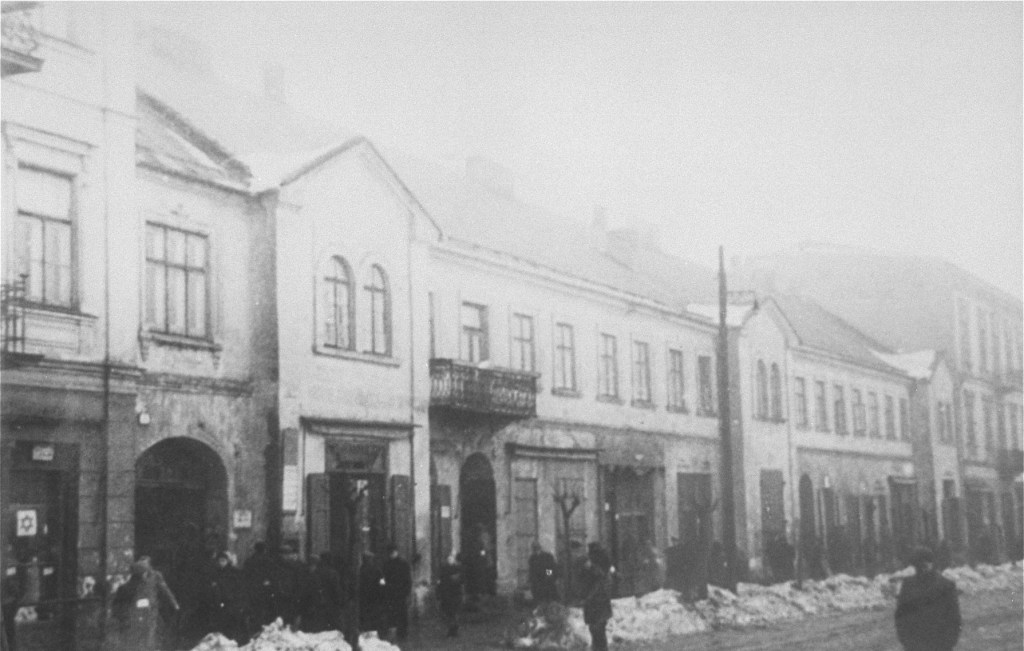
That illusion collapsed catastrophically in the autumn of 1942.
During Aktion Reinhardt—the coordinated Nazi operation to exterminate Polish Jewry—the SS moved to liquidate the “Big Ghetto” in Częstochowa. Over the course of mere weeks, nearly 40,000 Jews were rounded up, forced onto deportation trains, and sent directly to the gas chambers of Treblinka extermination camp. Families vanished overnight. Streets emptied into silence. Entire generations were erased with bureaucratic efficiency.
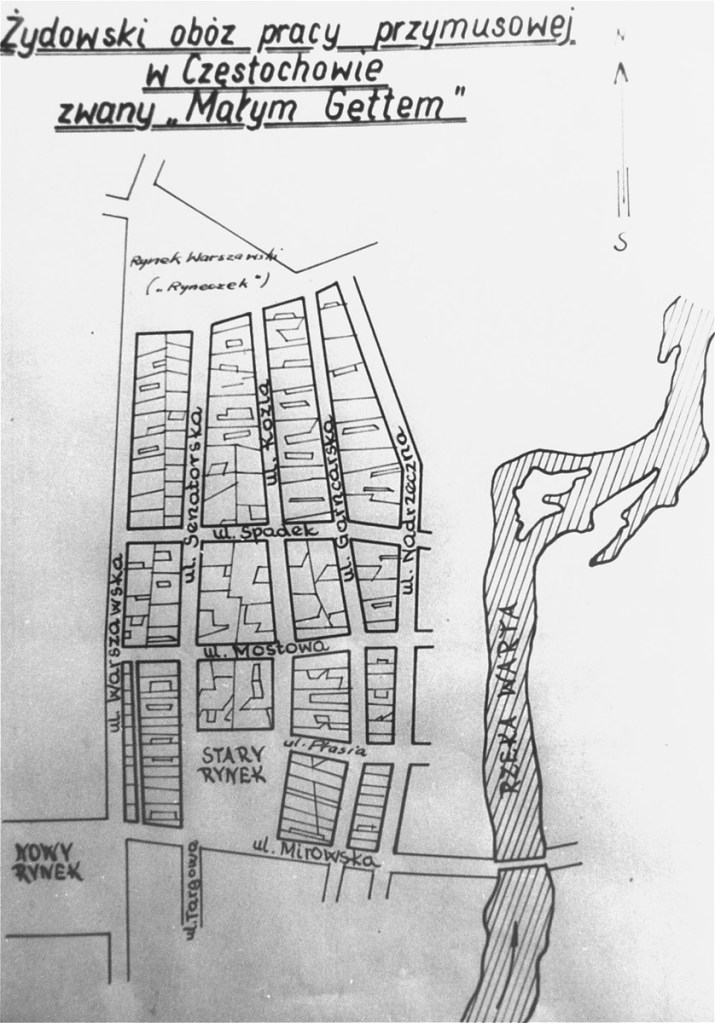
What remained afterward became known as the “Small Ghetto,” a tightly controlled enclave surrounded by barbed wire and guarded with ruthless vigilance. Inside were approximately 5,000 to 6,000 able-bodied workers and their concealed relatives, kept alive only because their labor continued to serve German military production.
The Emergence of the ŻOB
Within the suffocating confines of the Small Ghetto, the foundations of armed resistance slowly began to form. The surviving Jewish population had witnessed deportation, starvation, and industrialized murder on an unimaginable scale. Many had lost parents, spouses, siblings, and children. By late 1942, a growing number understood a horrifying reality: deportation no longer meant relocation—it meant death.
Out of this realization emerged a determination to resist.
In December 1942, underground activists established a local branch of the Żydowska Organizacja Bojowa (ŻOB), or Jewish Fighting Organization. The movement was led by figures such as Mordechaj Zylberberg and consisted largely of young men and women with almost no formal military training. In total, the organization numbered roughly 300 fighters.
Their material situation was desperate. Weapons were extraordinarily scarce. Pistols had to be smuggled into the ghetto piece by piece through clandestine networks. Ammunition was limited. Homemade grenades and crude explosives were secretly assembled using materials stolen from the very HASAG factories where Jewish prisoners were forced to manufacture weapons for Germany’s war effort.
Yet despite overwhelming disadvantages, the resistance persisted.
An early spark of armed defiance erupted on January 4, 1943. During a German selection operation intended to deport another 500 Jews, resistance fighters Mendel Fiszlewicz and Isza Fajner suddenly drew concealed pistols and opened fire on SS personnel gathered at Warsaw Square. The attack stunned the Germans. Both fighters were killed almost immediately, and the Nazis retaliated by executing dozens of Jews on the spot.
Militarily, the incident achieved little. Psychologically, however, it transformed the atmosphere within the ghetto. For the first time, many prisoners witnessed direct armed resistance against their oppressors. The myth of German invincibility had been punctured, if only briefly.
June 1943: The Final Revolt
The final confrontation began on June 25, 1943.
Having recognized that the Germans intended to liquidate the Small Ghetto entirely and destroy all remaining resistance networks, the ŻOB launched a full-scale uprising. The insurgents understood with painful clarity that victory in any conventional sense was impossible. They lacked manpower, heavy weapons, external support, and avenues of escape. What they possessed instead was determination born from desperation.
The fighters fortified themselves inside underground bunkers and defensive positions concentrated around Nadrzeczna Street. Barricades were erected. Secret passageways connected hideouts beneath ruined buildings. When German units entered the district, the resistance responded with gunfire, grenades, and coordinated ambushes.
The battle quickly descended into brutal urban warfare.
Armed with automatic weapons, artillery, and overwhelming numerical superiority, German forces methodically advanced through the ghetto. Resistance fighters engaged them in close-quarters combat from apartment windows, rooftops, alleyways, and underground shelters. For several days, the Small Ghetto ceased to function as a slave labor camp and became an active battlefield.
Częstochowa Ghetto Uprising: Key Facts
Date of Insurgency June 25 – June 30, 1943
Resistance Leadership Mordechaj Zylberberg and the ŻOB
Estimated Jewish Casualties Approximately 2,000 killed or executed
Outcome Uprising crushed; survivors deported to labor camps
Unwilling to sustain prolonged resistance in the district, German forces escalated their tactics toward total destruction. Buildings were shelled systematically. Bunkers were blown apart with explosives. Flamethrowers were used to force insurgents and civilians from underground shelters, often burning entire hiding places alive.
As German troops closed in on the ŻOB command bunker on Nadrzeczna Street, Mordechaj Zylberberg chose suicide over capture, refusing to allow the SS the satisfaction of interrogation or public execution.
By June 30, 1943, organized resistance had effectively been extinguished. Roughly 1,500 Jews died during the fighting itself, while hundreds more perished beneath collapsing structures or were burned alive inside bunkers consumed by fire and smoke. The surviving population was either executed or deported into the vast network of Nazi slave labor camps.
The Legacy of Defiance
The Częstochowa Ghetto Uprising did not alter the military course of the Second World War. It did not halt the machinery of genocide, nor did it prevent the destruction of the city’s Jewish community. By conventional military standards, the uprising ended in defeat.
But to measure the revolt solely through military outcomes is to fundamentally misunderstand its meaning.
The fighters of Częstochowa never believed they could destroy the German army. Their struggle was rooted in something deeper than battlefield victory. They fought to reclaim human agency in a world designed to reduce them to numbers, labor units, and ashes. They fought to assert dignity in the face of systematic dehumanization. Above all, they fought to ensure that the final chapter of their lives would not be written entirely by their executioners.
Today, the site once known as Warsaw Square has been renamed Ghetto Heroes Square in memory of those who resisted. The rebuilt streets of Częstochowa reveal little of the devastation that unfolded there in 1943, yet beneath the modern city lingers the memory of a community that chose resistance over passive submission.
The uprising remains one of the clearest demonstrations that even within the darkest machinery of industrialized death, the human spirit could still rebel. In the shadows of factories, barbed wire, and burning ruins, the fighters of Częstochowa proved that dignity itself could become an act of defiance.
sources
https://www.tandfonline.com/doi/abs/10.1080/17504902.2025.2509054
https://en.wikipedia.org/wiki/Cz%C4%99stochowa_Ghetto_uprising


Leave a Reply