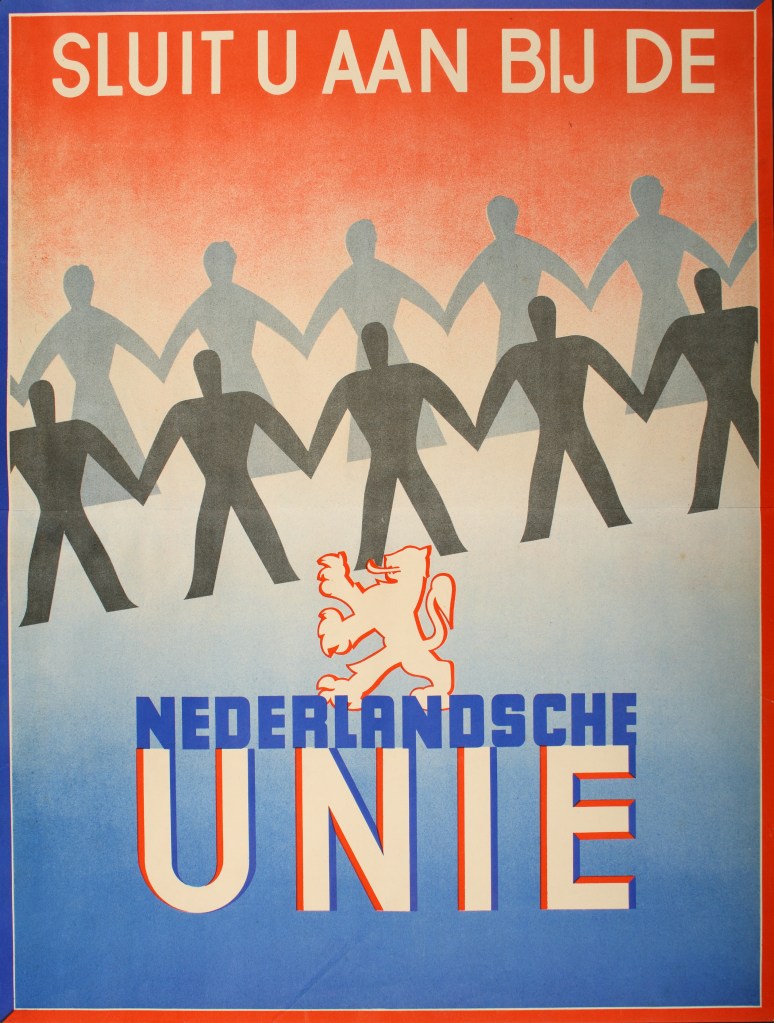
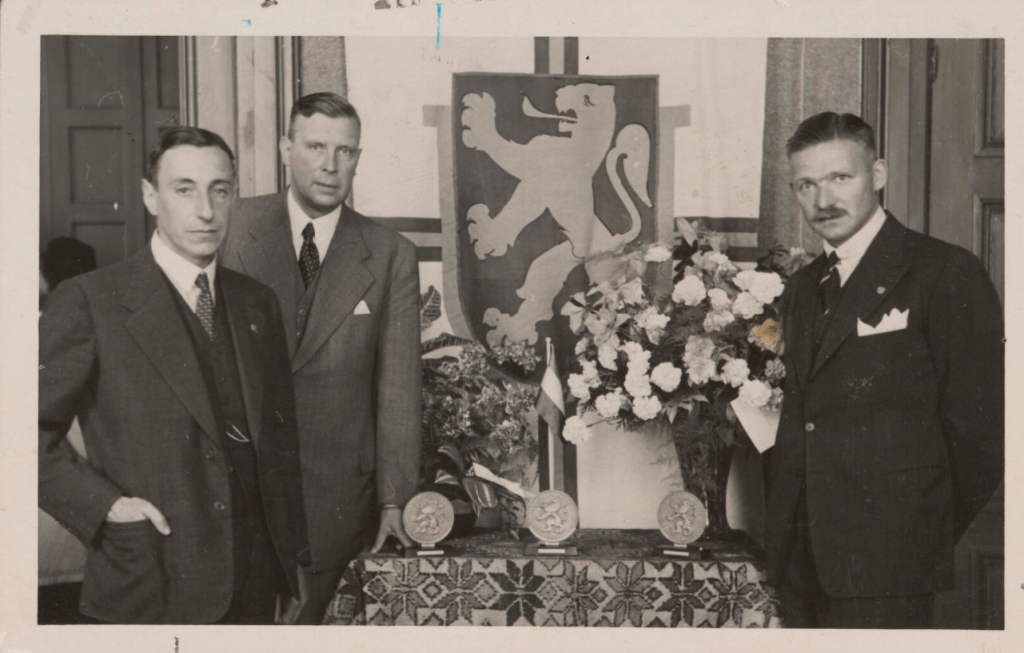
The Netherlands Union (Nederlandsche Unie) was a Dutch political movement during the German occupation of the Netherlands in the Second World War. It was founded by a trio consisting of Louis Einthoven (Chief Commissioner of Police in Rotterdam), Johannes Linthorst Homan (Queen’s Commissioner in the Province of Groningen), and Jan de Quay (Government Commissioner for Labour). The Netherlands Union was established in July 1940 and dissolved by the German occupation authorities in December 1941.
Foundation and Objectives
The movement was founded on 24 July 1940, following the German ban on all existing Dutch political parties after the invasion of the Netherlands. The Germans permitted the Netherlands Union to operate as the only non-National Socialist political organization. The three founders appealed to the Dutch people to unite in:
“deliberate efforts to preserve and strengthen the fatherland and the national community, and to prepare the conditions and the means for their future existence and welfare.”
The Union sought to build a new society, acknowledging the altered political realities in the Netherlands and Europe while cooperating with both the German and Dutch authorities. It envisioned a broad national community based on social harmony, cooperation, and social justice.
The movement also criticized the system of pillarization (verzuiling)—the division of Dutch society along religious and ideological lines. Because it aligned itself with several pre-war initiatives promoting national unity and “moral rearmament,” including the Groninger Gemeenschap, Brabantia Nostra, and the Movement for the Strengthening of the Dutch Community, some members of the Social Democratic Workers’ Party (SDAP) joined the Union. The Roman Catholic State Party (RKSP) even advised its members to become members of the organization.
The triumvirate made its first public appearance on 6 August 1940 at the Arts and Sciences Building in The Hague. Tickets sold out within two hours, demonstrating that public interest in the Union as an alternative to the NSB (National Socialist Movement) greatly exceeded enthusiasm for the NSB itself. The venue was decorated with Dutch red-white-blue flags.
Opposition to the NSB and Accommodation
The founders intended the Union to undermine the appeal of the NSB. As a symbolic countermeasure, the Union adopted the red-white-blue Dutch national flag, contrasting it with the Prince’s Flag (orange-white-blue) used by the NSB.
This irritated the German authorities. Hanns Albin Rauter, the Higher SS and Police Leader in the Netherlands, regarded the Dutch tricolour as a “party flag” when displayed by the Union. In a letter to the Secretary-General of Justice in November 1940, he wrote:
“I have observed that the Dutch national flag is being used by the ‘Netherlands Union’ as a party flag and employed for propaganda purposes. The Dutch national flag, however, is the symbol of the Dutch people as a whole and stands above the political struggle between parties.”
Rauter ordered that this “misuse” be stopped.
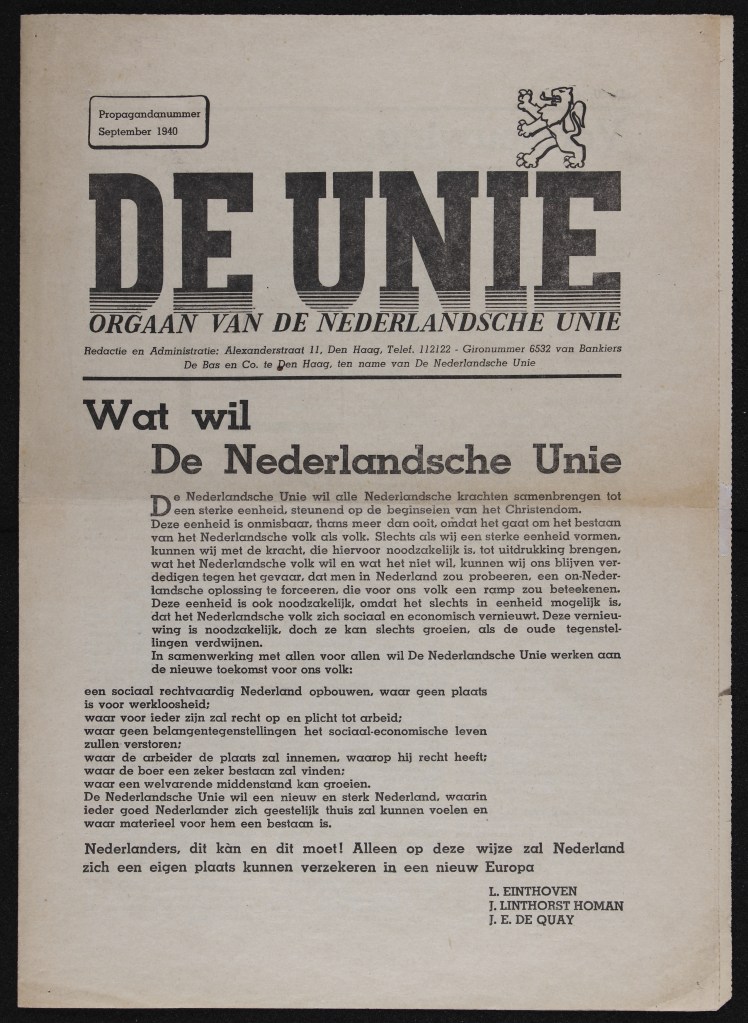
In January 1941, the Union sharply criticized the NSB in its weekly newspaper De Unie, pointing out that while the NSB continued to use the Prince’s Flag freely, the German authorities had prohibited the Union from displaying the Dutch national colours:
“No opportunity for propaganda or political activity is denied to them. Everything is placed at their disposal to win our people over to their ideas… We draw attention to the fact that the NSB is still permitted to display the orange-white-blue flag, while we are forbidden to use the red-white-blue.”
The rivalry extended beyond words. During the autumn and winter of 1940–41, newspaper vendors selling De Unie were repeatedly assaulted by members of the NSB’s Weerbaarheidsafdeling (WA), the party’s paramilitary wing. Union shops selling promotional materials were vandalized, and violent clashes between NSB members and Union supporters became increasingly common.
Nevertheless, the Netherlands Union also made concessions to the occupiers. In October 1940, the leadership argued that a special policy for Jewish refugees who had fled to the Netherlands was “necessary,” although they considered measures against Jews whose families had lived in the Netherlands for generations to be “unnecessary and undesirable.”
Among the three founders, Linthorst Homan went furthest in adapting to the new political reality. He sought contacts with both the NSB and the National Front. When close cooperation proved impossible—partly because the Union refused to ban Jewish members—he attempted to include representatives of both organizations on the Union’s Advisory Council. These efforts nearly prompted Einthoven and De Quay to resign in December 1940. Ordinary members remained largely unaware of these internal disputes. Most had joined simply to demonstrate their opposition to both the NSB and the German occupiers. They proudly wore Union lapel pins, attached Union pennants to their bicycles, and paid little attention to the direction taken by the leadership.
Antisemitism and Prohibition
In the spring of 1941, the triumvirate decided that one of its training institutes for active members would no longer admit Jews. However, Jewish members were never formally expelled.
The leadership asked Lodewijk Ernst Visser, chairman of the Jewish Coordination Committee (JCC), to advise Jewish members to withdraw voluntarily from the Union. Visser refused.
Following Germany’s invasion of the Soviet Union (Operation Barbarossa) on 22 June 1941, the German authorities increasingly expected the Union to adopt an openly pro-German position. The leadership declined to do so.
As a result, the Germans banned the Netherlands Union in December 1941. Its leaders were interned at Sint-Michielsgestel, where Jan de Quay became a member of the Heeren Zeventien (The Seventeen Gentlemen), a group that discussed the Netherlands’ political future after the war.
Membership and Popularity
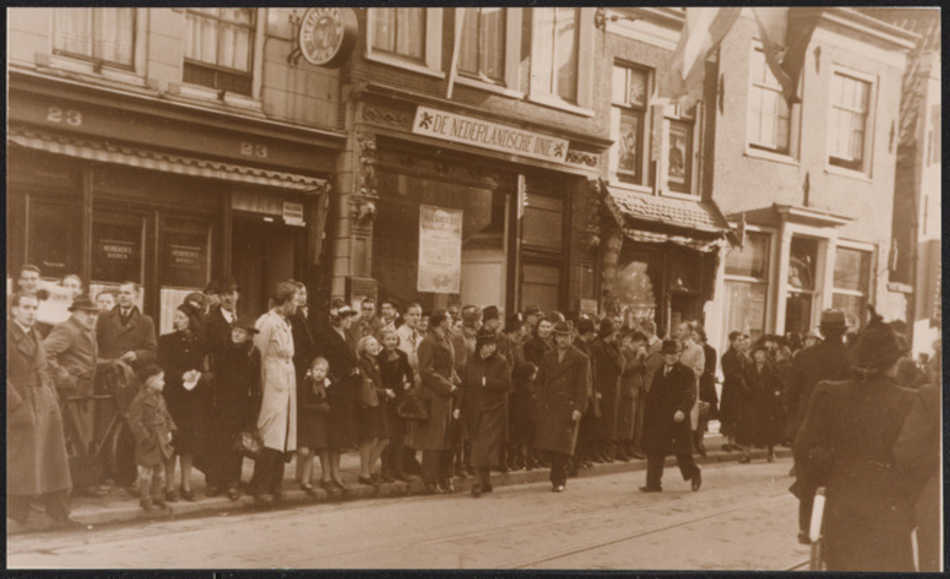
Within one week of its appeal on 24 July 1940, the Union had attracted more than 100,000 members.
At its peak, it enjoyed approximately one million supporters, of whom around 600,000 were registered members.
The movement was particularly popular among university students, much to the frustration of Huib Drion and his brother Jan Drion, who responded by founding the underground resistance newspaper De Geus, which criticized both the Netherlands Union and the German occupation.
The Union also published the weekly newspaper De Unie, which reached a circulation of approximately 314,000 copies.
Historical Assessment
The Union’s apparent acceptance of the political situation created by the German invasion became a source of severe criticism during the occupation and even more so after the war. Critics accused it of defeatism, arguing that it accepted German dominance in Europe as inevitable, and of displaying an unpatriotic willingness to cooperate with the occupiers.
Furthermore, the leadership appeared to hold parliamentary democracy in low regard and instead favoured reorganizing the Netherlands as a corporatist state. Although these ideas were relatively widespread in Europe at the time and were not exclusive to fascist movements, they nevertheless overlapped with aspects of fascist political theory. (It is worth noting that after the war the Netherlands established several public-law industrial organizations, such as the Product Boards, which reflected certain corporatist principles.)
Historian Lou de Jong, in his monumental work The Kingdom of the Netherlands During the Second World War, harshly condemned the triumvirate, accusing them of collaboration. Later historians have taken a more nuanced view. Many now argue that the Netherlands Union significantly slowed the growth of the NSB, preventing it from developing into a genuine mass movement and thereby reducing its value to the German occupation authorities.
Legacy
Members of the Heeren Zeventien, including Jan de Quay, Louis Einthoven, and Willem Schermerhorn, played important roles in shaping the Netherlands’ post-war political system.
Before the war and during the transition from occupation to liberation, De Quay and Einthoven worked closely with Prince Bernhard on defence matters. Although Queen Wilhelmina strongly favoured appointing De Quay as post-war Prime Minister, he instead became Minister of War.
Louis Einthoven became head of the Bureau for National Security (BNV), the organization that later evolved into the Domestic Security Service (BVD).
Immediately after the liberation, many Dutch citizens remained dissatisfied with the Union’s conduct during 1940–41. Public controversy intensified before the first post-war elections in May 1946, when De Quay announced his intention to become Queen’s Commissioner of North Brabant. Prime Minister Schermerhorn ordered a historical investigation, which ultimately cleared De Quay of wrongdoing.
Linthorst Homan, however, was not permitted to return to his former office as Queen’s Commissioner after the liberation. Following the completion of a government inquiry into the Netherlands Union in 1947, he was granted an honourable discharge with retroactive effect.
sources
https://www.oorlogsbronnen.nl/thema/Nederlandse%20Unie
https://www.parlement.com/nederlandse-unie
https://nl.wikipedia.org/wiki/Nederlandsche_Unie
https://www.verzetsmuseum.org/nl/kennisbank/nederlandse-unie
Donation
Your readership is what makes my site a success, and I am truly passionate about providing you with valuable content. I have been doing this at no cost and will continue to do so. Your voluntary donation of $2 or more, if you are able, would be a significant contribution to the continuation of my work. However, I fully understand if you’re not in a position to do so. Your support, in any form, is greatly appreciated. Thank you. To donate, click on the credit/debit card icon of the card you will use. If you want to donate more than $2, just add a higher number in the box left from the PayPal link. Your generosity is greatly appreciated. Many thanks.
$2.00


Leave a Reply