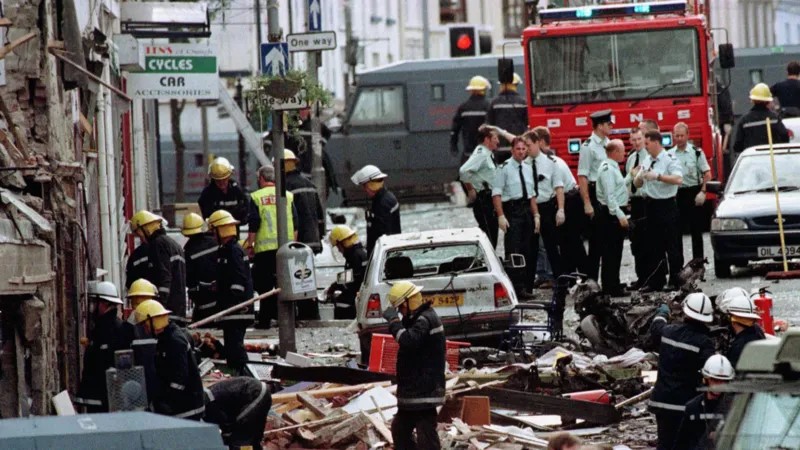
The Omagh bombing, which took place on August 15, 1998, stands as the deadliest single atrocity of the decades-long sectarian conflict in Northern Ireland known as the Troubles. Just four months after the historic signing of the Good Friday Agreement, a car bomb exploded in the busy centre of Omagh, County Tyrone, in an attack carried out by dissident republicans determined to derail the fragile peace process. Yet, rather than fracturing the emerging political consensus, the immense tragedy generated widespread cross-community solidarity, further isolated violent extremists, and reinforced the determination to preserve the peace that had been so painstakingly negotiated.
To understand the tragedy of Omagh, it is necessary to examine the fragile political landscape of Northern Ireland in 1998. In April of that year, the major political parties, together with the British and Irish governments, reached the Good Friday Agreement, establishing a power-sharing assembly and a framework for closer cooperation between Northern Ireland and the Republic of Ireland. The agreement subsequently received overwhelming public support in referendums on both sides of the border. However, its acceptance also deepened divisions within militant republicanism. Dissidents opposed to the Provisional IRA’s ceasefire and its participation in the political process broke away to form the Real IRA. Rejecting the compromises embodied in the peace agreement, the group sought to continue an armed campaign aimed at ending British sovereignty in Northern Ireland.
On Saturday, August 15, 1998, Real IRA operatives drove a stolen car containing a large quantity of explosives from County Monaghan across the border into Omagh. The vehicle was driven into the town centre and parked on Market Street, close to the courthouse and a number of busy shops. The bombers then armed the device and abandoned the car.
Approximately forty minutes before the explosion, three telephone warnings were issued to the media and emergency services using the recognised paramilitary codeword “Martha Pope”. Tragically, however, the warnings contained inaccurate information about the bomb’s location. They indicated that the device was near the courthouse, rather than on Market Street where the bomb-laden vehicle was actually parked. As the police attempted to evacuate people from the area identified in the warnings, members of the public were inadvertently directed towards the very location of the bomb.
At approximately 3:10 p.m., the bomb exploded in the crowded town centre. The blast caused horrific devastation, killing 29 people and injuring more than 200 others, many of whom suffered permanent and life-changing injuries. The scale of the destruction overwhelmed local emergency and medical services, while the town centre was transformed within seconds into a scene of unimaginable carnage.
The victims reflected the diverse character of Omagh and Northern Ireland itself. Catholics and Protestants were among the dead and injured, as were children, teenagers, local workers and visitors from abroad. A group of Spanish students who were in Northern Ireland on a language-exchange programme were caught in the blast. The victims included members of the same family spanning three generations, while one of those killed was a young woman who was pregnant with twins. The human cost of the attack was devastating and extended far beyond the 29 people who lost their lives, affecting families and an entire community for generations.
The immediate aftermath of the bombing was marked by shock, grief and widespread condemnation, both in Ireland and internationally. For the Real IRA, the attack proved to be a catastrophic strategic failure. Rather than turning public opinion against the Good Friday Agreement, the bombing produced the opposite effect. Unionists and nationalists stood together in mourning, while the Real IRA found itself increasingly isolated and condemned within the wider nationalist community. Under enormous pressure, the organisation issued an apology and announced a suspension of its military activities.
The British and Irish governments also responded by strengthening measures against dissident republican groups. New legislation and enhanced cooperation between the two governments and their security agencies were introduced to restrict the activities of paramilitary organisations and prevent further attacks. In this sense, the bombing had the opposite effect to that intended by its perpetrators: rather than destroying the peace process, it strengthened the resolve of political leaders and much of the public to protect it.
For the families of the victims, however, the pursuit of justice was far from over. The criminal investigation and subsequent prosecutions proved difficult, and for many years no one was convicted of the murders themselves. Frustrated by what they regarded as the shortcomings of the criminal justice system, relatives of the victims pursued a landmark civil action against individuals alleged to have been responsible for the bombing.
In June 2009, the High Court in Belfast found four men—Michael McKevitt, Liam Campbell, Colm Murphy and Seamus Daly—civilly liable for the attack and awarded the victims’ families approximately £1.6 million in damages. Although a civil judgment is distinct from a criminal conviction, the case represented an important development in the families’ long campaign for accountability and recognition of responsibility for the atrocity.
In the years that followed, attention increasingly turned to another painful question: could the bombing have been prevented? Investigations by the Police Ombudsman examined claims that intelligence concerning a possible dissident republican attack had reached the security authorities but had not been adequately communicated to those responsible for policing Omagh. These allegations became a central issue in the long-running campaign by victims’ families for a full investigation into the circumstances surrounding the bombing.
After years of campaigning, the UK government announced an independent statutory inquiry in 2023. The inquiry is examining whether intelligence held by the security services could have been acted upon in time to prevent the bombing, as well as questions surrounding intelligence sharing, mobile-phone data and the actions of the authorities before the attack. For the families, the inquiry represents not merely an examination of historical events but a continuing search for answers to questions that have remained unresolved for decades.
Ultimately, the Omagh bombing remains one of the defining tragedies of modern Irish and British history. It inflicted permanent wounds on the families of the victims and left an enduring scar on the town of Omagh and the wider community of County Tyrone. Yet the bombing also demonstrated the limits of terrorism as a means of overturning political change. The Real IRA sought to destroy the emerging peace, but the slaughter of innocent civilians instead strengthened public determination to reject a return to large-scale violence.
The memory of Omagh therefore carries a painful dual legacy. It is, above all, a story of 29 lives brutally taken and of hundreds more permanently changed. But it is also a reminder of the resilience of ordinary people confronted with extraordinary violence. The victims came from different backgrounds and communities, but in death they became a shared symbol of the terrible human cost of the Troubles. Their memory continues to underline the importance of reconciliation, political compromise and the preservation of peace—and the devastating consequences when those principles are abandoned.
Sources
https://www.oireachtas.ie/en/bills/bill/2026/28
https://www.bbc.com/news/articles/c1lqyl53960o


Leave a comment