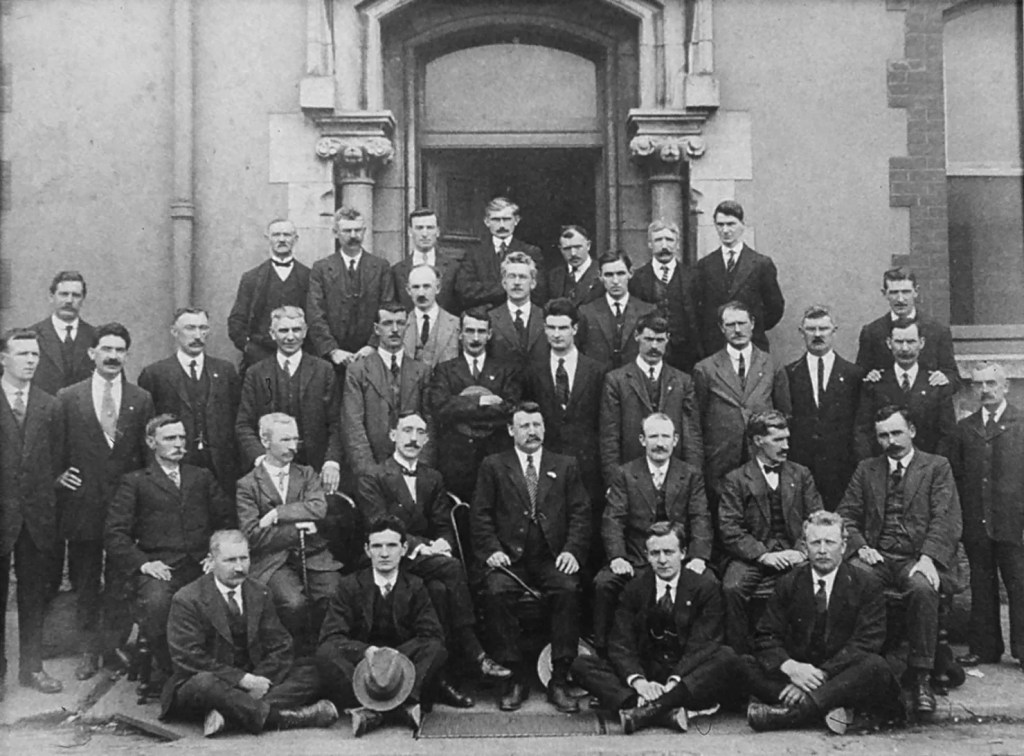
In the spring of 1919, as the Irish War of Independence was beginning to spread across the island, an extraordinary and largely anomalous episode in revolutionary history unfolded in the mid-west of Ireland. For two weeks, from 14 to 27 April, Limerick was effectively governed not by the British authorities or the newly established Dáil Éireann, but by a self-organized council of workers. Dubbed the “Limerick Soviet” by international journalists who arrived in the city, the movement brought approximately 15,000 workers into a general strike that effectively brought normal civic and commercial life to a standstill. Yet the workers did far more than simply withdraw their labour: they organized food distribution, maintained essential services, established a civilian policing system, regulated prices, published newspapers, and even issued their own strike currency.
Although the term soviet inevitably evoked the Bolshevik Revolution in Russia, the Limerick movement was not a straightforward Marxist or Bolshevik insurrection. Rather, it emerged from a distinctive combination of Irish nationalism, trade-union activism, syndicalism, and opposition to British military rule. The episode offers a fascinating glimpse into the complexity of revolutionary Ireland, demonstrating that the struggle for independence was not fought solely through armed republican resistance, but also through organized labour and experiments in grassroots self-government.
The Spark: Robert Byrne and Martial Law
The immediate catalyst for the Limerick Soviet was the escalating confrontation between British Crown forces and Irish republicans. In January 1919, Robert Byrne, a local trade unionist and Irish Volunteer, was arrested and sentenced to a year of hard labour for possessing firearms. While imprisoned in Limerick Jail, Byrne embarked on a campaign of civil disobedience and hunger striking in an effort to secure recognition as a political prisoner.
As his health deteriorated, Byrne was transferred under armed guard to the Union Hospital. On 6 April 1919, more than twenty IRA volunteers attempted to rescue him. The operation descended into a gun battle in which Byrne was mortally wounded and a police constable was killed. Byrne died shortly afterwards, and his funeral became a huge public demonstration, attracting an estimated 15,000 mourners to the streets of Limerick.
Alarmed by this extraordinary display of republican sentiment, the British authorities responded with increasingly severe measures. Under the Defence of the Realm regulations, Brigadier General Christopher J. Griffin designated Limerick City and parts of the surrounding area a “Special Military Area.” The measures, which came into force in mid-April, placed the city under stringent military control. The British Army established a cordon around Limerick and erected checkpoints at key routes, particularly the bridges crossing the River Shannon.
Citizens wishing to enter or leave the city were required to obtain permits endorsed by the Royal Irish Constabulary. For working-class residents, this represented not merely a political restriction but a serious economic threat. Workers living in areas such as Thomondgate routinely crossed the bridges to reach their places of employment, including Cleeve’s Condensed Milk Factory and the city’s distilleries. Suddenly, their ability to earn a living depended upon obtaining permission from the very authorities they increasingly regarded as an occupying power.
The permit system was therefore perceived by many Limerick workers as both an intolerable humiliation and a direct attack on their livelihoods.
The Birth of the Soviet and Civic Governance
Faced with economic restrictions and increasing military interference in everyday life, Limerick’s labour movement responded decisively. On 13 April 1919, the Limerick United Trades and Labour Council, representing thirty-five trade unions, voted to call a general strike in protest against British militarism and the restrictions imposed upon the city.
The strike began on Monday, 14 April. Workers at Cleeve’s Factory, many of them women, were among the first to walk out, setting the tone for what quickly became a city-wide stoppage. Within twenty-four hours, approximately 15,000 workers had joined the action, bringing much of Limerick’s commercial activity to a standstill.
Yet the workers did not simply abandon the city to disorder. Instead, the Trades Council transformed itself into a centralized Strike Committee, chaired by John Cronin, and began assuming many of the practical responsibilities normally associated with municipal government. Meeting at the Mechanics’ Institute, the committee established what was, in effect, a parallel civic administration.
One of its first priorities was maintaining public order. To prevent the disorder, looting, and social breakdown that opponents of the strike had predicted, the committee established a civilian vigilance committee to oversee policing. Essential municipal services, including gas, electricity, and water, were maintained by skeleton staffs. Other committees were established to regulate food supplies and prices, organize distribution, and communicate the workers’ position to the public.
Local bakers continued producing bread, while food was distributed throughout the city according to a system overseen by the Strike Committee. Newspapers and other publications were used to communicate the movement’s objectives and challenge the narrative presented by British authorities.
The degree of organization impressed foreign journalists who happened to be in the region to report on an attempted transatlantic flight. Their reports introduced the term “Limerick Soviet” to an international audience, portraying the city as an extraordinary experiment in working-class self-government.
Despite the dramatic terminology, however, the movement remained fundamentally practical. Its primary objective was not to establish a Bolshevik-style communist state but to resist British restrictions and defend the workers’ ability to live and work without submitting to military authority.
Financial Ingenuity: The Strike Treasury Notes
As the strike entered its second week, the Strike Committee confronted an increasingly serious financial problem. Workers participating in the general strike were receiving no wages, while household savings and supplies were rapidly being exhausted. The problem was compounded by the refusal of some national trade unions, including the National Union of Railwaymen, to provide official strike pay for members involved in the Limerick dispute.
The committee therefore needed to find an innovative means of keeping the city’s economy functioning.
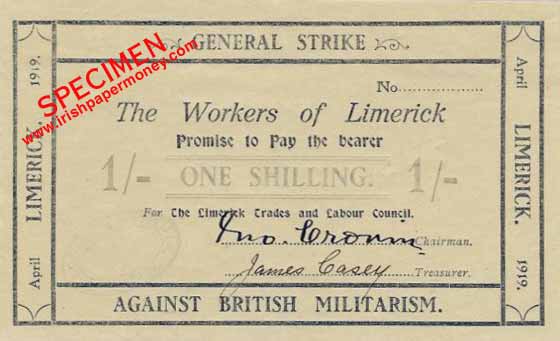
Its solution was extraordinary: the movement issued its own Strike Treasury Notes.
Printed in denominations of one, five, and ten shillings, the notes were issued in the name of “The Workers of Limerick.” Signed by John Cronin and James Casey, they functioned less as a conventional sovereign currency than as locally backed vouchers. Their value rested upon the collective authority and credit of the Trades Council, along with financial contributions and material assistance arriving from outside Limerick.
The committee compiled a list of local merchants willing to accept the notes in exchange for food and other necessities. Shopkeepers participated on the understanding that the notes would eventually be redeemed by the Strike Committee once the dispute had been settled.
The experiment demonstrated the extraordinary degree of organization achieved by the movement. What had begun as a protest against military restrictions had developed into a functioning alternative economic system capable of maintaining commerce despite the absence of normal wages and banking arrangements.
The notes subsequently became one of the most enduring symbols of the Limerick Soviet, representing the remarkable extent to which the city’s organized workers were prepared to assume responsibility for the economic as well as civic life of their community.
Isolation and the Dissolution of the Soviet
Despite its impressive internal organization, the Limerick Soviet faced a fundamental weakness: it was geographically and politically isolated.
A local general strike could only exert sustained pressure on the British government if it developed into a broader national movement. There were attempts to encourage solidarity elsewhere, particularly among railway workers in Cork and Dublin, but the national leadership of the Irish Labour Party and Trade Union Congress, associated with figures such as William O’Brien, stopped short of calling for a nationwide general strike.
Instead, the national labour leadership adopted a cautious approach. Proposals were discussed for providing assistance to the workers of Limerick, but no decisive national industrial action materialized. Without broader support, the local movement increasingly found itself unable to maintain the confrontation indefinitely.
This exposed one of the central tensions within revolutionary Ireland: the relationship between the labour movement and the struggle for national independence. Irish workers could oppose British rule while simultaneously pursuing goals rooted in class politics, economic justice, and workers’ control. Yet the wider nationalist movement was dominated by forces whose primary objective was political independence rather than social revolution.
Sinn Féin and sections of the Catholic hierarchy in Limerick therefore found themselves in a complicated position. They strongly opposed British military rule and sympathized with resistance to the cordon, but they were also uneasy about the increasingly autonomous organization of the city’s working class and the international association of the movement with Bolshevism.
Local political and religious leaders, including Sinn Féin Lord Mayor Alphonsus O’Mara and Bishop Denis Hallinan, consequently played an important mediating role. Their intervention helped create the conditions for a negotiated end to the strike.
By this stage, the Strike Committee was also facing increasingly serious shortages of food and money. With no prospect of a national escalation and the movement’s resources becoming exhausted, the workers were forced to consider a compromise.
The British authorities made limited concessions, including an agreement to accept letters from employers as valid identification rather than requiring workers to obtain permits directly from the police. These concessions did not remove British authority, but they eased some of the restrictions that had triggered the dispute.
On 27 April 1919, after fourteen days of industrial action, the Strike Committee formally ended the general strike and began organizing the return to work.
Conclusion and Legacy
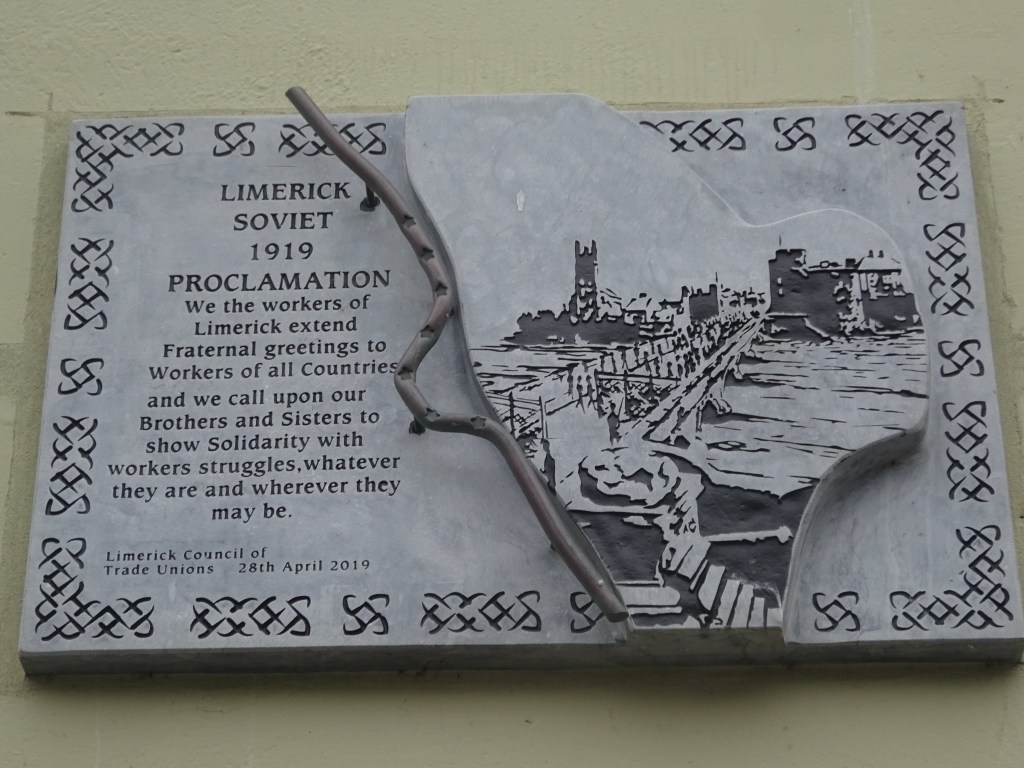
The Limerick Soviet existed for only fourteen days, but its significance far exceeds the brevity of its existence. It remains one of the most remarkable episodes of the Irish revolutionary period: a moment when organized workers temporarily assumed many of the responsibilities of civic government while simultaneously challenging the authority of the British state.
Its importance lies not simply in the fact that 15,000 workers went on strike. What made Limerick extraordinary was what happened after they stopped working. Rather than allowing the city to descend into chaos, the workers organized policing, food distribution, essential services, communications, and even a functioning system of credit. They demonstrated that industrial action could become something more than a withdrawal of labour; under exceptional circumstances, it could become an experiment in alternative governance.
At the same time, the Soviet exposed the ideological divisions within revolutionary Ireland. The failure of the national labour leadership to transform the Limerick dispute into a nationwide confrontation demonstrated the limits of working-class solidarity when confronted with the overriding political priority of national independence. For many within the nationalist movement, social revolution was either a distraction from the struggle for independence or a potentially dangerous force that could fracture the coalition opposing British rule.
For decades, the Limerick Soviet received comparatively little attention within the predominantly nationalist narrative of the Irish War of Independence. Yet its history reveals another dimension of revolutionary Ireland—one in which ordinary workers were not merely participants in a national struggle but political actors in their own right.
The events of April 1919 remind us that the Irish struggle for freedom was fought in many different ways. It was fought with rifles and ambushes, but also with strikes, trade-union organization, economic resistance, and experiments in democratic self-government. For fourteen extraordinary days, the workers of Limerick demonstrated that a community could challenge state authority not only by taking up arms, but by taking responsibility for the everyday functioning of society itself.
The Limerick Soviet was ultimately defeated by its isolation, its lack of sustained national support, and the political realities of revolutionary Ireland. Yet its brief existence left behind a powerful historical legacy: a remarkable example of working-class organization, civic discipline, and resistance during one of the most turbulent periods in Irish history.
sources
https://en.wikipedia.org/wiki/Limerick_Soviet


Leave a comment