
Few stories from the early Christian Church are as striking as that of Saint Lawrence, a Roman deacon whose courage, generosity, and extraordinary composure in the face of death made him one of Christianity’s most celebrated martyrs. His story has been remembered for almost two thousand years, not only because of the brutality of his execution, but because tradition portrays Lawrence meeting his tormentors with faith, defiance, and even a remarkable sense of humour.
Lawrence, whose name is traditionally given in Latin as Laurentius, served as one of the seven deacons of Rome under Pope Sixtus II during the third century. As a deacon, he had responsibility for assisting the Church and distributing its resources, particularly to the poor, widows, orphans and other people in need. He lived during a dangerous period for Christians in the Roman Empire, when the authorities could regard Christianity as a threat to the established religious and political order.
In AD 258, the Emperor Valerian intensified his persecution of the Christian Church. Pope Sixtus II and several of his deacons were arrested and executed. Lawrence was left behind, apparently because he was responsible for the administration of the Church’s possessions. According to Christian tradition, the Roman authorities demanded that he surrender the Church’s treasures.
Lawrence asked for three days to gather them.
What happened next became one of the defining stories of his life.
Rather than collecting gold, silver and other valuable possessions, Lawrence distributed what the Church possessed among the poor. When the appointed time arrived, he appeared before the Roman authorities accompanied by the people whom he had helped: the poor, the sick, widows, orphans and others who depended upon the Church.
According to the ancient tradition, when Lawrence was asked where the Church’s treasures were, he pointed towards the people before him. These, he declared, were the true treasures of the Church.
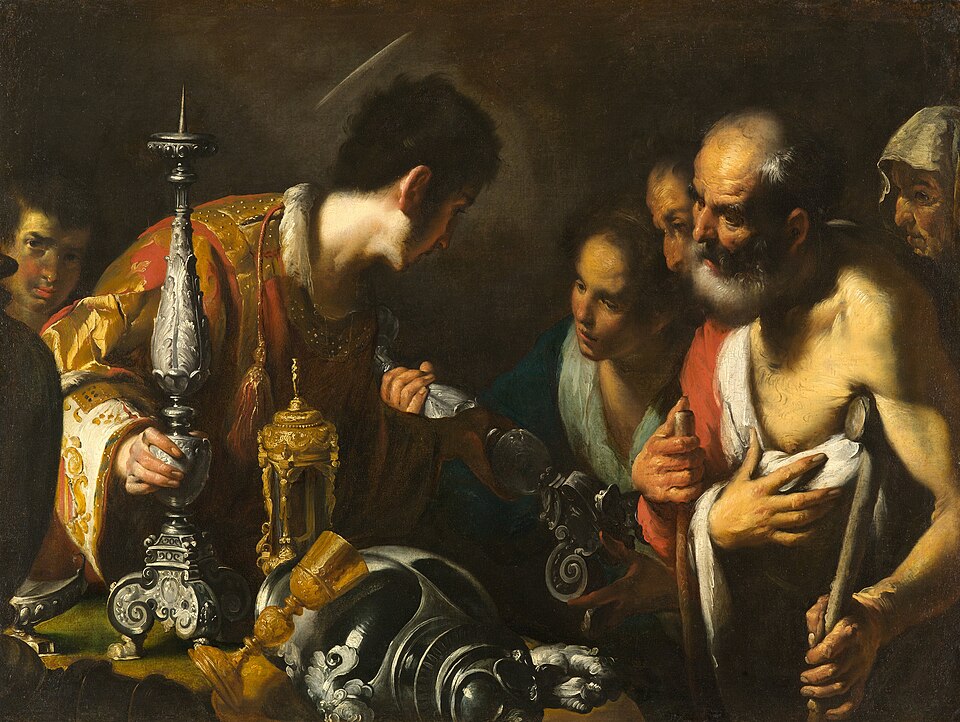
The story is particularly powerful because Lawrence turned the meaning of wealth upside down. To the Roman official, treasure meant money and precious objects. To Lawrence, the greatest wealth possessed by the Church was human life—the people whom Christians were called to serve. His response was therefore not merely an act of defiance; it was a statement about what he believed Christianity was supposed to be.
The Roman authorities were enraged.
According to the traditional account of his martyrdom, Lawrence was condemned to a particularly cruel death. He was bound to an iron gridiron placed above burning coals and slowly roasted alive.
The image of Lawrence lying upon the burning gridiron has become inseparable from his identity as a martyr. Yet what has made his story especially memorable is not simply the manner of his death, but the extraordinary courage and composure he is said to have displayed while suffering.
According to a tradition preserved by Saint Ambrose of Milan in the fourth century, Lawrence eventually addressed his executioners with words that have become legendary:
“Assum est; versa et manduca.”
The Latin is commonly translated as:
“It is cooked on this side; turn me over and eat.”
In English, the famous saying is often rendered more simply as:
“I’m well done on this side. Turn me over!”
The remark is shocking precisely because of its circumstances. Lawrence was not making a joke from the safety of his home or among friends. According to the tradition, he was speaking while being burned alive. His humour therefore became an expression of defiance: his executioners could destroy his body, but they could not force him to surrender his faith or dignity.
Some later versions of the story add another prayer after he had been turned over, in which Lawrence thanked God and declared that he was ready to enter heaven. These details belong to the developed tradition surrounding his martyrdom, rather than to contemporary eyewitness testimony.
That distinction is important. The historical details of Lawrence’s death are not all certain. The earliest surviving accounts of the persecutions under Valerian indicate that Roman authorities executed Christian clergy, and scholars have questioned whether Lawrence was actually killed on a gridiron in the manner traditionally depicted. Some evidence suggests that Christians subjected to Valerian’s persecution were more commonly executed by decapitation. The gridiron story nevertheless became deeply established in Christian tradition, particularly through writers such as Ambrose.
Whether every detail of the traditional account can be established historically or not, the significance of Lawrence’s story is undeniable. His martyrdom became a powerful symbol of Christian courage and charity. The Church remembered a man who refused to regard wealth as more important than people, who gave away what he had been entrusted with, and who ultimately refused to renounce his beliefs even when threatened with death.
His story also explains some of the unusual patronages associated with him. Because of the manner in which tradition says he was executed, Lawrence became associated with cooks, chefs and others whose work involves fire. His feast day is celebrated on 10 August, and the meteor shower known as the Perseids has traditionally been associated in popular culture with the “tears of Saint Lawrence.”
Yet perhaps the most enduring aspect of Lawrence’s story is his attitude toward death. He was confronted with an execution designed to break him physically and psychologically. Instead, according to tradition, he retained his faith, his courage and even his humour.
There is something profoundly human about that final remark. Lawrence did not answer brutality with hatred. He answered it with defiance. His executioners possessed the power to inflict terrible suffering upon his body, but they could not determine the state of his soul.
For nearly two thousand years, Christians have therefore remembered Saint Lawrence not simply as a man who died, but as a man who chose how he would face death. His supposed final words—“I’m well done on this side. Turn me over!”—have survived because they capture something larger than the humour of the moment. They represent a refusal to allow fear to have the final word.
Lawrence’s body could be burned, but his courage could not.
And that is why the story of Saint Lawrence has endured, and probably unsurprisingly he is the Patron Saint of Comedians
Sources
https://www.christiantoday.com/news/st-lawrence-the-christian-martyr-who-died-telling-a-joke


Leave a Reply