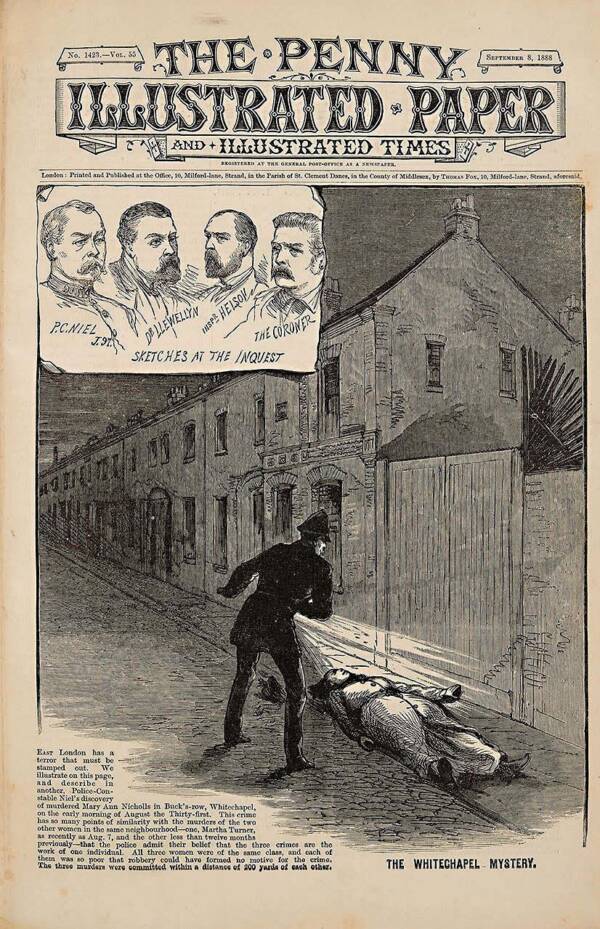
On the morning of 31 August 1888, a woman’s body was discovered in Buck’s Row, a dark and relatively quiet street in Whitechapel, London. She was lying on the pavement, her clothing disarranged and her throat brutally cut. Within hours, her name was known: Mary Ann Nichols, usually called Polly. She was forty-three years old.
Her death would become one of the most notorious murders in British criminal history. Nichols is generally regarded as the first canonical victim of the unidentified killer known as Jack the Ripper, although the question of whether the murderer had killed before her remains unresolved. Her murder marked the beginning of a terrifying sequence of killings that would transform Whitechapel into a symbol of Victorian London’s poverty, violence and social inequality.
Yet behind the mythology of Jack the Ripper stands a woman whose life is often reduced to a few lines in a list of victims. Mary Ann Nichols was not simply “the first Ripper victim.” She was a daughter, wife, mother and working woman whose difficult life reflected many of the hardships experienced by London’s urban poor.
A Difficult Life
Mary Ann Nichols was born Mary Ann Walker on 26 August 1845, in London, to Edward Walker, a locksmith and blacksmith, and Caroline Green. She grew up in a working-class family during a period when London was expanding rapidly and social divisions were becoming increasingly stark.
In 1864, she married William Nichols, a printer. The couple had children, and for a time their lives followed the conventional path expected of a Victorian married couple. But the marriage eventually deteriorated. By the 1880s, Mary Ann and William were living apart.
The circumstances surrounding their separation were complicated and have been the subject of considerable speculation. William later claimed that Mary Ann had left him and that she had become involved with another man. Mary Ann, meanwhile, maintained that her husband had abandoned her. Whatever the precise truth, the marriage had broken down, leaving Mary Ann to make her own way.
Her life subsequently became increasingly precarious.
Like many working-class women in Victorian London, she had few protections against unemployment, illness, poverty and homelessness. When conventional employment failed to provide enough income, she sometimes relied on casual labour and, eventually, prostitution.
It is important, however, not to allow the label “prostitute” to define her entire existence. Victorian records frequently reduced poor women to their economic circumstances. Nichols had worked as a domestic servant and laundress, among other occupations. Her life was considerably more complicated than the stereotype later attached to her.
Whitechapel in 1888
By the summer of 1888, Nichols was living in the Whitechapel area of London’s East End.
Whitechapel was one of the most densely populated and impoverished parts of London. Thousands of people lived in overcrowded housing, and casual employment was common. The streets were filled with lodging houses, pubs, markets, factories and workshops. For people without secure employment or accommodation, the area offered places where they could sleep for very little money—but it also exposed them to considerable danger.
Women such as Nichols were particularly vulnerable.
Many women entered prostitution not because they had chosen it as a profession in any conventional sense, but because poverty left them with few alternatives. A woman could lose her employment, become homeless and find herself dependent on casual sex work simply to obtain food or a bed for the night.
Nichols frequently stayed in common lodging houses. Her movements were dictated largely by whether she had enough money to pay for accommodation.
That vulnerability would ultimately contribute to the circumstances of her death.
The Night of 30 August 1888
On the evening of 30 August 1888, Nichols was in Whitechapel. She had been drinking and was attempting to obtain enough money to pay for a bed at a lodging house.
At around 2:30 a.m. on 31 August, she was seen near the junction of Osborn Street and Whitechapel Road. She was reportedly in the company of another woman and appeared to be attempting to find customers.
One of the most haunting details from that night comes from Nichols herself.
She reportedly told a fellow lodger that she had earned enough money three times that night to pay for her bed—but had spent it on alcohol. She then indicated that she intended to go out again to earn the necessary money.
She never returned to the lodging house.
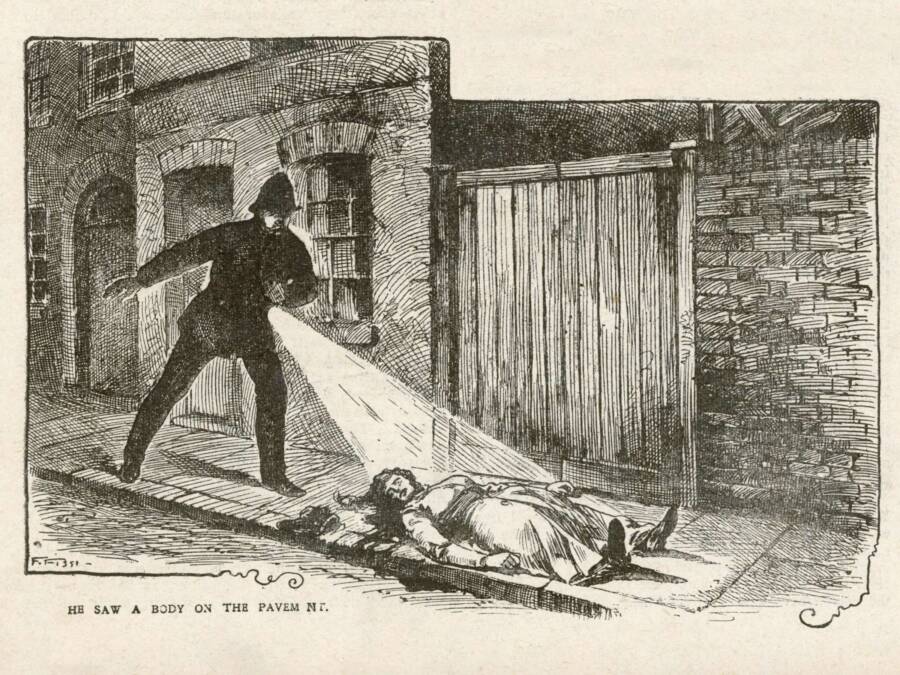
At approximately 3:40 a.m., a carman named Charles Cross was travelling through Buck’s Row, now known as Durward Street. He noticed what appeared to be a tarpaulin lying on the ground.
As he approached, he realized that it was a woman.
Another man, Robert Paul, soon came along. The two examined her and initially believed she might still be alive. Cross went to seek assistance.
A police constable arrived shortly afterwards.
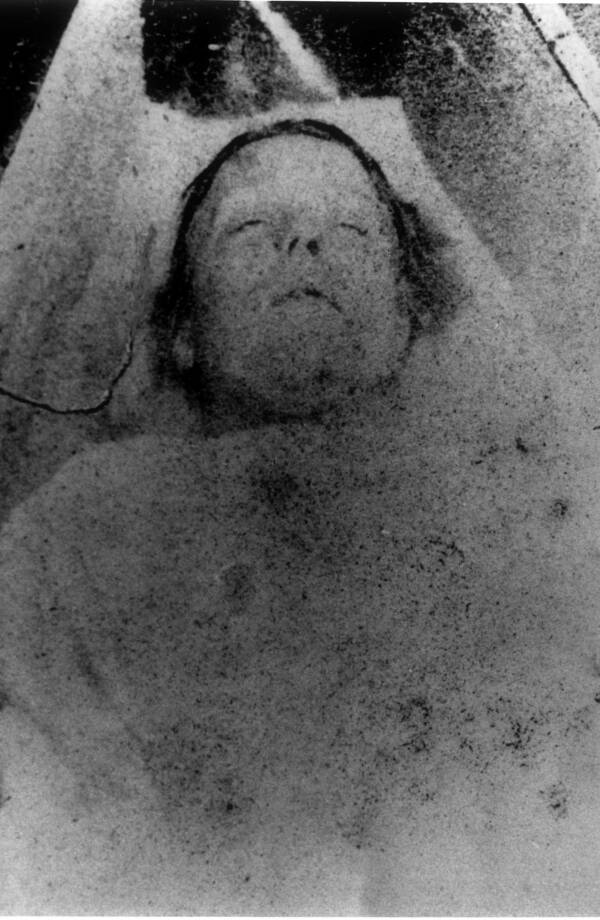
The woman was dead.
The Murder
Nichols had suffered a horrific attack.
Her throat had been cut twice, and she had sustained extensive abdominal injuries. The violence inflicted upon her body immediately distinguished the crime from an ordinary street murder.
Dr Rees Ralph Llewellyn, the doctor who examined Nichols at the scene, believed that she had been dead only a short time. Her body was subsequently taken to the mortuary at Old Montague Street, where a post-mortem examination was conducted.
The murder shocked the local community.
But at first there was no reason for anyone to assume that a serial killer was responsible.
London had experienced countless violent crimes. Whitechapel, in particular, had a reputation for disorder and criminality. Nichols was initially regarded as another victim of London’s dangerous streets.
Within days, however, the possibility that her death was connected to other murders began to emerge.
The Ripper Murders
Nichols was killed at the beginning of what became known as the Whitechapel murders.
On 8 September 1888, just eight days after Nichols’s death, Annie Chapman was murdered in the backyard of a house in Hanbury Street. Her body had suffered similarly horrific mutilation.
Then came Elizabeth Stride and Catherine Eddowes, murdered on 30 September.
Finally, on 9 November, Mary Jane Kelly was killed in her room at Miller’s Court.
These five women—Nichols, Chapman, Stride, Eddowes and Kelly—are generally known as the “canonical five” victims of Jack the Ripper.
Whether all five were murdered by the same person has never been established beyond doubt. Nevertheless, the similarities between the crimes convinced investigators, journalists and the public that a single killer might be operating in Whitechapel.
Nichols therefore acquired a grim historical distinction: she became the woman whose murder opened the most famous unsolved serial-murder case in British history.
The Investigation
The investigation into Nichols’s death was conducted by the Metropolitan Police. Detectives interviewed residents, lodging-house occupants, workers and anyone who might have seen Nichols during her final hours.
But the investigation faced enormous difficulties.
There was no modern forensic science. There was no DNA analysis, no CCTV, no comprehensive criminal database and no sophisticated system for preserving or comparing evidence. The police depended heavily on witness testimony, which could be contradictory or unreliable.
Whitechapel itself presented another enormous challenge. Thousands of people moved through its streets every day. Many lived under assumed names or had little formal documentation. Prostitutes and homeless people often disappeared from one lodging house and reappeared somewhere else without leaving a reliable trail.
The murderer had also chosen his victims in circumstances that made detection exceptionally difficult. Nichols was attacked in the early hours of the morning, in an area where people could appear and disappear rapidly.
Despite extensive police work, no murderer was identified.
Was Nichols Really the First?
The phrase “first victim of Jack the Ripper” requires some qualification.
Nichols is the first of the five canonical victims,( “Canonical” means conforming to a general rule, standard, or official list)but there were earlier unsolved murders in the Whitechapel area that some researchers have attempted to connect with the Ripper.
The most famous is the murder of Emma Elizabeth Smith, who was attacked in April 1888 and died from her injuries. Another was Martha Tabram, murdered on 7 August 1888, only weeks before Nichols.
Both women have sometimes been described as possible Ripper victims.
However, the evidence is insufficient to establish that either was murdered by the same person. Smith’s case, in particular, involved circumstances and injuries that differed substantially from the later murders. Tabram’s killing was extraordinarily violent, but her wounds did not conclusively match the pattern associated with the canonical five.
Consequently, historians generally distinguish between the possible early victims and the five women traditionally associated with Jack the Ripper.
Nichols remains the first canonical victim.
The Human Being Behind the Legend
Over the decades, the story of Jack the Ripper has become almost inseparable from Victorian Gothic imagery: fog-filled streets, gas lamps, sinister alleyways and an unseen killer stalking women through the darkness.
That mythology can obscure the actual victims.
Mary Ann Nichols was a real woman who lived through poverty, marriage, separation, motherhood and the struggle to survive in nineteenth-century London. She was not merely a name in a police file.
She had children.
She had friends and acquaintances.
She had a history.
She had hopes and disappointments.
And, on the night of 30 August 1888, she was trying to earn enough money to obtain a bed.
That mundane detail makes her death all the more tragic. She was not seeking adventure or deliberately placing herself in some extraordinary situation. She was attempting to survive another difficult night.
Her vulnerability was a product of circumstances much larger than herself.
The Legacy of Mary Ann Nichols
Nichols’s murder helped create one of the most enduring mysteries in criminal history. Newspapers sensationalized the killings, London’s streets became filled with rumours, and fear spread throughout the East End.
The police received thousands of letters, many of them claiming to identify the murderer. The infamous “From Hell” letter and the “Dear Boss” letter later became associated with the Ripper mythology, although their authenticity and connection to the murderer remain disputed.
The identity of Jack the Ripper has never been conclusively established.
More than a century later, countless suspects have been proposed, from doctors and aristocrats to criminals and immigrants. Books, documentaries, websites and television programmes have repeatedly attempted to solve the mystery.
But perhaps the enduring fascination with the Ripper case should not begin with the killer.
It should begin with his victims.
Remembering Polly Nichols
Mary Ann Nichols was buried on 6 September 1888 at Manor Park Cemetery. Her funeral took place only days after her murder, while London was still struggling to understand what had happened in Whitechapel.
Her coffin was accompanied by relatives and mourners. Newspapers were already reporting on the growing fear surrounding the murders.
Yet Nichols could not have known that her name would still be remembered more than a century later.
She could not have known that historians would examine her final movements, that detectives and writers would reconstruct her last hours, or that her death would become the opening chapter of the Jack the Ripper mystery.
She was simply Polly.
A woman trying to survive in a harsh city.
A mother.
A daughter.
A worker.
A woman who, like countless others living in the East End, occupied the margins of Victorian society.
And that is perhaps the most important way to remember Mary Ann Nichols. Before she became the first name in the story of Jack the Ripper, she was a human being with a life of her own.
Her murder transformed her into a historical symbol, but the woman herself should never disappear behind the legend.
Sources
https://www.onthisday.com/people/mary-ann-nichols
https://en.wikipedia.org/wiki/Mary_Ann_Nichols
https://allthatsinteresting.com/mary-ann-nichols


Leave a Reply