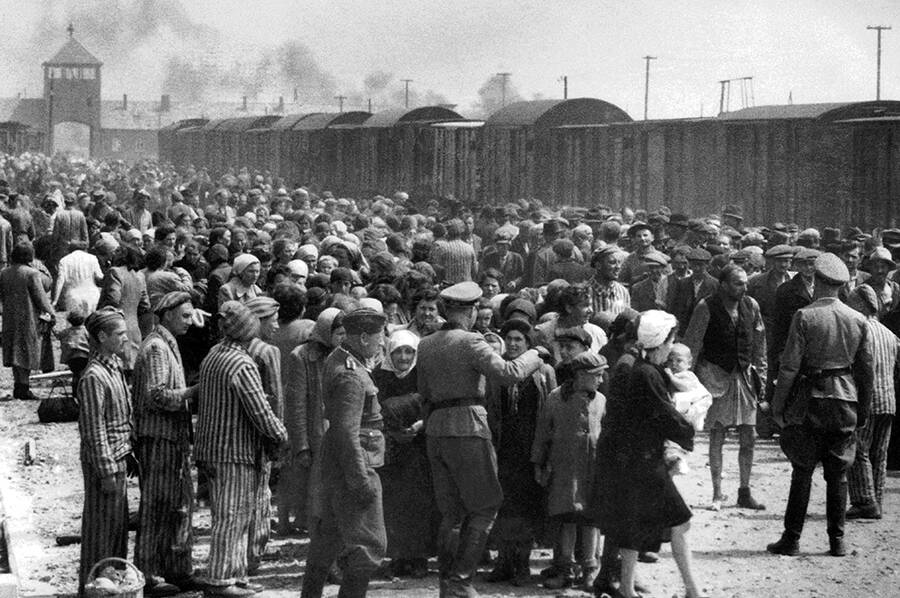
While it is accurate that this schedule applied only to registered prisoners kept alive for forced labor, historical records show that over 400,000 people were registered as prisoners in the Auschwitz camp complex—representing approximately 30 to 35% of all those who were deported to Auschwitz.
To ensure historical accuracy, here is a breakdown of the numbers:
Total Arrivals: ~1.3 million people were deported to Auschwitz.
Immediately Murdered upon Arrival: ~900,000 people (roughly 70%) were sent directly to the gas chambers without being registered.
Registered for Forced Labour: ~400,000 people (roughly 30%) were issued numbers, assigned to barracks, and subjected to the daily routine described.
While the majority was murdered upon arrival, calling those who were registered a “small percentage” understates the scale of forced labor at the complex—hundreds of thousands of victims endured these conditions.
Those selected for registration and forced labour were generally assigned a prisoner serial number, which was tattooed onto their bodies. Auschwitz was unique within the Nazi concentration-camp system in routinely tattooing prisoners with their camp numbers.
Conditions inside Auschwitz were deliberately brutal. Starvation, disease, exhaustion, overcrowding and systematic violence were used to weaken prisoners, and many eventually died as a consequence of these conditions.
Forced labour was another means through which prisoners were systematically worn down and many were ultimately killed. Prisoners were organised into Kommandos, or work details, and assigned to large construction and industrial projects both within Auschwitz and throughout its extensive network of subcamps. They could be forced to work for ten or eleven hours a day, often under appalling conditions and with inadequate food, clothing and rest.
Many prisoners therefore died not in the gas chambers, but as a consequence of the brutal system of forced labour itself—through starvation, disease, exhaustion, beatings and the cumulative effects of inhuman working conditions.
The Daily Routine of Forced Labour at Auschwitz-Birkenau
There was no truly “ordinary” day in Auschwitz. Conditions varied by period, prisoner category, assigned work detail, and specific subcamp. Yet for those selected upon arrival for forced labour rather than immediate murder, the daily routine was systematically designed to exhaust, humiliate, and dehumanize.
Morning Routine and Morning Roll Call
According to the Auschwitz-Birkenau Memorial and Museum, a prisoner’s day began between 4:00 a.m. and 5:30 a.m. Morning prep was frantic: prisoners had to dress instantly and meticulously arrange their sleeping quarters—typically crude wooden platforms crammed with straw mattresses and filthy blankets. Any perceived disorder invited immediate beatings from block personnel.
Sanitary conditions were catastrophic. Hundreds of prisoners competed for access to grossly inadequate washrooms lacking proper plumbing, leaving virtually no time or space for basic hygiene.
Breakfast was a meager ration: two cups of warm, herbal coffee substitute or tea. While prisoners were technically allowed to save part of their evening bread ration for the morning, acute starvation meant most had consumed it the night before.
Next came Appell (roll call). Prisoners stood in rigid rows of ten to be counted—a process that dragged on for hours if numbers failed to match administrative records. The sick, dying, and dead were not exempt. If a prisoner died overnight, their corpse was dragged outside and lined up with the living so the SS could account for every registered individual.
Once the count satisfied camp administration, the command echoed across the grounds: “Arbeitskommando formieren!” (“Form work details!”).
Forced Labour and Daily Violence
Men and women were divided into specialized labor commandos bound for construction sites, gravel pits, agricultural plots, factories, and warehouses. As work details marched out of the main camp, they were often accompanied by the camp’s prisoner orchestra. Far from a gesture of humanity, the music was a tool of psychological humiliation and rhythmic control used to streamline the movement of thousands of prisoners.
The working day lasted from 6:00 a.m. to as late as 7:00 p.m., depending on the season. Tasks ranged from supplying the German war economy to intentionally useless, backbreaking manual labor intended solely to hasten physical collapse. Malnourished and clad in thin garments, prisoners performed heavy physical labor in extreme weather. Severe exhaustion left them vulnerable to disease, and those no longer capable of working were systematically selected for the gas chambers.
Throughout the shift, violence was constant. SS guards, civilian overseers, and kapos (prisoner functionaries) regularly beat prisoners for working too slowly, displaying physical weakness, or committing minor missteps.
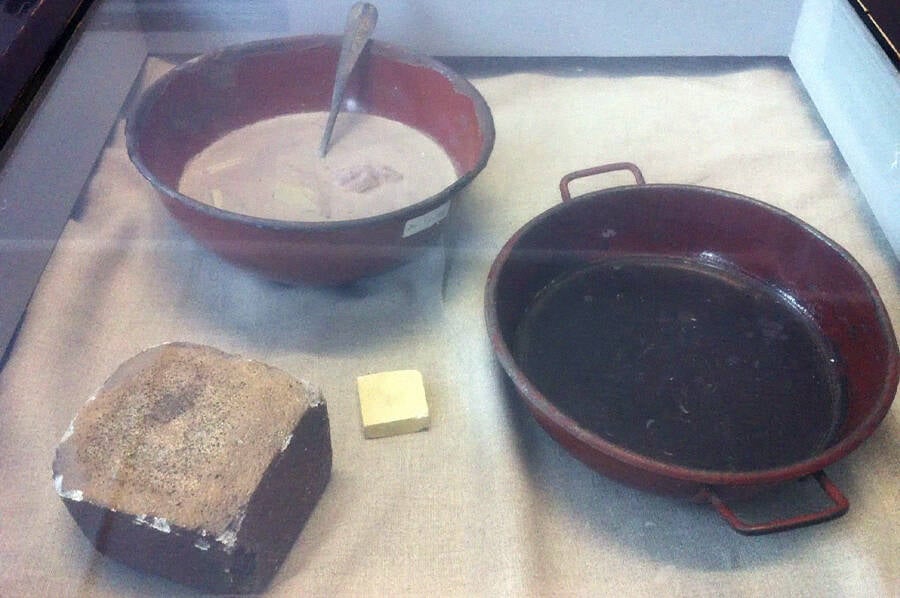
Around noon, work halted briefly for the primary meal: a bowl of thin, watery soup made from rutabagas, potatoes, or small amounts of rye flour. The break was often so brief that prisoners had to gulp down the scalding broth in minutes before returning to work.
Evening Roll Call, Rations, and Nightfall
At the end of the shift, work details marched back to camp, carrying the bodies of those who had died during the day.
The evening roll call began around 7:00 p.m. If a discrepancy in the numbers occurred, thousands of exhausted prisoners were forced to stand at attention in the cold for hours. Public floggings and beatings often followed for alleged infractions. Victims were frequently forced to count their lashes aloud in German; losing count meant the punishment restarted from one.
Following evening roll call, prisoners received their main food ration: a small piece of dark bread paired with a smear of margarine, a scrap of sausage, or cheese, accompanied by more bitter tea.
Before lights-out at 9:00 p.m., prisoners used their final moments to attempt basic survival tasks—picking lice from clothing, tending to infected wounds, or repairing shoes. When lights-out finally arrived, sleep offered little relief. Barracks were severely overcrowded, vermin-infested, and unheated. After a few short hours of fitful rest, the brutal cycle began again.
A Crucial Distinction
On January 27, 1945, Soviet forces liberated Auschwitz-Birkenau, finding only a fraction of the population alive after the SS forced most prisoners onto brutal death marches westward. More than 1.1 million people were murdered at the complex, the overwhelming majority of them European Jews, alongside Poles, Roma, Soviet POWs, and others.
While understanding this daily routine is vital, it represents only one part of the camp’s history. This schedule applied exclusively to registered prisoners kept alive temporarily for forced labor—primarily between 1942 and 1944.
The majority of people deported to Auschwitz were never registered, never assigned a prisoner number, and never slept in a barrack. Upon arrival at the railway platform, they underwent immediate selection. Those deemed unfit for labor—including young children, mothers with small children, the elderly, and the sick—were sent directly to the gas chambers. For them, Auschwitz was not a routine of forced labor, but a site of immediate mass murder.
Sources:
https://allthatsinteresting.com/auschwitz-daily-life
https://mjhnyc.org/blog/the-struggle-to-survive-auschwitz
https://www.camps.bbk.ac.uk/themes/daily-life.html
https://hmd.org.uk/resource/wiener-library-life-in-the-camps
https://www.yadvashem.org/holocaust/about/camps/daily-life.html
Donation
Your readership is what makes my site a success, and I am truly passionate about providing you with valuable content. I have been doing this at no cost and will continue to do so. Your voluntary donation of $2 or more, if you are able, would be a significant contribution to the continuation of my work. However, I fully understand if you’re not in a position to do so. Your support, in any form, is greatly appreciated. Thank you. To donate, click on the credit/debit card icon of the card you will use. If you want to donate more than $2, just add a higher number in the box left from the PayPal link. Your generosity is greatly appreciated. Many thanks.
$2.00


Leave a Reply