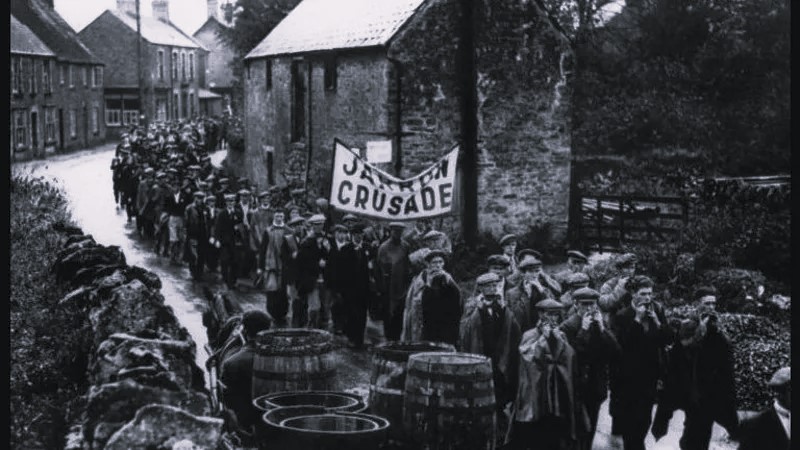
The Jarrow March of October 1936 remains one of the most poignant and defining symbols of Great Britain’s Interwar economic crisis. Undertaken during the height of the Great Depression, this 300-mile pilgrimage from the post-industrial town of Jarrow in North East England to the Houses of Parliament in London was not an ideological uprising, but a disciplined, dignified petition for the right to work. Driven by catastrophic local unemployment, the march captured the national imagination and ultimately transformed public perception surrounding state responsibility, poverty, and unemployment in modern Britain.
To understand the necessity of the march, one must examine the economic devastation of Jarrow in the 1930s. Known historically as a single-industry town, Jarrow’s economy was almost entirely dependent on Palmer’s Shipbuilding and Iron Company. The collapse of international trade following the 1929 Wall Street Crash hit heavy industries with particular severity. When Palmer’s closed its yards in 1934, followed by the deliberate dismantling of the site by National Shipbuilders Security to eliminate regional competition, Jarrow was effectively neutralized. By 1936, local unemployment reached an astounding 70 to 80 percent. Deprived of its primary economic engine, the town faced widespread poverty, malnutrition, and despair.
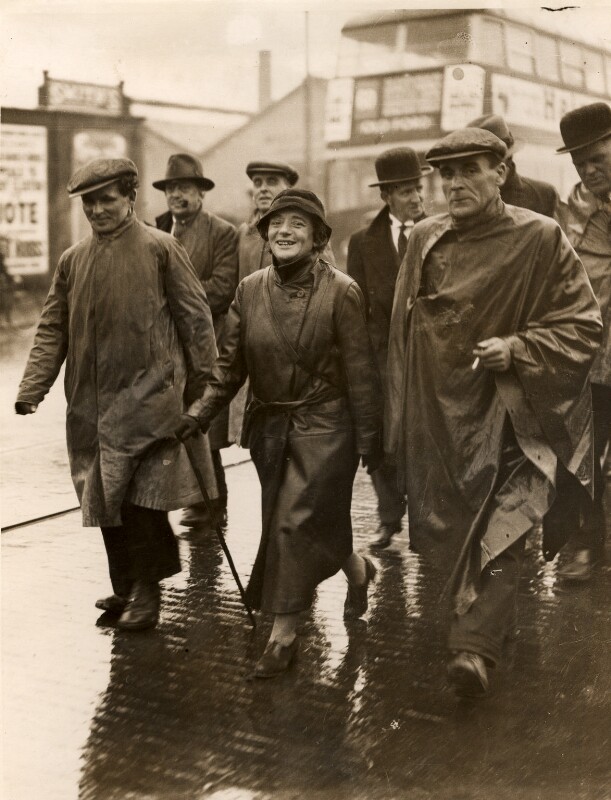
In response to this crisis, the Jarrow Urban District Council organized a non-partisan demonstration to bring a petition directly to Parliament. Led by Ellen Wilkinson—Jarrow’s energetic Labour Member of Parliament, famously nicknamed “Red Ellen”—and supported by local political and religious leaders across party lines, 200 carefully selected men set out on October 5, 1936. The marchers were subject to strict discipline: they were medically examined to ensure physical fitness, marched in military step, and wore neat, uniform attire.
Wilkinson didn’t just coordinate from London—she physically walked significant stretches of the 300-mile route alongside the 200 marchers, enduring the same weather and grueling physical demands. Her presence ensured high visibility and constant media coverage.
Wilkinson was crucial in framing the protest as a non-partisan “Crusade” for work rather than a left-wing political riot. By involving local Conservative and religious leaders, she insulated the march from government claims that it was an extremist insurrection.
A second-hand bus carried medical supplies, cooking equipment, and the heavy petition containing over 11,000 signatures from the people of Jarrow, alongside an additional petition signed by thousands across the country.
Over 25 days, the “Jarrow Crusaders”—a title bestowed by the press—walked through towns and cities across England. The march was meticulously organized to garner broad support rather than project radicalism. In many towns, particularly working-class northern communities, the marchers were greeted with warmth, hot meals, and temporary shelter. However, the response from the political establishment was decidedly cold. The Cabinet and Conservative Prime Minister Stanley Baldwin refused to meet the marchers upon their arrival in London on October 31, fearing that validating the march would encourage similar mass demonstrations. Furthermore, the national Labour Party leadership and the Trades Union Congress (TUC) officially discouraged local branches from aiding the marchers, wary of communist influence in hunger marches of the era.
In immediate political terms, the Jarrow March appeared to fail. The petition presented to the House of Commons on November 4 was received with little more than formal acknowledgements, and no immediate government intervention or industrial investment was directed toward Jarrow. The marchers returned home by train to face the same bleak economic reality they had temporarily left behind.
Despite its immediate lack of legislative success, the long-term impact of the Jarrow March was profound. The dignity, restraint, and sheer perseverance of the marchers reshaped the public debate around unemployment. It humanized the statistical reality of the Great Depression, exposing the stark regional inequalities between the depressed industrial North and the more prosperous South. Following World War II, the memory of Jarrow served as a powerful moral backdrop for the creation of the British Welfare State, full-employment policies, and the National Health Service (NHS).
Ultimately, the Jarrow March stands as a landmark moment in 20th-century British social history. It proved that civil protest, anchored in dignity and community solidarity, could challenge the conscience of a nation. Though the Crusaders returned to a town still in ruin, their 300-mile journey cemented Jarrow’s place in history as an enduring emblem of working-class resilience and human dignity.
Sources:
https://en.wikipedia.org/wiki/Jarrow_March
https://www.bbc.com/news/articles/c5n4k4j88v9mo
https://www.theguardian.com/society/2021/oct/06/jarrow-marchers-set-off-for-london-1936
Donation
Your readership is what makes my site a success, and I am truly passionate about providing you with valuable content. I have been doing this at no cost and will continue to do so. Your voluntary donation of $2 or more, if you are able, would be a significant contribution to the continuation of my work. However, I fully understand if you’re not in a position to do so. Your support, in any form, is greatly appreciated. Thank you. To donate, click on the credit/debit card icon of the card you will use. If you want to donate more than $2, just add a higher number in the box left from the PayPal link. Your generosity is greatly appreciated. Many thanks.
$2.00


Leave a comment