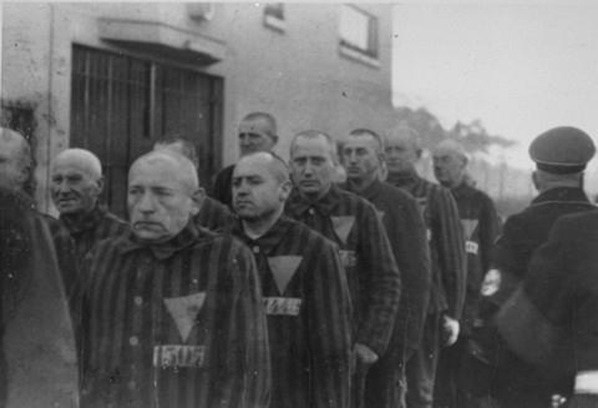
Although decent people made many sacrifices to fight Fascism and the Nazi regime, it is unfathomable that some of the Nazi laws were being maintained after the war or appear to be making a comeback nowadays, albeit under a different name and context, but the fundamentals are basically the same.

Although the German government established Article 175 on 15 May 1871, in 1935, the Nazis strengthened Paragraph 175 by redefining the crime as a felony and thus increasing the maximum penalty from six months’ to five years’ imprisonment. Further, by removing the adjective widernatürlich (“against nature”), they removed the longtime tradition that the law applied only to penetrative intercourse. A criminal offense would now exist if “objectively the general sense of shame was offended” and subjectively “the debauched intention was present to excite sexual desire in one of the two men, or a third.” [The quotations are from German case law, RGSt 73, 78, 80 f.] Mutual physical contact was no longer necessary.
Beyond that, much as had already been planned in 1925, such as the creation of the new Paragraph 175a, punishing “qualified cases” as schwere Unzucht (“severe lewdness”) with no less than one year and no more than ten years in the penitentiary. These included:
- sexual relations with a subordinate or employee in a work situation,
- homosexual acts with men under the age of 21,
- male prostitution.
“Unnatural fornication with a beast” was moved to Paragraph 175b.
According to the official rationale, in the interest of moral health of the Volk—the German people, Paragraph 175 had been amended because “according to experience, homosexuality inclines toward plague-like propagation and exerts a ruinous influence on the circles concerned.”
This 1935 aggravation of Paragraph 175’s severity increased the number of convictions tenfold, to 8,000 annually. Only about half of the prosecutions resulted from police work; about 40 percent from private accusations (Strafanzeige) by non-participating observers; and about 10 percent from denouncements by employers and institutions.
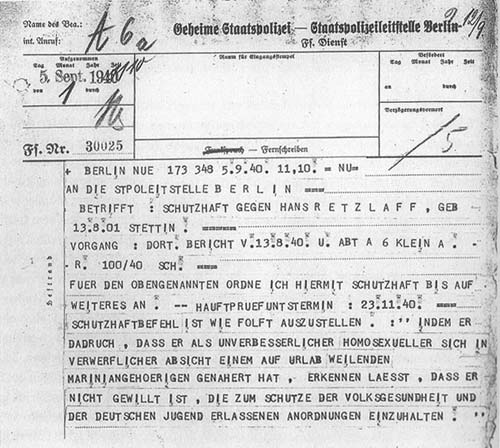
The Gestapo was authorized in contradistinction to regular police to take gay men into preventive detention (Schutzhaft) of arbitrary duration without an accusation (or even after an acquittal). It was often the fate of so-called “repeat offenders”—at the end of their sentences, homosexuals were not freed but sent for additional “reeducation” (Umerziehung) in a concentration camp. Only about 40 percent of these pink triangle prisoners—whose numbers amounted to an estimated 10,000—survived the camps. Some of them, after their release by the Allied Forces, were placed back in prison because they had not yet finished court-mandated terms of imprisonment for homosexual acts.


Nazi Eugenics
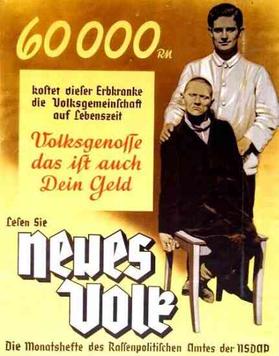
Nazi propaganda poster from 1936, supporting Nazi Germany’s 1933 Law for the Prevention of Hereditarily Diseased Offspring (their compulsory sterilization).
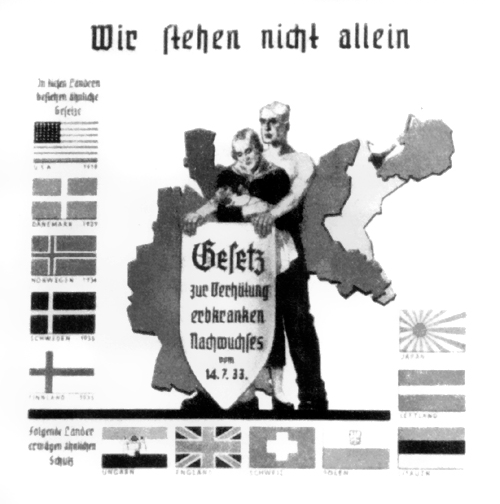
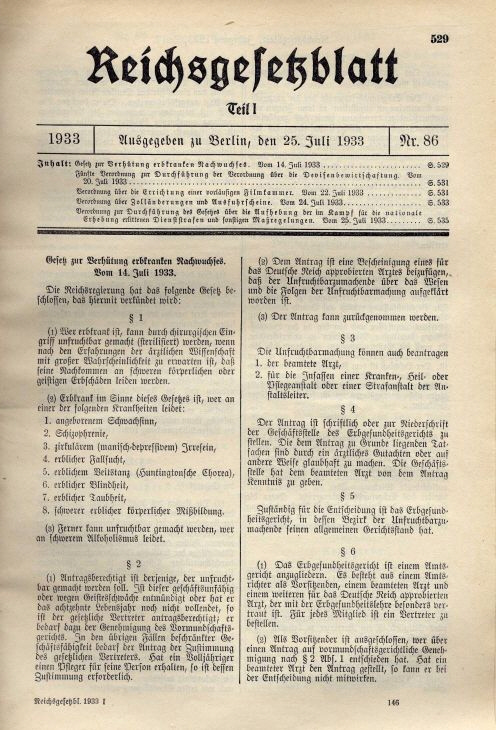
Law for the Prevention of Genetically Diseased Offspring (Ger. Gesetz zur Verhütung erbkranken Nachwuchses) or “Sterilisation Law” was a statute in Nazi Germany enacted on July 14, 1933, (and made active in January 1934)which allowed the compulsory sterilisation of any citizen who in the opinion of a “Genetic Health Court” suffered from a list of alleged genetic disorders – many of which were not, in fact, genetic. The elaborate interpretive commentary on the law was written by three dominant figures in the racial hygiene movement: Ernst Rüdin, Arthur Gütt, and the lawyer Falk Ruttke. The law itself was based on a ‘model’ American law developed by Harry H. Laughlin.
The introductory provisions of the 1933 law stated that:
- (1) Any person suffering from a hereditary disease may be rendered incapable of procreation by means of a surgical operation (sterilization), if the experience of medical science shows that it is highly probable that his descendants would suffer from some serious physical or mental hereditary defect.
- (2) For the purposes of this law, any person will be considered as hereditarily diseased who is suffering from any one of the following diseases:
-
- (1) Congenital Mental Deficiency,
- (2) Schizophrenia,
- (3) Manic-Depressive Insanity,
- (4) Hereditary Epilepsy,
- (5) Hereditary Chorea (Huntington’s),
- (6) Hereditary Blindness,
- (7) Hereditary Deafness,
- (8) Any severe hereditary deformity.
- (3) Any person suffering from severe alcoholism may also be rendered incapable of procreation.
- The law applied to anyone in the general population, making its scope significantly larger than the compulsory sterilisation laws in the United States, which generally were only applicable to people in psychiatric hospitals or prisons.The 1933 law created a large number of “Genetic Health Courts”, consisting of a judge, a medical officer, and a medical practitioner, which “shall decide at its own discretion after considering the results of the whole proceedings and the evidence tendered”. If the court decided that the person in question was to be sterilised, the decision could be appealed to the “Higher Genetic Health Court”. If the appeal failed, the sterilization was to be carried out, with the law specifying that “the use of force is permissible”. The law also required that people seeking voluntary sterilization also go through the courts.
There were three amendments by 1935, most of which made minor adjustments to how the statute operated or clarified bureaucratic aspects (such as who paid for the operations). The most significant changes allowed the Higher Court to renounce a patient’s right to appeal, and to fine physicians who did not report patients whom they knew would qualify for sterilisation under the law. The law also enforced sterilization on the so-called “Rhineland bastards.”(This was a derogatory term used in Nazi Germany to describe multiracial children with Caucasian, German mothers who had been fathered by Africans serving with French colonial troops during the Occupation of the Rhineland after World War I. According to Nazi racial theory, these children were considered inferior to Aryan children and consigned to compulsory sterilization.)
At the time of its enactment, the German government pointed to the success of sterilisation laws elsewhere, especially the work in California documented by the American eugenicists E. S. Gosney and Paul Popenoe, as evidence of the humaneness and efficacy of such laws. Eugenicists abroad admired the German law for its legal and ideological clarity. Popenoe himself wrote that “the German law is well drawn and, in form, may be considered better than the sterilization laws of most American states”, and trusted in the German government’s “conservative, sympathetic, and intelligent administration” of the law, praising the “scientific leadership” of the Nazis. The German mathematician Otfrid Mittmann defended the law against “unfavorable judgements.”
In 1934, the first year of the law’s operation, 84,600 cases were brought to the Genetic Health Courts, with 62,400 forced sterilisations. Nearly 4,000 people appealed against the decisions of sterilisation authorities; 3,559 of the appeals failed.[In 1935, it was 88,100 trials and 71,700 sterilizations. By the end of the Nazi regime, over 200 “Genetic Health Courts” were created, and under their rulings, over 400,000 people were sterilized against their will.
Along with the law, Adolf Hitler personally decriminalised abortion in case of fetuses having racial or hereditary defects for doctors, while the abortion of healthy “pure” German, “Aryan” unborn remained strictly forbidden.
The phrase “life unworthy of life” (in German: “Lebensunwertes Leben”) was a Nazi designation for the segments of the populace that, according to the Nazi regime of the time, had no right to live. Those individuals were targeted to be euthanized. The term included people with serious medical problems and those considered grossly inferior according to the racial policy of Nazi Germany. This concept formed an essential component of the ideology of Nazism and eventually helped lead to the Holocaust.
The euthanasia programme was officially adopted in 1939 and came through the personal decision of Adolf Hitler. It grew in extent and scope from Action T4 ending officially in 1941, when public protests stopped the programme, through the Action 14f13 against concentration camp inmates.
The euthanasia of people with disabilities continued more or less discreetly until the end of World War II. The methods used initially at German hospitals such as lethal injections and bottled gas poisoning.
This poster (from around 1938) reads: “60,000 Reichsmark is what this person suffering from a hereditary defect costs the People’s community during his lifetime. Fellow citizen, that is your money too. Read ‘[A] New People’, the monthly magazine of the Bureau for Race Politics of the NSDAP.
Several ‘developed’ countries currently have abortion and euthanasia programs not very dissimilar to the Nazi eugenics laws.
For example, in 2014, in Denmark, 98 percent of pregnant women who were revealed to be carrying an unborn child with Down Syndrome chose to have an abortion.
You could argue this is done voluntarily by the women, but it is all about how you relay the information to the mothers that ultimately determines their “free will.” If you put the emphasis on the negatives, you will subliminally influence a decision.
Similar programs, although with lower percentages, are in place in the Netherlands, France, and other European countries. Belgium even offers euthanasia to young children who have mental problems.
I don’t want to judge, but some of the similarities are scary and seem to go under the radar.

Donation
Your readership is what makes my site a success, and I am truly passionate about providing you with valuable content. I have been doing this at no cost and will continue to do so. Your voluntary donation of $2 or more, if you are able, would be a significant contribution to the continuation of my work. However, I fully understand if you’re not in a position to do so. Your support, in any form, is greatly appreciated. Thank you. To donate, click on the credit/debit card icon of the card you will use. If you want to donate more than $2, just add a higher number in the box left from the PayPal link. Your generosity is greatly appreciated. Many thanks.
$2.00

 History of Sorts
Leave a comment