
It is important to tell the stories of those who collaborated with the Nazis. Regardless of what some governments want you to believe, there were collaborators in all occupied countries. Some were even more evil than the occupiers.
However, it is equally important to honour those who helped their fellow citizens, often at risk of their own lives.
Jan Michiel Peters married Maria Wilhelmina Roberts on 27 August 1937 in the town of Geleen, in the province of Limburg in the Netherlands. Little did they know then how life would change for them within a few years.
When Gienga Keizer’s father was arrested and deported in 1942, she was forced to move from Utrecht to Amsterdam with her mother, sister, and brother. There, the family made contact with the Amsterdam Student Group* (ASG), which arranged hiding places for the Keizers in Limburg. After moving between various locations, Gienga Keizer (later Shimonowicz) was sheltered by the Peters family in Geleen. Jan Michiel Peters, who lived with his wife, Maria, and two daughters, made a modest living as a miner. The family also sheltered several other Jewish refugees for short periods. Whenever a raid was imminent, Gienga was brought to stay with relatives of the Peters family in other villages. aria Peters also helped Gienga stay in touch with her family, who were hiding in the same area. The Peters family acted out of purely humanitarian principles and always treated Gienga as another daughter. After the liberation of Limburg, the family immediately tried to reunite Gienga Keizer with her surviving family. Gienga maintained a close relationship with her rescuers, and their daughters and grandchildren. After she immigrated to Israel, she returned to the Netherlands to visit the Peters family and their daughters came to see her in Israel.
On 15 July 1981, Yad Vashem recognized Jan Michiel Peters and his wife, Maria Wilhelmina Peters-Roberts, as Righteous Among the Nations.
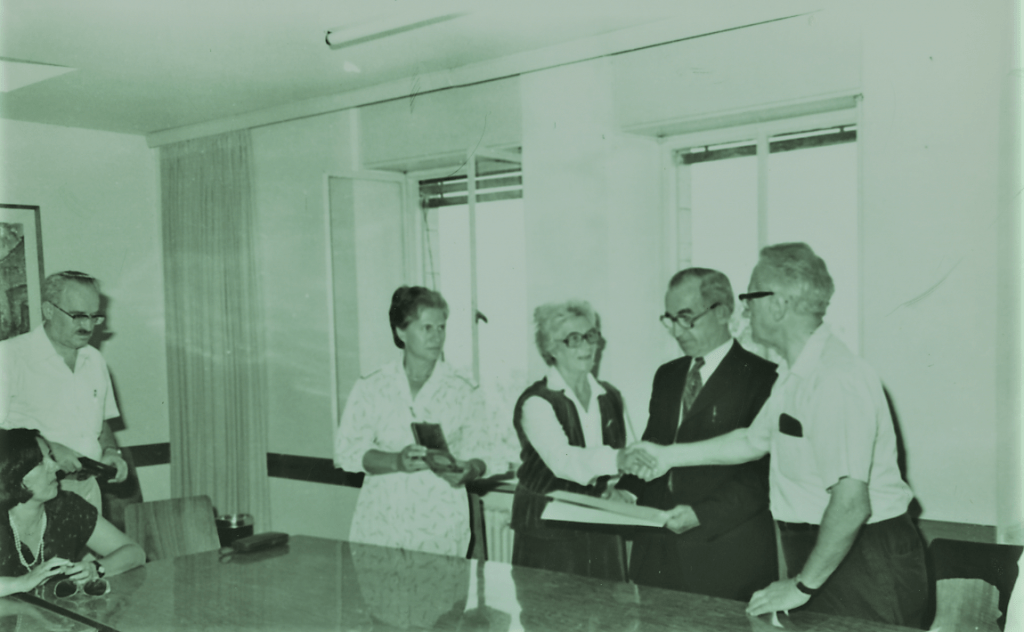
I was 13 when the Peters were recognized as Righteous Among the Nations, and I was oblivious to that fact.
Hendrik and Hiltje Douwes lived in the town of Geleen, Limburg. Hiltje’s brother and his wife, the Hofstedes, also lived there and both couples were active in the hiding of Jewish children throughout the area. The Hofstedes hid Henny Kalkstein, a six-year-old Jewish girl whose parents had fled from Poland. She was brought to them from Amsterdam by the NV group in 1943 with her brother Ronnie, who was hidden in another village. It sometimes became dangerous for the Hofstedes to hide Henny when there were searches in the area, so they moved her for shorter and longer periods to other families, but mainly to the Douwes. The child liked being with her “cousins,” who had a baby. They treated her like part of the family. In her testimony to Yad Vashem, Henny recalled that they did this without any compensation and out of purely humanitarian motives. At the end of the war, Henny returned to her parents after they had gotten back on their feet financially. She kept in close contact with the Douweses and the Hofstedes even after she moved to Israel.
On 16 February 1984, Yad Vashem recognized Hendrik Douwes and his wife, Hiltje Douwes-Hofstede, as Righteous Among the Nations.
Hendrik and Hiltje lived long lives and were buried in the Lutterade cemetery in Geleen.
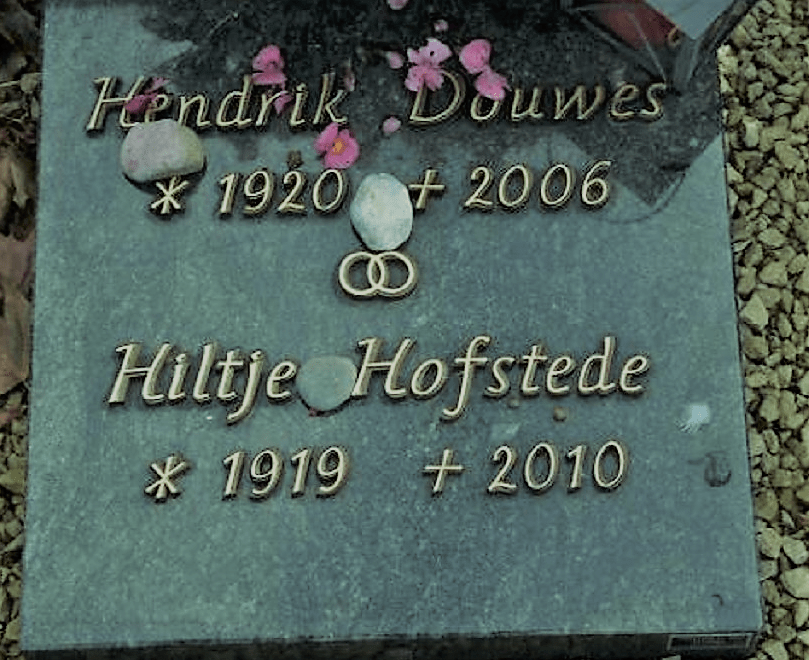
I was born in Geleen and had not heard of these brave souls.
 History of Sorts
Leave a comment