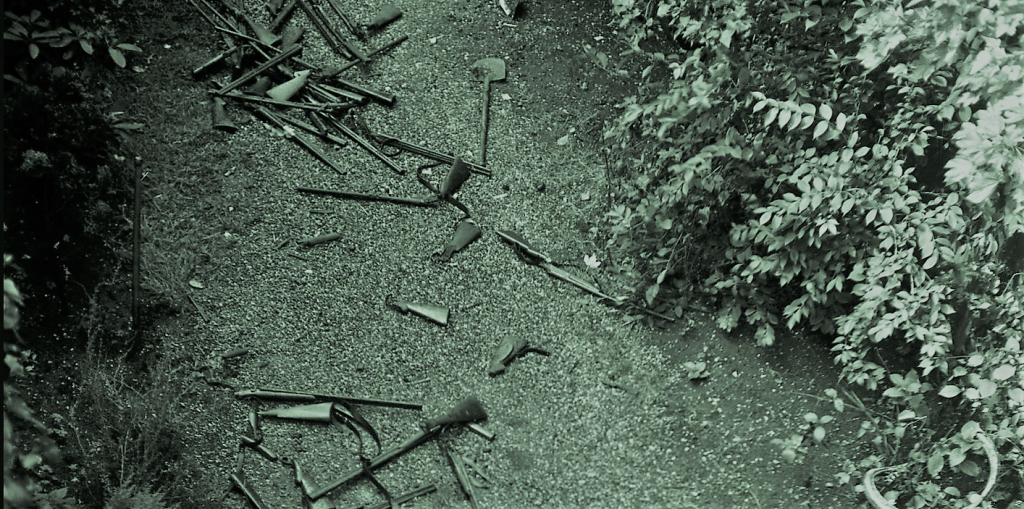
On 5 September 1944, exiled representatives of the three countries, Belgium, the Netherlands, and Luxembourg signed the London Customs Convention, the treaty that established the Benelux. A politico-economic union and formal international intergovernmental cooperation of the three neighbouring nations. However, that is not why 5 September 1944 would become known as Dolle Dinsdag or Mad Tuesday.
Many German soldiers were in a hurry to leave on Tuesday, 5 September 1944. They had heard that the Allies had crossed the Dutch border in the South and were advancing rapidly to the North of the Netherlands. Within a few days, the troops that had stayed back had destroyed the ports of Amsterdam and Rotterdam with explosives. For fear of retaliation, many collaborators were afraid to stay in the Netherlands as well. They left on the same day, heading for the East of the Netherlands or Germany.

On 4 September 1944, the Allies conquered Antwerp, and it was thought that they already advanced into the Netherlands. Radio Oranje broadcasts, one by the Prime Minister-in-exile Pieter Sjoerds Gerbrandy, increased the confusion; twice, in just over twelve hours (at 23.45 on 4 September and again in the morning of the 5th), they announced that Breda, 8 kilometres from the border with Belgium, had been liberated. The BBC had picked up the announcement too.
The news spread rapidly, with underground newspapers preparing headlines announcing “The Fall of Breda.”
Further fueling speculation, German occupation officials Arthur Seyss-Inquart (appointed Reichskommissar for the Occupied Netherlands in May 1940) and Hanns Albin Rauter, SS and police leader announced a “State of Siege” for the Netherlands to the 300,000 cable radio listeners and in the newspapers of the following day:
Further fueling speculation, German occupation officials Arthur Seyss-Inquart (appointed Reichskommissar for the Occupied Netherlands in May 1940) and Hanns Albin Rauter, SS and police leader announced a “State of Siege” for the Netherlands to the 300,000 cable radio listeners and in the newspapers of the following day:
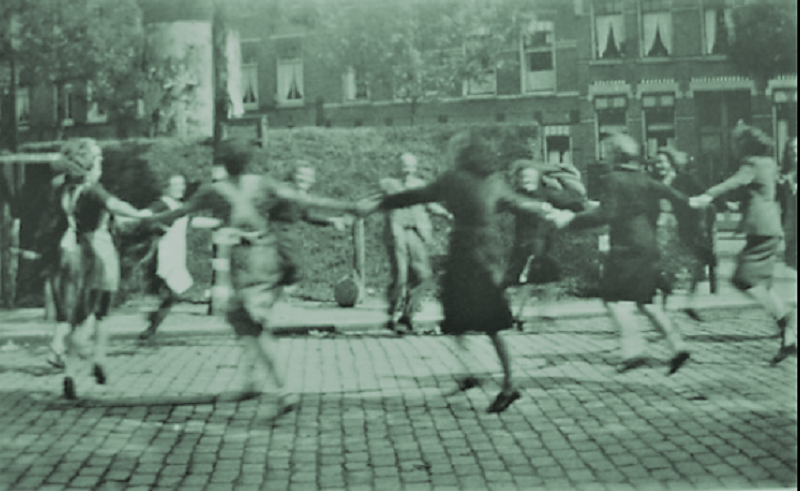
Despite the threats, many Dutch celebrated on the streets while preparing to receive and cheer on the Allied liberators. Dutch and Orange flags and pennants were prepared, and many workers left their workplaces to wait for the Allies to arrive.
The Nazis decided to evacuate the Vught concentration camp and deported 2,800 men to Sachsenhausen and 650 women to Ravensbrück, in Germany. About half of them were eventually murdered there.
Luckily there were no fatal casualties as a result of this, among the general Dutch population, although a few celebrants were shot and others were arrested.
The day after however, on September 6 a train carrying wives and children of members of the NSB headed for Germany. The train was attacked by allied planes and about 30 passengers were killed. I do feel sorry for the wives and especially the children for they were innocent bystanders but I do also believe this was karma, and the irony is not lost on me for the NSB had helped to put so many Jews and others on trains to their final destinations.
The name Dolle Dinsdag was coined by Willem van den Hout, alias Willem W. Waterman, who first used it in the Dutch Nazi propaganda newspaper Yel) which was funded by the German propaganda department.

It would take another nine days before Maastricht would be liberated, which was the first major Dutch city to be liberated by Allied troops. The north of the Netherlands still had to wait for its liberation, and the western part of the Netherlands, where the big cities are, had to endure a Hunger Winter before it was liberated on 5 May 1945. Approximately 20,000 died during the famine caused by the Hunger Winter.
Gerard Martens was an eyewitness to the events of Dolle Dinsdag below is the account of his experiences of that day.
“One morning, it was Tuesday, September 5, and the phone rang early. Check? No, my brother Aad, who lived in Willebrordusstraat, stood at the door and shouted: Come on Gerard. It’s time! The Canadians will be here in a few hours. I reacted as if I had to feel his head, but he was absolutely sure. I heard it myself about the B.B.C. They are already near Breda.
Well, I improved the dressing record in passing and off we went onto the street. It was busier than usual and yet people walked around a bit dazed. Would it be true after all? Via Willebrordusplein we arrived at the Bergwegziekenhuis, where we immediately had to join a group of nurses who were hustling in front of the door. There were even flags hanging out. I started to believe more and more that it wasn’t all a dream.
At one point, carts even passed by with household goods and fleeing N.S.B members. They passed amid loud boos. Very small and very timid. Some German soldiers were also seen heading towards Hillegersberg. With grim faces and still armed. An older man next to me commented. This is not possible. The Germans may be what they are, but withdraw without a fight? I do not believe it. And to be honest, that’s when the first doubts crept into my mind. Breda was only 50 km from Rotterdam, so the liberators should have at least passed Dordrecht.
My brother just responded with Oh, there’s Gé again. Come on. We walked through Benthuizerstraat and saw a big commotion at Peletier’s bakery. The owner of the bakery had also fled and many customers suddenly had to get bread somewhere else and many people discussing. We were not there when this photo was taken.
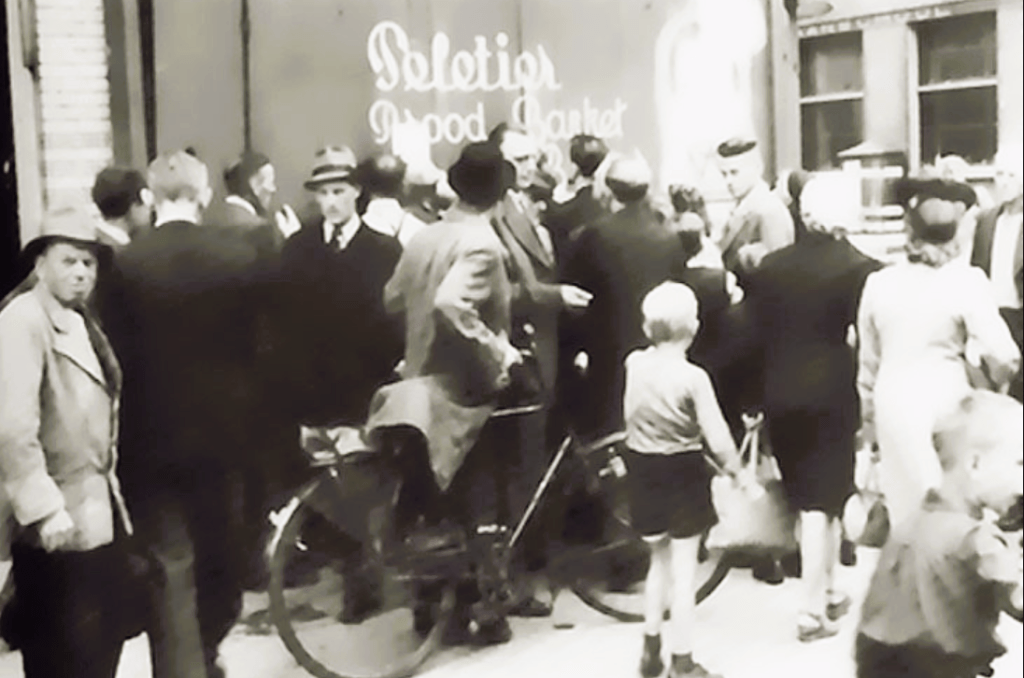
Now that I look at him more closely, I suddenly see that The tallest man with glasses was the later chairman of the Archery club the Romans. William of Hattum. And now I am 99.99% sure that I can just see my future wife’s hairstyle. She sometimes told me that she had gone to the bakery that morning for nothing. At her home, they were customers of Peletier, also because they sometimes bought a loaf of bread or something, which only had to be paid for at the end of the week. Just look at the front right there.
We continued through the Zwart Janstraat to the Willebrordusstraat, to find out at Aad’s house whether there was any news via the B.B.C. To our disappointment, there was no news at all and therefore no message at all that the Allies were approaching South Rotterdam.
After eating something we went to have a look again and we soon noticed that the jubilant mood was over. There were even people who said that the Germans were back on the streets and shooting every now and then. And we heard later that they were shooting. In the afternoon there was a shooting in Agniesestraat of people who were on the street and during that shooting, the Germans shot dead an old woman for no reason who was standing in front of the door talking. A cowardly murder of a dear wife and mother. It was the mother of my friend Kees de Jong, who was in Berlin. I was devastated by that for a moment. A daughter of hers worked at Stadler and Sauerbier, and I can tell you that it was the end of a very strange day for me.
Mad Tuesday! No one knows yet why that day was called that because he was not that mad. According to some, the Germans came up with that name and it is not surprising if you think of Ein toller Dienstag, for example.
It remains a sad day for me. A day of unfounded optimism, and a lot of miscommunication, ending with cowardly action by the Germans. I had to return to the life of being forced to be ill and trying to get a permanent exemption to work in Germany. I almost succeeded, but the raid threw a spanner in the works.”
Sources
https://www.annefrank.org/en/anne-frank/the-timeline/entire-timeline/#36
http://www.engelfriet.net/Alie/Gastenboek/dolledinsdag.htm

Donation
Your readership is what makes my site a success, and I am truly passionate about providing you with valuable content. I have been doing this at no cost and will continue to do so. Your voluntary donation of $2 or more, if you are able, would be a significant contribution to the continuation of my work. However, I fully understand if you’re not in a position to do so. Your support, in any form, is greatly appreciated. Thank you. To donate, click on the credit/debit card icon of the card you will use. If you want to donate more than $2, just add a higher number in the box left from the PayPal link. Your generosity is greatly appreciated. Many thanks.
$2.00

 History of Sorts
Leave a reply to TTRPG Roll 23-42 – War Stories: A World War 2 RPG – Campaign Area of Operations (AO) using GMT Games Holland ’44 and Antony Beevor – Rocky Mountain Navy Gamer Cancel reply