We are in the middle of a new UEFA Champions League season and only a few months away of UEFA Euro 2024 This inspired me to look at some players who never had a chance to play in football tournaments, either as players or coaches.
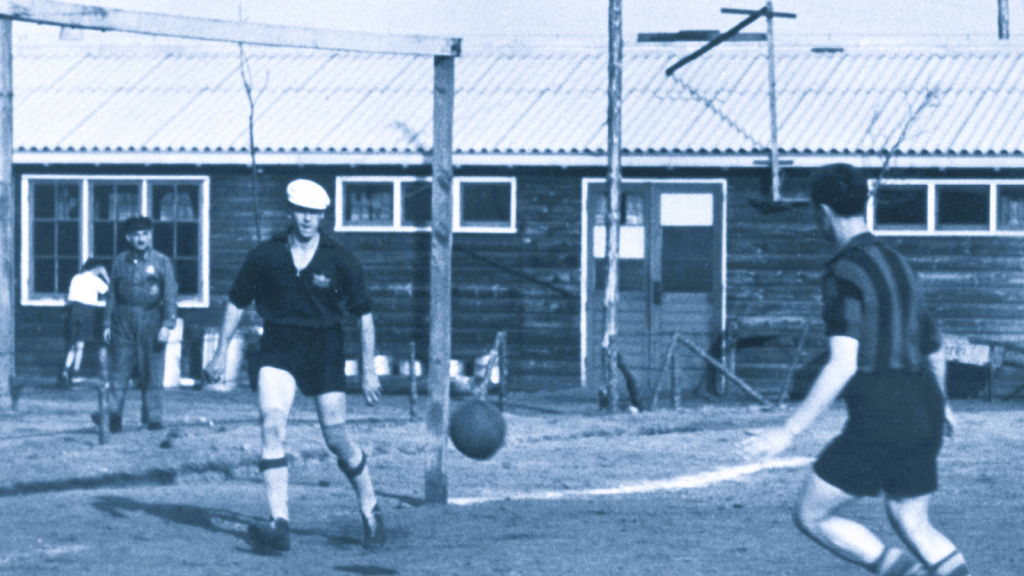
Before I go into the stories of some individual footballers, first view the context of the photograph above. Football on a Sunday afternoon in Camp Westerbork. Jewish prisoners during a football match.
The attentive spectator behind the goal is the Austrian Arthur Pisk, leader of the Order Service. A football competition between teams with Jewish prisoners in 1943 at Camp Westerbork was set up. Many of them were murdered in the extermination camps at Sobibor and Auschwitz.

Antal Vágó was a Hungarian-Jewish international footballer who played as a midfielder. Vágó played club football for MTK for twelve seasons, winning the league nine times. Vágó also played for Fővárosi TC and represented the Hungarian national team at international level, earning 17 caps between 1908 and 1917. Vágó was killed during the Holocaust, and some claim that he was shot and his body thrown into the river Danube in late 1944 along with thousands of other Budapest Jews.

Árpád Weisz, Julius Hirsch and Ron Jones
Árpád Weisz was a Hungarian Jewish football player and manager who played for Törekvés SE in his native Hungary, in Czechoslovakia for Makabi Brno, and in Italy for Alessandria and Inter Milan. Weisz was a member of the Hungarian squad at the 1924 Summer Olympics in Paris. After retiring as a player in 1926, Weisz settled in Italy and became an assistant coach for Alessandria before moving to Inter Milan.
Weisz and his family were forced to flee Italy following the enactment of the Italian Racial Laws. They found refuge in the Netherlands, where Weisz got a coaching job with Dordrecht. In 1942, Weisz and his family were deported to Auschwitz. Weisz’s wife, Elena, and his children, Roberto and Clara, were murdered by the Nazis upon arrival. Weisz was kept alive for 18 months and exploited as a worker before his death in January 1944.
Julius Hirsch was a German-Jewish international footballer who played for the clubs SpVgg Greuther Fürth and Karlsruher FV for most of his career. He was the first Jewish player to represent the German national team, who played in seven international matches for Germany between 1911 and 1913.
He retired from football in 1923 and continued working as a youth coach for his club, KFV. Hirsch was deported to Auschwitz concentration camp on 1 March 1943. His exact date of death is unknown.
Ron Jones, known as the Goalkeeper of Auschwitz, was a British prisoner of war (POW) sent to E715 Wehrmacht British POW camp, part of the Auschwitz complex, in 1942. Jones was part of the Auschwitz Football League and was appointed goalkeeper of the Welsh team.
In 1945, Jones was forced to join the ‘death march’ of prisoners across Europe. Together with 230 other Allied prisoners, he marched 900 miles from Poland into Czechoslovakia and finally to Austria, where they were liberated by the Americans. Less than 150 men survived the death march. Jones returned to Newport after the war and was a volunteer for the Poppy Appeal for more than 30 years until his death in 2019 at the age of 102.

Hundreds of matches of soccer were played in Terezin. From 1942-1944, on an impoverished field, Jewish prisoners in Terezin organized and played matches set up in the courtyard of the barracks they lived. In the summer of 1944, the Nazis shot a propaganda film directed by Kurt Gerron. Gerron’s film was shown to the International Red Cross in late 1944, convincing the organization that there was no extermination in the camps.
The 2013 documentary film is setting out to change that. Liga Terezin was aired for the first time on Israeli television at the Holocaust Remembrance Day. It tells the story of the league through the perspective of its survivors and their relatives. The film’s backbone is extensive coverage of a game on 1 September 1944—just weeks before most players were sent to extermination camps.
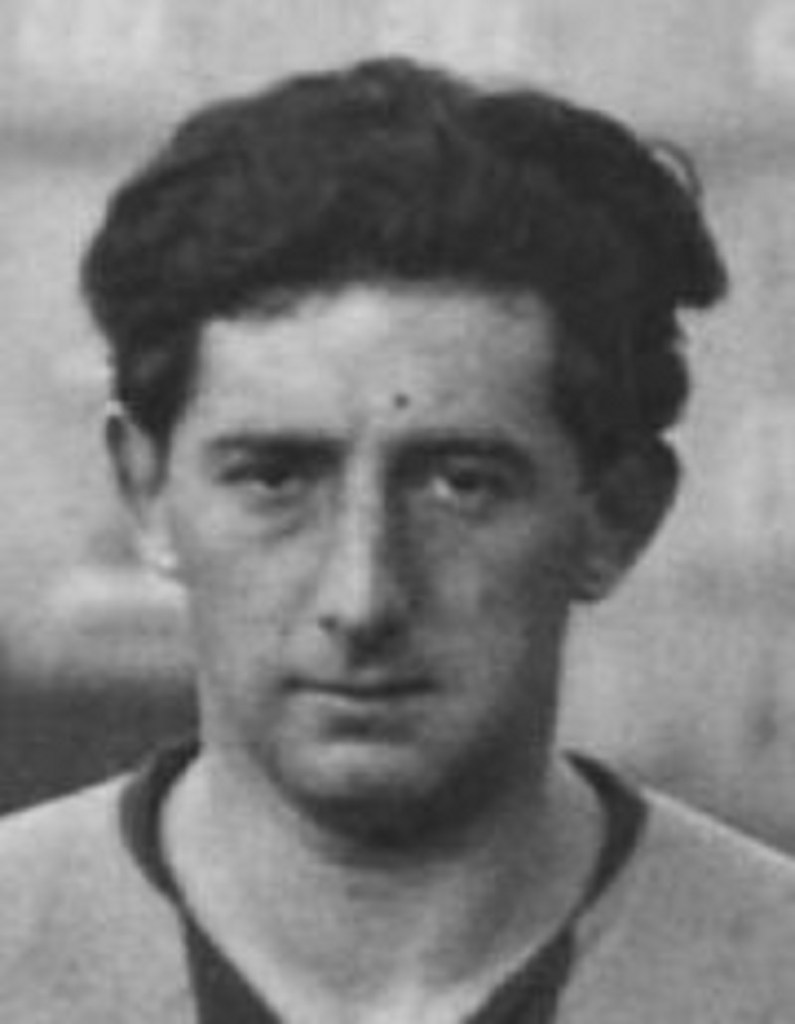
Zygmunt Steuermann played for Hasmonea Lvov, one of the clubs throughout the area with Zionist foundations. He scored a hat-trick on his debut for the national team against Turkey in Lvov in 1926.
Born in Sambor, then in Austro-Hungarian Galicia, Steuermann was Jewish and a member of a Polonized Jewish family. His older brother was pianist Eduard Steuermann. His older sister was the actress and screenwriter Salka Viertel. As a child, he was nicknamed Dusko.
At the age of 12, Steuermann joined the local Korona Sambor. During World War I, he fled to Vienna, where he continued his training in a variety of sports clubs, including Gersthof Wien, Germania Wien, and Amateure Wien. After the war, he returned to Poland. In 1920, he started a semi-professional career in Korona Sambor. The following year, he moved to Lwów (modern Lviv, Ukraine), and joined the ŻKS Lwów Sports Club. In 1923, he was transferred to Hasmonea Lwów, a most important Jewish football club in Poland and one of the four Lwów-based clubs playing in the first league.[6] He remained one of the most notable players of that club until 1932 when he joined Legia Warsaw.
Steuermann also played twice in the Poland national team, scoring four goals: three in a match against Turkey in 1926 and one against the USA in 1928. He was one of only two first-timers in the history of the Poland national team to score a hat-trick in the first match, the other being Józef Korbas (in 1937 against Bulgaria).
During the Nazi and Soviet invasion of Poland in 1939, he fled Warsaw settling in his hometown, which was then annexed by the USSR. He returned to Korona Sambor, which was soon afterward closed down and recreated as Dinamo Sambor by the Soviet authorities. Following the Nazi take-over of eastern Poland, he was arrested and sent to the Lemberg Ghetto, where he died in December 1941 at the age of 42.
Sources
Liga Terezin
https://en.wikipedia.org/wiki/Zygmunt_Steuermann
https://www.49flames.com/exhibition

Donation
Your readership is what makes my site a success, and I am truly passionate about providing you with valuable content. I have been doing this at no cost and will continue to do so. Your voluntary donation of $2 or more, if you are able, would be a significant contribution to the continuation of my work. However, I fully understand if you’re not in a position to do so. Your support, in any form, is greatly appreciated. Thank you. To donate, click on the credit/debit card icon of the card you will use. If you want to donate more than $2, just add a higher number in the box left from the PayPal link. Your generosity is greatly appreciated. Many thanks.
$2.00
 History of Sorts
Leave a comment