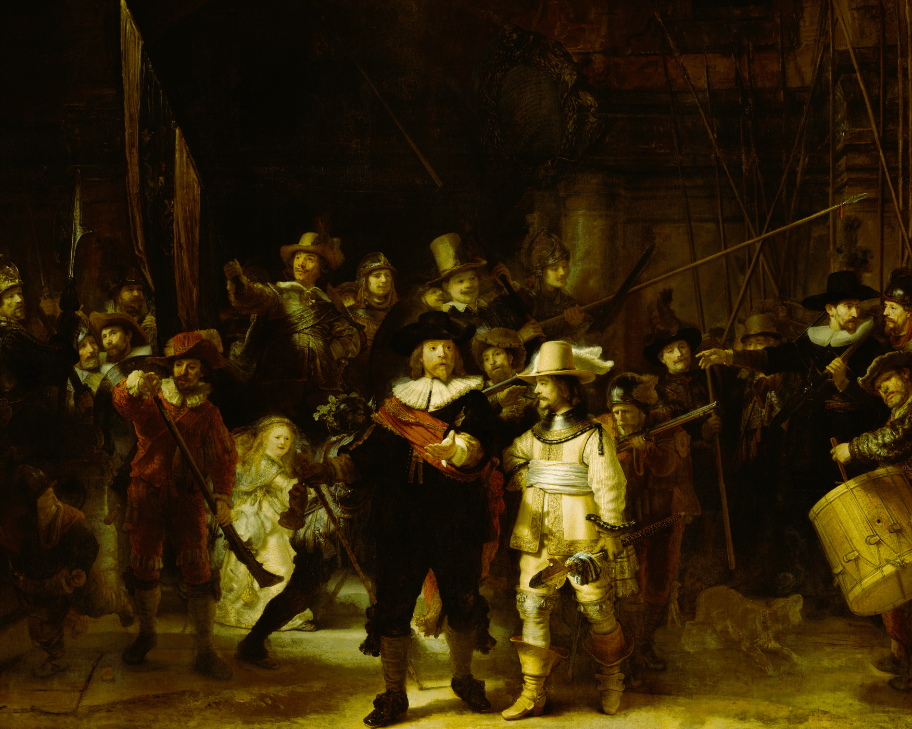
The one thing that always puzzled me is that the Nazis never stole one of the most famous paintings, if not the most famous Rembrandt—”Nacht Wacht” (Night Watch).
Recently, I found out the reason.
In August 1939, it became clear that war was inevitable. The Dutch government took steps for the safety of the Dutch artworks. Even though, at the time, the Netherlands was neutral.
At the end of 1939, the government ordered building art bunkers for the national collection at Heemskerk and Zandvoort. In the meantime, the municipality of Amsterdam did not sit idle and had its small bunker built near Castricum for the Stedelijk Museum’s collection (and that of some wealthy collectors).
When war broke out in May 1940, the government art bunkers were not yet ready. Fortunately—the collections made it to safety in time, and the Night Watch took residence in the Knight’s Hall of Radboud Castle in Medemblik. Medemblik was not a military target, and the artwork here was considered safer than in Amsterdam.
The Amsterdam art bunker (completed on time in March 1940) held the paintings of Van Gogh, Breitner and Mondriaan. They were safely buried under the dune sand near Castricum (when the war broke out). Previously, this entire collection had floated in ships on the Rijpweteringschevaart. After the outbreak of war, the Amsterdam art bunker in Castricum also temporarily housed the masterpieces of the Rijksmuseum, the Boijmans van Beuningen and private collectors such as the Van Gogh family. The Night Watch was moved from Medemblik to Castricum on May 12, 1940.

It was not until November 1940 that the other art bunkers were ready. They moved the Night Watch from the small Amsterdam bunker in Castricum to the official government bunker in Heemskerk. Germany occupied the Netherlands and allowed the Dutch to have their way. The Dutch Art Protection Inspectorate was left intact by the Germans because the Germans also had an interest in protecting art treasures. After the war, the Dutch masterpieces were to be displayed at the Führer Museum in Linz.

The war progressed, and the Dutch dunes became a new war front. Here, the Germans built the Atlantic Wall to protect themselves against a possible British invasion. The dunes, once considered safe, were no longer considered a suitable place for storing the most important Dutch works of art. New homes were therefore urgently sought for the paintings.
From December 1941 to March 1942, a hermitage in the marl caves of the St Pietersberg, in Maastricht, was constructed. The Night Watch was safely moved there for its protection on 24 March 1942.

The Night Watch, while in three years of storage, was rolled up. The cloth hung on scaffolding that rotated (a little each day) to prevent adhesions. The works of art were also guarded 24 hours a day by police officers and museum staff. In this storage facility, 750 paintings were in the vault, including 43 Rembrandts, 24 works by Jan Steen and 14 paintings by Frans Hals.
Thanks to the efforts of the Art Protection Inspectorate, all important museum collections survived the war. In July 1945, the artwork, was rescued, and returned to its rightful owners.
The original Night Watch has not been in the caves of St Pietersberg for 78 years, but there is a copy for viewing. Artist Jules Sondeijker made the full-size reproduction in the early 1900s with charcoal on marl. The drawing is in the museum at the Caves Zonneberg, Maastricht, Netherlands. Today, it is a tourist attraction containing artwork and anecdotes.

The existence of the hiding place and its location were no secret. In fact, the Nazis had the vault built themselves. Their intention was to take Dutch art treasures to Germany after the war. And, of course nothing was allowed to happen to it. The Night Watch was joined in National Storage No. 9 by other famous masterpieces, such as The Street by Johannes Vermeer and The Bull by Paulus Potter. The latter painting came to Maastricht from the Mauritshuis in The Hague.
sources

Donation
Your readership is what makes my site a success, and I am truly passionate about providing you with valuable content. I have been doing this at no cost and will continue to do so. Your voluntary donation of $2 or more, if you are able, would be a significant contribution to the continuation of my work. However, I fully understand if you’re not in a position to do so. Your support, in any form, is greatly appreciated. Thank you. To donate, click on the credit/debit card icon of the card you will use. If you want to donate more than $2, just add a higher number in the box left from the PayPal link. Your generosity is greatly appreciated. Many thanks.
$2.00
 History of Sorts
Leave a comment