
Although I have literally written hundreds of posts on World War II and the Holocaust, I hadn’t heard about the great bank robbery.
The bank robbery at Almelo 1944, is a bank robbery was committed by the Dutch resistance on November 15, in which 46.1 million guilders (value in 2023: €354 million) was taken. It concerned money moved from Arnhem to Almelo on behalf of Reich Commissioner Seyss-Inquart to end up in Germany. At the time, an NSB member worked as a director at the bank.
This robbery of thirteen cash boxes was considered the largest bank robbery in the Netherlands until well after the year 2000, and more money was involved than the well-known British train robbery. Ex-bank employee Derk Smoes, leader of the Fighting Squad in Almelo, initiated this robbery. Other members included Douwe Mik, Herman Höften, Hendrik Frielink, who survived the Neuengamme Concentration Camp, and resistance fighter Henk Bosch. It was an act of resistance for which the Dutch government had given written permission from London. The loot was intended to finance the 1944 railway strike.
The resistance had received a tip that the large sum of money was stored in the Almelo bank branch. From there, Reich Commissioner Seyss-Inquart wanted to have it brought to Germany. After the successful robbery, which was carried out with the approval of the Dutch government in London, there was no trace of the perpetrators.
“Wednesday, November 15, 1944, half past six in the afternoon. The bank building is closed. Then the doorbell rings. The youngest servant opens the door and immediately looks into the barrels of the pistols. Four K.P. members enter. The others keep watch outside and occupy the house above the building. The staff, who are completely surprised, raise their hands and the director (matte SS pin on his jacket!) is forced to lead the men downstairs and open the safe. “I don’t know the numerical code,” he said. But when he notices that it is serious and that refusal will cost him his life, the iron gate opens and so do the safe doors. The millions are up for grabs. The staff must pack everything into boxes. Thirteen boxes full! Meanwhile, the director puts away his SS pin. “I don’t want to annoy you with your work,” he says. After forty-five minutes (“It seemed like hours,” the robbers said later) everything above. The truck of Willem Meenks from Rijssen can drive up. The engine runs on wood gas and cuts out repeatedly. But he still manages to get the car in front of the door with the loading platform facing backwards. Just as loading is underway, the K.P. members get the fright of their lives. An entire column of Grime Polizei marches past. They still have to circle around the car because it is half on the road. One of the K.P. members gives them some guidance. But the Germans notice nothing and continue singing loudly (Auf der Heide blüht ein kleines Blümelein). Everyone breathes a sigh of relief when it all ends well. Shortly afterwards everything was loaded. Just cut the telephone wires and then drive away. But the wrong wire is cut and the alarm system starts blaring. How could it be otherwise, a small panic arises, but everyone knows what to do. The retreat does not go entirely according to plan, but during the evening the millions arrive safely in Daarle where they are temporarily stored in a haystack. A few days later the money, a total of ƒ46,150,000, was brought to Daarlerveen in two trips by horse and cart, again in a haystack. Everything went well.”
The Germans had offered 1 million guilders for the golden tip that would lead to the arrest of the bank robbers. Ultimately, the arrest of an acquaintance of the robbers, with forged identity cards in his pocket, led the Germans on the trail of the resistance group involved.

The false identification documents led to the hiding place of Derk Smoes, the ringleader of the bank robbery. He was arrested together with others involved in the robbery. The Germans proposed a compromise to Smoes: if he told them where the money was, they would not conduct any further large-scale research in the area.
Smoes, who feared that such an investigation would reveal more to the Germans than the resistance wanted, passed on the location of the money. The SD eventually found the entire amount under the hay at a farm in Daarlerveen.

Nine people were arrested and sent to Neuengamme and Reiherhorst, Reiherhorst, a wooden barracks camp within Wöbbelin Concentration Camp. Six of them had to pay for it with their lives.
Below are a few of the biographies of those involved.
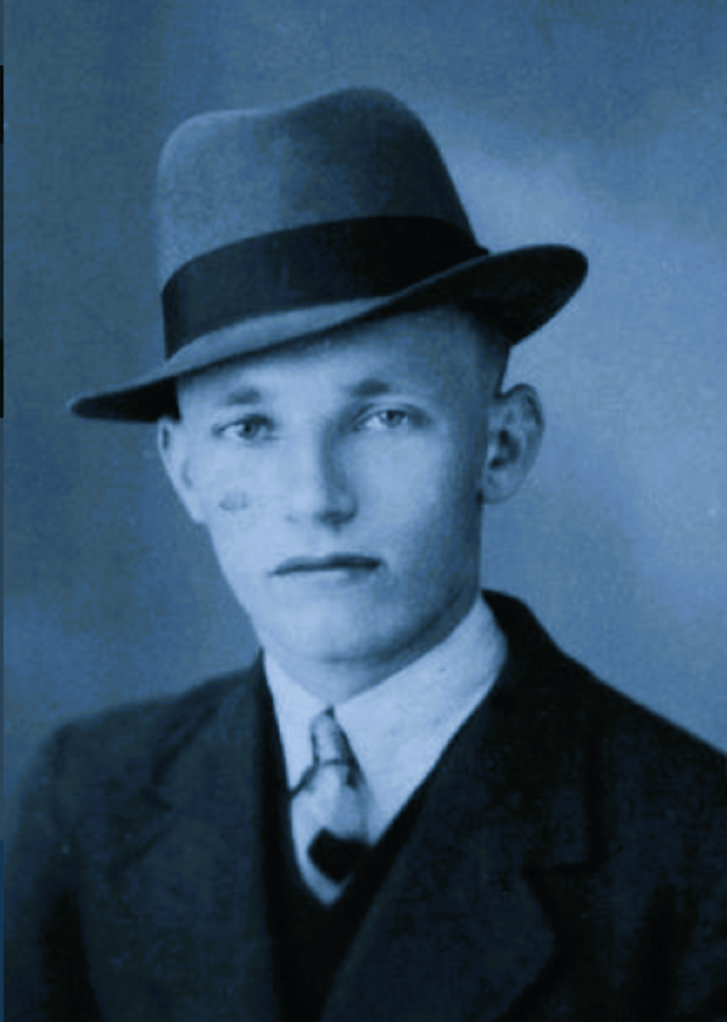
Derk Smoes (Vriezenveen, 7 December 1914–Neuengamme, 14 March 1945) was a bank clerk. From July 1944, he took over the leadership of the KP (a resistance group) Almelo together with Andries Kalter. Smoes was involved in several robberies on distribution transports and the bank robbery of the Dutch Bank in Almelo. He was arrested on 30 November 1944. Smoes died on 14 March 1945 in Camp Neuengamme.


Douwe Mik (Borger, 23 May 1917–Wöbbelin, Germany, 17 April 1945) was a police officer. Mik had to go into hiding and subsequently ended up in the Twente resistance. He was involved, among other things, in the squatting of the Dutch Bank in Almelo. Mik was arrested for this and died in Wöbbelin Concentration Camp.

Herman Höften (Wierden, February 15, 1920)was a resistance fighter and politician. During the Second World War, he was affiliated with KP Almelo. He took part in the robbery of the Detention Center in Almelo and the robbery of the Dutch Bank in Almelo. Herman died in Almelo in 2007.

Berend Bruijnes (Ermelo, 6 January 1921–11 March 1945) After being imprisoned for several months in 1943 following the May strike, Berend Bruijnes (Bruintje) took over the work of his father (Arie Bruijnes) on November 25 after he was arrested for betrayal along with Jewish people in hiding. He has been involved in, among other things, distributing distribution vouchers and identity cards in the Epe and Zwolle areas. He was also part of the RVV group Epe of the Domestic Armed Forces under the command of Johannes Daamen and also provided shooting instructions. On 29 November 1944, he was arrested in Almelo in possession of blank identity cards and, after “sharpened” interrogation, was imprisoned in the Kruisberg in Doetinchem. From there he was deported to Neuengamme on 1 February 1945, and from there to Reyerhorst Concentration Camp in Wöbbelin, where he died of dysentery on March 11.

Willem Meenks (Rijssen, 20 December 1915–15 March 1945) On 5 February 1945, Willem Meenks was transported from Doetinchem to Neuengamme, where he died on 15 March 1945.

Gerardus Hendrikus Frielink (Tubbergen, 14 January 1912–28 April 1945, Auffanglager Wöbbelin) was one of the seven young men who were transported by train from the Netherlands to the Neuengamme Concentration Camp near Hamburg, on the night of February 1–2, 1945. Frielink and his brother Hendrik may not have been robbers but owners of the café of the same name in Harbrinkhoek, they had made their pub available to the gang to plan the robbery. However, it turned into a tragedy when the robbers were caught, and the Frielink brothers were also arrested by the Nazis.
The journey followed in appalling conditions, lasted almost a week in a closed wagon, after which the train arrived at Camp Neuengamme on 7 February.
“The men were desperate for water and food, but when they arrived at the camp, a reception committee of SS men and kapos (prisoners who were appointed as camp guards, etc.) was ready with clubs and eager sheepdogs,” says Krake. “After they had gone through this welcome, they received their camp number (70900 for Gerard Frielink). It was on a piece of fabric that they had to sew onto their camp clothes themselves.”
He died at the camp on April 28, 1945.

Gerhard Nijland The Twente resistance fighter Gerhard Nijland did not survive the Nazi camp Ahlem. He was buried ingloriously and under the wrong name, while his SS camp commander Otto ‘Thull’ Harder— an acclaimed professional football player—avoided the death penalty and was later buried by a guard of honour. “It is distressing,” says Gerhard’s niece.
Gerhard Nijland was involved in the 1944 robbery of De Nederlandsche Bank, in which 46 million guilders were stolen. Nijland hid the loot in the family’s haystack in Daarlerveen. The Germans were at their wits’ end and did everything they could to capture the resistance group. They arrested seven men, including Nijland. He was never heard from again.
Since Gerhard’s death, he was no longer talked about in the family. Gerie has been ordered since childhood never to talk about him. It was too painful. Because of that silence, no one in the family knew exactly what had happened to Gerhard. His father could not cope with his death and committed suicide in 1948.
In contradiction, Gerhard’s tormentor, Otto Fritz Harder, had been a German Footballer before World War II. In October 1932, following his football career, Harder ran an insurance agency and became a member of the NSDAP before joining the SS in May 1933. In August 1939, he was drafted into the Waffen-SS and served shortly at Sachsenhausen Concentration Camp, then at Neuengamme in Hamburg by the end of that year.[10] On 30 November 1944, Harder became an SS-Hauptscharführer and a commander (Schutzhaftlagerführer) at the Ahlem camp in Hanover. On 30 January 1945, he was promoted to SS-Untersturmführer (equivalent second lieutenant). He also served as a camp commander in Uelzen, a subcamp of Neuengamme, which was evacuated under his leadership on 16–17 April due to British attacks, in which prisoners were transferred to the main camp. In May 1945, he was captured by the British military and was taken to Iserbrook. Due to health issues, he was initially released but then was arrested again.
After World War II, Harder was tried for war crimes by the British military court at the Curio house in Rotherbaum. On 6 May 1947, he was sentenced to 15 years’ imprisonment. After the trial, Hamburger SV excluded him for a short time. However, his sentence was later reduced to ten years in prison, of which he ended up serving only four years. He was released from Werl Prison before Christmas 1951. Harder later moved to Bendestorf, where he worked as an insurance agent until his death on 4 March 1956 in Hamburg.
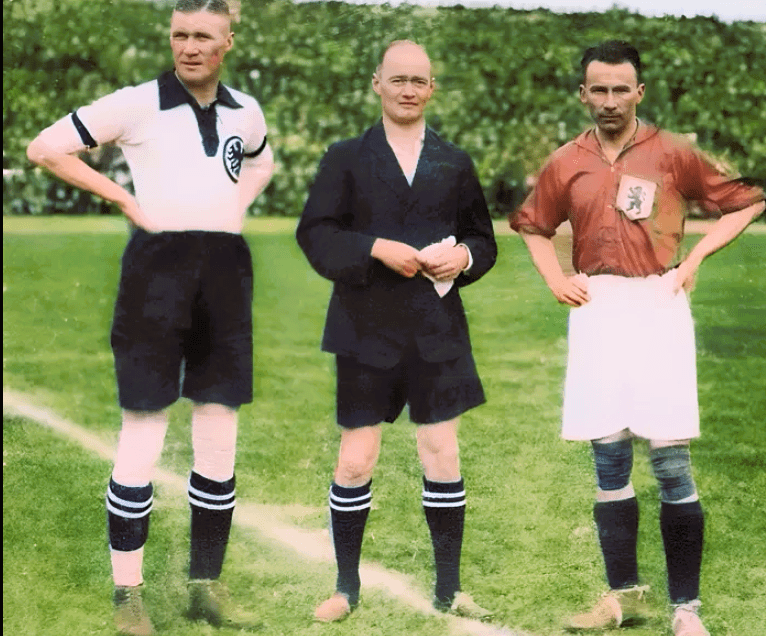
In Frank Krake’s 2023 book, The Resistance Man and the Football Hero, the author contrasts the life of SS Camp Commandant Harder, who “created a living hell” (according to Henry Kissinger, one of the US 84th Division which liberated the Ahlen Concentration Camp), with the life of Gerhard Nijland, a Dutch resistance hero who became a prisoner in Harder’s camp. Nijland died in April 1945, five days after being liberated by the Americans, and was buried in an unmarked grave.
When the Football World Cup was held in Germany in 1974, the city of Hamburg even produced a brochure in which Harder was also honoured as one of their great football heroes. Frank Krake, “That ultimately went too far. The page was removed from the brochure at the very last minute.”
Sources
https://doetinchemherdenkt.nl/bankovervallers
https://www.oudvriezenveen.nl/dorpsgeschiedenis/bankoverval/eenstelkoelbloedigesnotneuzen
https://nos.nl/75jaarbevrijding/bericht/2313050-verzetsleden-die-bankoverval-pleegden-opgepakt
https://nl.wikipedia.org/wiki/Bankroof_Almelo_1944

Donation
Your readership is what makes my site a success, and I am truly passionate about providing you with valuable content. I have been doing this at no cost and will continue to do so. Your voluntary donation of $2 or more, if you are able, would be a significant contribution to the continuation of my work. However, I fully understand if you’re not in a position to do so. Your support, in any form, is greatly appreciated. Thank you. To donate, click on the credit/debit card icon of the card you will use. If you want to donate more than $2, just add a higher number in the box left from the PayPal link. Your generosity is greatly appreciated. Many thanks.
$2.00
 History of Sorts
Leave a comment