There are very few positive Holocaust stories—but this is one of them.
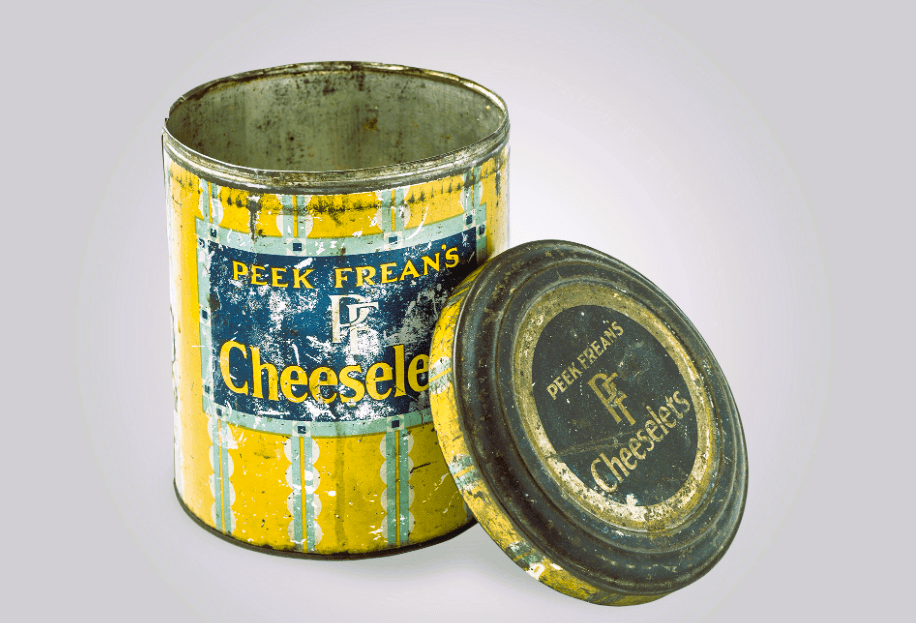
When Abel and Thea Herzberg return from Germany after the Second World War, they only have two things with them: a biscuit tin in which they kept meagre leftovers of food in recent months and the diary that Abel kept about the period in Bergen-Belsen. That diary, which he called ‘Tweestromenland’, was published in 1950 by De Groene Amsterdammer and later published in book form. It gives a disturbing picture of the situation in Bergen-Belsen in the last year of the war.
All kinds of groups ended up in the camp—Jews from Auschwitz, forced labourers, and Jews who might be exchanged. There was no longer any concern for the prisoners as there wasn’t any food to feed them. Typhus was rampant: people were dying in large numbers—35,000 between January and April 1945 alone. Abel Herzberg meticulously described what he and his wife Thea saw and heard.
At the end of December 1944, Herzberg noted, “The reports remained bad. The mood is miserable. The number of deaths is increasing. Irritability increases. The arguments increase. The men argue with the women and the women bore the men. (…) T. has diarrhoea—again. It doesn’t go away, it repeats itself. For now, corruption is high. Bread, food, cigarettes. Our feet are frozen, our hearts are dead.”
In April, the camp management decided to send a large number of Jews away by train, probably Theresienstadt being the destination, but that remains unclear. The train on which Abel and Thea Herzberg ended up had 2,500 passengers. The Russian troops were approaching from the East. The train ran in no man’s land, standing still for hours, sometimes days, and travelled short distances in all directions. The ghost journey became known as “The Lost Transport.” The passengers sometimes picked up turnips or beets from the field where the train was stationary. Abel and Thea stored the leftovers in the cookie tin.

And Abel kept taking notes.
On 19 April. 30 deaths yesterday. Dr A. and G. have died. Nothing but good things have been said about Dr A. I saw G. this morning. He died in the toilet with his head and hands in mud. There are nine sick people in our wagon tonight. People are currently fighting over the moorings. It’s all terrible enough. And God knows what’s coming next.
A short time later, on 26 April, when the horrific journey had lasted two weeks, Abel and Thea also knew: the train was in territory liberated by the Russians, near the village of Tröbitz.

The Russians were taking a radical approach—the Germans had to leave their houses, and the Jews were allowed in.
Herzberg wrote, “We have nothing. We are sick. We are billeted with the farmers. The train is empty. My legs are swollen and inflamed. T. has bronchitis, diarrhoea and fever. Nothing happens. (…) How is it in the Netherlands? The birds are chirping outside. At night I lie awake and count the strokes of the clock. Is that freedom?”
In Tröbitz, the survivors of The Lost Transport (about 2000 of the 2500) regained some breath. Repatriation began after two months. Abel and Thea Herzberg could return home—with a diary and biscuit tin.
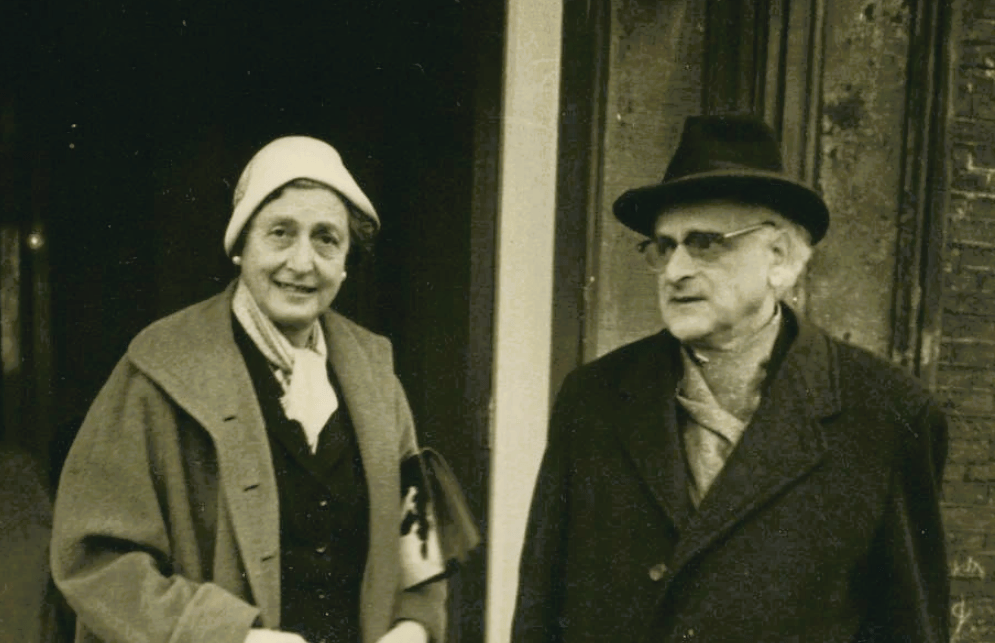
Abel Herzberg was born in Amsterdam into a family of Russian Jews. His parents migrated from Lithuania, having been part of the exodus of Eastern European Jews of 1882–1911 due to Pogroms. Because Abel’s parents were Russian—he automatically received Russian nationality despite being born in Amsterdam.
In 1918, he obtained his doctoral degree in law from the University of Amsterdam. He settled in Amsterdam to practice law, became president of the local chapter of the Zionist Union, and in 1922, became a Dutch citizen, giving up his Russian citizenship. He married Thea Loeb, whom he had met in the NZSO in 1923. In 1930, he joined the national board of the Dutch Zionist Union. A year later, he became the editor of their magazine. From 1934–1937, he served as president of the organization, proving to be a brilliant public speaker, capable of enthusing audiences regardless of education or class.
Herzberg, his wife Thea, and their three children were on the so-called Frederiks list and, therefore, enjoyed certain protections from March 1943 until he and his family were interned in Barneveld.
The Frederiks Plan was a plan from the Second World War by executives of the Dutch administration working under the German occupier to protect a group of Jews residing in the Netherlands with the cooperation of the German occupier in connection with the social significance they had before the Second World War. Netherlands or Germany. The Frederiks Plan was conceived and drawn up by Dutch Secretary General K.J. Frederiks from the Ministry of the Interior.
Frederiks and Secretary General of the Department of Education, Science and Cultural Protection Jan van Dam drew up a list of Jews who needed to be protected from transport to the concentration camps. This list became popularly known as the Barneveld List or Barneveld Group.
The people on the list were placed in one of the three reservation camps: Villa Bouchina, Huize De Biezen or Huize De Schaffelaar.

The Jews on that list would be safe for transport to extermination or labour camps. From these three reservation camps, they were transported to Theresienstadt via the Westerbork transit camp. Nevertheless, most survived the war.
Abel’s siblings survived the war. His Father died in 1941, before the deportations, and his Mother died before the war.
Thea’s Father died on 19 December 1940. this was early on in the war, and things hadn’t changed all that much yet for the Jews in the Netherlands. Her Mother died in 1928. Two of Thea’s siblings died before the war, one brother survived the war, and her sister Johanna Martha Paradies-Loeb was murdered in Sobibor on 30 April 1943.
Abel Herzberg was a controversial figure in Dutch public life after the World War II. He played a role in an all-important debate about the appreciation of the participation of some Dutch during the Nazi regime. Whether it concerned the actions of the Jewish Council, the pardon of the war criminal Willy Lages, the release of De Three of Breda (convicted war criminals), or the overthrow of the ARP politician Wim Aantjes because of his allegedly wrong war record. He always took positions that provoked strong reactions.
Sources
https://www.dbnl.org/tekst/_ons003199801_01/_ons003199801_01_0136.php
https://www.joodsmonument.nl/en/page/189941/johanna-martha-paradies-loeb
https://www.geni.com/people/Theodora-Thea-Herzberg/6000000010433095563
https://www.geni.com/people/Abel-Jacob-Herzberg/6000000010432629012

Donation
Your readership is what makes my site a success, and I am truly passionate about providing you with valuable content. I have been doing this at no cost and will continue to do so. Your voluntary donation of $2 or more, if you are able, would be a significant contribution to the continuation of my work. However, I fully understand if you’re not in a position to do so. Your support, in any form, is greatly appreciated. Thank you. To donate, click on the credit/debit card icon of the card you will use. If you want to donate more than $2, just add a higher number in the box left from the PayPal link. Your generosity is greatly appreciated. Many thanks.
$2.00
 History of Sorts
Leave a comment