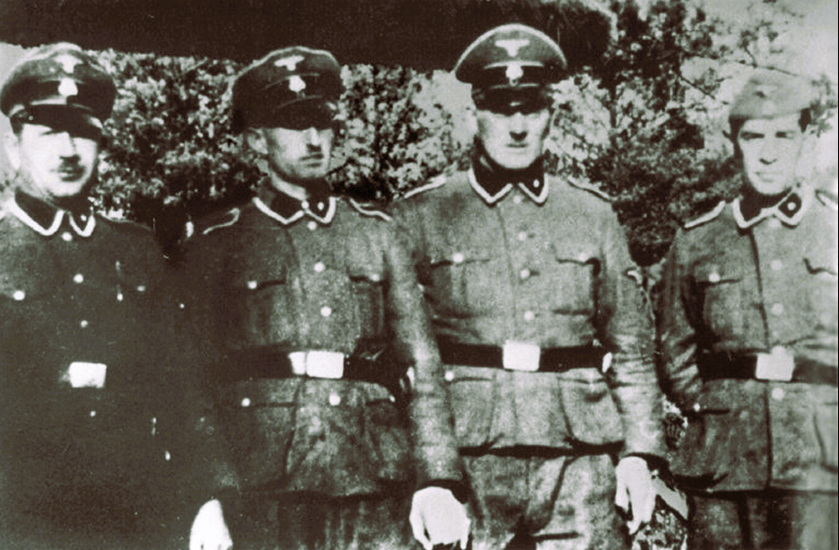
It is hard to put a value on the words of those who survived the Holocaust. Their words serve us as a constant reminder of the evil mankind is capable of.
I believe the perpetrators’ testimonies are equally as important because they give some indication of the psyche that created such evil and the delusion that kept it going, even to this day.
Below are a few of their testimonies.
Willi Mentz:
“When I came to Treblinka, the camp commandant was a doctor named Dr. Eberl. He was very ambitious. It was said that he ordered more transports than could be “processed” in the camp. That meant that trains had to wait outside the camp because the occupants of the previous transport had not yet all been killed. At the time, it was very hot, and as a result of the long wait inside the transport trains in the intense heat, many people died. At the time, whole mountains of bodies lay on the platform. The Hauptsturmfuehrer Christian Wirth came to Treblinka and kicked up a terrific row. And then one day, Dr. Eberl was no longer there…
For about two months, I worked in the upper section of the camp, and then, after Eberl had gone, everything in the camp was reorganized. The two parts of the camp were separated by barbed wire fences. Pine branches were used so that you could not see through the fences. The same thing was done along the route from the “transfer” area to the gas chambers…
Finally, new and larger gas chambers were built. I think that there were now five or six larger gas chambers. I cannot say exactly how many people these large gas chambers held. If the small gas chambers could hold 80-100 people, the large ones could probably hold twice that number…
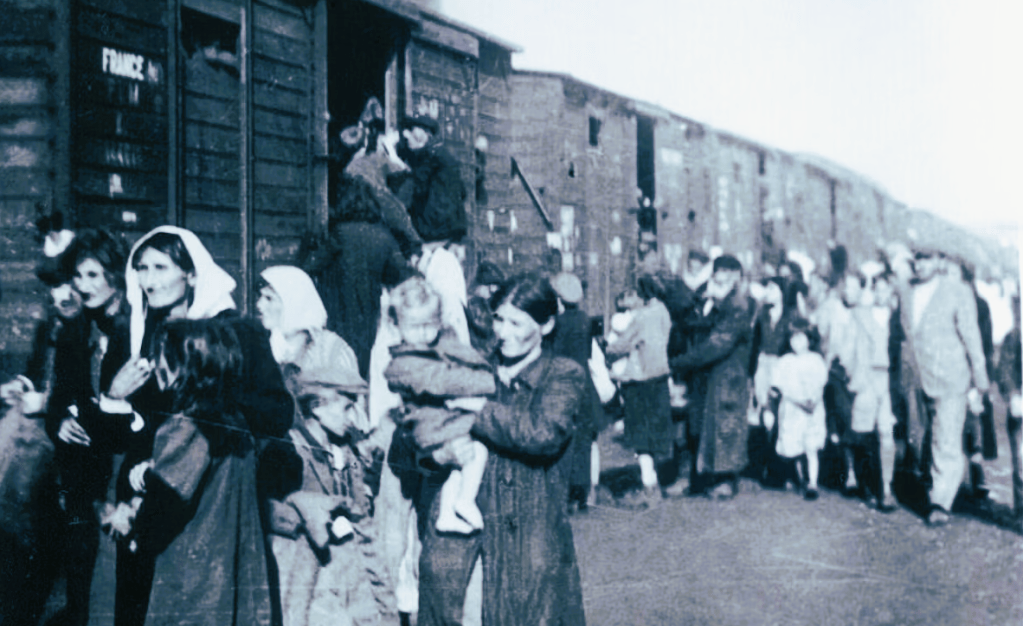
Following the arrival of a transport, six to eight cars would be shunted into the camp, coming to a halt at the platform there. The commandant, his deputy Franz, Kuettner and Stadie or Maetzig would be here waiting as the transport came in. Further SS members were also present to supervise the unloading: for example, Genz and Belitz had to make absolutely sure that there was no one left in the car after the occupants had been ordered to get out.
When the Jews had got off, Stadie or Maetzig would have a short word with them. They were told something to the effect that they were a resettlement transport, that they would be given a bath and that they would receive new clothes. They were also instructed to maintain quiet and discipline. They would continue their journey the following day.
Then, the transports were taken off to the so-called “transfer” area. The women had to undress in huts, and the men out in the open. The women were then led through a passageway, known as the ‘tube,’ to the gas chambers. On the way, they had to pass a hut where they had to hand in their jewelry and valuables.”
Kurt Franz:
“I cannot say how many Jews in total were gassed in Treblinka. On average each day a large train arrived. Sometimes there were even two. This, however, was not so common.
In Treblinka, I was commander of the Ukrainian guard unit as I had been in Belzec. In Treblinka, as in Belzec, the unit consisted of sixty to eighty men. The Ukrainians’ main task was to man the guard posts around the camp perimeter. After the uprising in August 1943, I ran the camp more or less single-handedly for a month; however, during that period, no gassings were undertaken.
It was during that period that the original camp was demolished. Everything was leveled off, and lupins were planted…”
SS Oberscharfuehrer Heinrich Matthes:
“During the entire time I was in Treblinka, I served in the upper camp. The upper camp was that part of Treblinka with the gas chambers, where the Jews were killed and their corpses laid in large pits and later burned.
About fourteen Germans carried out services in the upper camp. There were two Ukrainians permanently in the upper camp. One of them was called Nikolai, the other was a short man—I don’t remember his name… These two Ukrainians who lived in the upper camp served in the gas chambers. They also took care of the engine room when Fritz Schmidt was absent. Usually, this Schmidt—was in charge of the engine room. In my opinion, as a civilian, he was either a mechanic or a driver…
Altogether, six gas chambers were active. According to my estimate, about 300 people could enter each gas chamber. The people went into the gas chamber without resistance. Those who were at the end, the Ukrainian guards had to push inside. I personally saw how the Ukrainians pushed the people with their rifle butts…
The gas chambers were closed for about thirty minutes. Then Schmidt stopped the gassing, and the two Ukrainians who were in the engine room opened the gas chambers from the other side.”
Erich Fuchs:
“We unloaded the motor. It was a heavy Russian benzine engine, at least 200 horsepower. we installed the engine on a concrete foundation and set up the connection between the exhaust and the tube.
I then tested the motor. It did not work. I was able to repair the ignition and the valves, and the motor finally started running. The chemist, who I knew from Belzec, entered the gas chamber with measuring instruments to test the concentration of the gas.
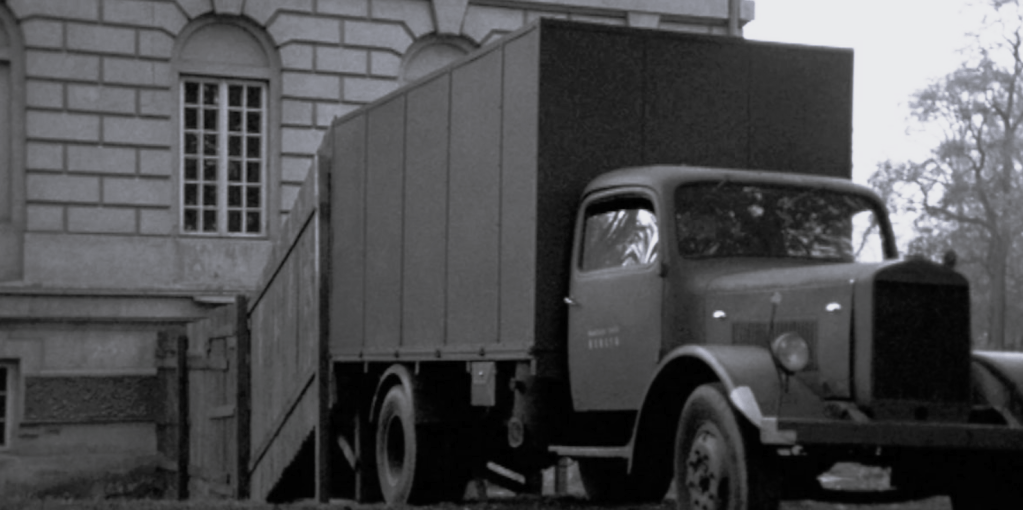
Following this, a gassing experiment was carried out. If my memory serves me right, about thirty to forty women were gassed in one gas chamber. The Jewish women were forced to undress in an open place close to the gas chamber and were driven into the gas chamber by the above-mentioned SS members and the Ukrainian auxiliaries. When the women were shut up in the gas chamber, Bolender and I set the motor in motion. The motor functioned first in neutral. Both of us stood by the motor and switched from “Neutral” (Freiauspuff) to “Cell” (Zelle) so that the gas was conveyed to the chamber. At the suggestion of the chemist, I fixed the motor on a definite speed so that it was unnecessary henceforth to press on the gas. About ten minutes later, the thirty to forty women were dead.”
Kurt Möbius:
“I would also like to say that it did not at all occur to me that these orders could be unjust. I know that it is the duty of the police to protect the innocent, but I was then of the conviction that the Jews were not innocent but guilty. I believed in the propaganda, that all Jews were criminals and subhuman as well as the fact that they were the cause of Germany’s decline after the First World War. The thought that one should disobey or evade the order to participate in the extermination of the Jews did not, therefore, enter my mind at all.”
Sources
https://www.jewishvirtuallibrary.org/testimonies-of-nazi-ss-at-treblinka
https://www.bbc.co.uk/teach/class-clips-video/articles/zdvh2sg
chrome-extension://efaidnbmnnnibpcajpcglclefindmkaj/https://auschwitz.org/gfx/auschwitz/userfiles/agju/perpetrators.pdf

Donation
Your readership is what makes my site a success, and I am truly passionate about providing you with valuable content. I have been doing this at no cost and will continue to do so. Your voluntary donation of $2 or more, if you are able, would be a significant contribution to the continuation of my work. However, I fully understand if you’re not in a position to do so. Your support, in any form, is greatly appreciated. Thank you. To donate, click on the credit/debit card icon of the card you will use. If you want to donate more than $2, just add a higher number in the box left from the PayPal link. Your generosity is greatly appreciated. Many thanks.
$2.00
 History of Sorts
Leave a comment