
Even after death, the Nazi victims were still subjected to evil science.
Hermann Stieve and His Connection to Liane Berkowitz and Mildred Harnack: An Intersection of Science and Ethical Transgression
Hermann Stieve, a German anatomist who held a prominent position at what is now Humboldt University of Berlin, is remembered not only for his contributions to the study of human anatomy but also for the disturbing context in which his research was conducted. During the Nazi regime, Stieve used the bodies of executed political prisoners, including resistance fighters like Liane Berkowitz and Mildred Harnack, to study the effects of stress on the female reproductive system. His work, though scientifically influential, was marred by profound ethical violations that highlight the darker intersections of medical science and state violence during the Third Reich.
Hermann Stieve: A Prominent Anatomist in a Dark Era
Born in 1886, Stieve became a leading figure in the field of anatomy during the early 20th century. His expertise in reproductive anatomy, particularly the study of the menstrual cycle and its physiological responses to stress, earned him recognition within the scientific community. Stieve’s work sought to illuminate how external pressures, especially emotional stress, affected the female body. However, it was under the Nazi regime that his access to a unique and deeply problematic resource — the bodies of executed prisoners — allowed him to conduct research on a scale that would have been impossible under ethical conditions.
With the rise of Adolf Hitler in 1933 and the Nazi government’s increasingly brutal repression of political dissent, the number of political prisoners executed in Germany grew rapidly. Stieve capitalized on this grim reality by forming close connections with prison officials, notably at Plötzensee Prison in Berlin. Through these connections, Stieve was able to access the bodies of executed prisoners, often within hours of their deaths. This arrangement, which blurred the line between medical research and state complicity, became a cornerstone of his most controversial work.

Liane Berkowitz: A Young Resistance Fighter
One of the prisoners whose body was used by Stieve was Liane Berkowitz, a young woman who became involved in the anti-Nazi resistance as a member of the Rote Kapelle (Red Orchestra). This network that opposed Hitler’s regime. Berkowitz, born in 1923, was only 19 when she was arrested by the Gestapo in 1942. She had been involved in distributing anti-Nazi leaflets and participating in protests against the regime. Along with her fellow resistance members, Berkowitz was sentenced to death by the Nazi Volksgerichtshof (People’s Court), a court infamous for its swift and harsh rulings against political dissidents.
She was pregnant when she was arrested, giving birth to a daughter shortly before her execution in 1943. She was executed two days before her 19th birthday, despite her youth and the fact that she had just become a mother. On April 12, 1943, she gave birth to her daughter Irene in Barnimstraße Women’s Prison in Berlin. The baby was cared for by her grandmother from July 1943 on and was probably killed in October 1943 at Eberswalde Hospital.
Berkowitz was guillotined at Plötzensee Prison. It was after her death that her body was delivered to Hermann Stieve for research.
Stieve used the bodies of Berkowitz and other female prisoners to study the impact of extreme psychological stress on the menstrual cycle and the reproductive organs. In Berkowitz’s case, as with many others, Stieve collected detailed data about her menstrual cycle while she was in prison and then examined her reproductive system post-mortem to confirm his hypotheses. His studies aimed to show that the stress of imprisonment, particularly the psychological strain of facing imminent execution, caused disruptions in the menstrual cycle and alterations in reproductive health.
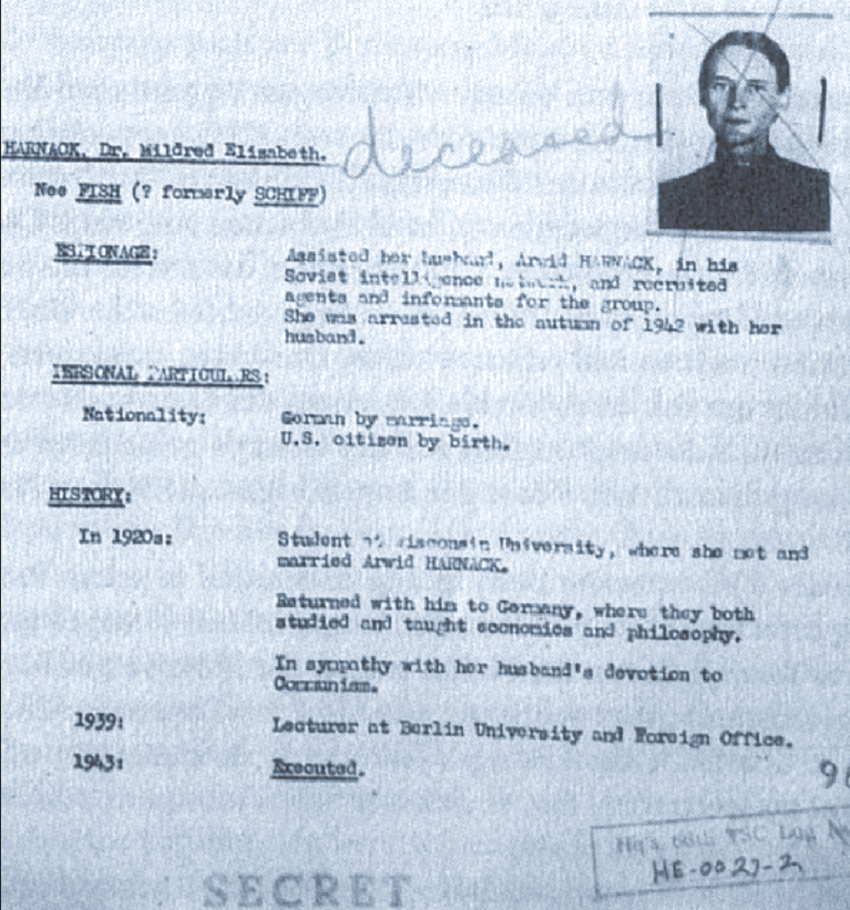
Mildred Harnack: An American Scholar and Anti-Nazi Activist
Another notable victim whose body Stieve utilized was Mildred Harnack, a member of the same Rote Kapelle resistance group as Berkowitz. Harnack, an American-born scholar, moved to Germany with her German husband, Arvid Harnack, in the 1920s. As Hitler’s dictatorship tightened its grip on Germany, the Harnacks became deeply involved in anti-Nazi activities, gathering intelligence, helping Jews escape persecution, and distributing anti-Nazi propaganda. Like Berkowitz, Harnack was arrested in 1942 and later sentenced to death by the Volksgerichtshof.
In February 1943, Mildred Harnack was executed by beheading, the only American woman to be executed on Hitler’s orders. After her execution, her body was sent to Hermann Stieve for anatomical research, just as Liane Berkowitz’s had been. Stieve’s post-mortem examinations on Harnack, like those he conducted on Berkowitz and other female prisoners, sought to provide scientific insights into how the anticipation of death affected female reproductive physiology.
The Ethical Quagmire of Stieve’s Research
While Stieve’s work may have contributed to the understanding of stress on the reproductive system, the ethical implications of his research cannot be overstated. His access to the bodies of executed political prisoners often delivered mere hours after their deaths, was a direct result of Nazi policies of terror and repression. The prisoners whose bodies Stieve used had been killed for their resistance to a genocidal regime, and their bodies were exploited without consent, in violation of basic human dignity and medical ethics.
Stieve’s research, especially his use of the bodies of political prisoners, raises profound moral questions about the complicity of scientists in systems of oppression. Stieve did not directly cause the deaths of the women he studied, but he undoubtedly benefitted from the Nazi state’s apparatus of repression and death. His work is an example of how scientific curiosity and the quest for knowledge can become dangerously entangled with political power, especially in times of authoritarianism and war.
The fact that Stieve continued to have a respected career after the war without facing severe consequences for his involvement in Nazi-era atrocities is reflective of a broader trend in postwar Germany. Many professionals, especially in the medical and scientific fields, who had been complicit in Nazi crimes were able to resume their careers with little to no accountability. This allowed Stieve’s research to be cited and built upon for years after his death, even though it was tainted by the unethical means through which it was conducted.
Hermann Stieve’s research on the female reproductive system, and his use of the bodies of women like Liane Berkowitz and Mildred Harnack, epitomizes the deep moral compromises made by many scientists under the Nazi regime. His career reflects the dangers of scientific complicity in state violence, where the pursuit of knowledge is conducted at the expense of basic human rights. Though Stieve’s work may have yielded valuable anatomical insights, the manner in which it was conducted, using the bodies of executed political prisoners without consent, marks it as a tragic example of unethical science in an era of extreme political repression. Today, the memory of Liane Berkowitz, Mildred Harnack, and countless others serves as a reminder of the human cost behind such scientific pursuits and the importance of maintaining ethical integrity in all fields of research.
Hermann Stieve died in 1952, relatively unscathed by the post-war denazification processes that targeted other prominent figures in the Nazi medical and scientific community. For many years after his death, his research continued to be referenced without much acknowledgment of the unethical practices he had engaged in.
Sources
https://www.bbc.com/news/health-21086388?print
https://www.tracesofwar.com/sights/9206/Memorial-Liane-Berkowitz.htm
https://pubmed.ncbi.nlm.nih.gov/23238847/
https://www.sciencedirect.com/science/article/abs/pii/S0940960221000467
Donation
Your readership is what makes my site a success, and I am truly passionate about providing you with valuable content. I have been doing this at no cost and will continue to do so. Your voluntary donation of $2 or more, if you are able, would be a significant contribution to the continuation of my work. However, I fully understand if you’re not in a position to do so. Your support, in any form, is greatly appreciated. Thank you. To donate, click on the credit/debit card icon of the card you will use. If you want to donate more than $2, just add a higher number in the box left from the PayPal link. Your generosity is greatly appreciated. Many thanks.
$2.00

 History of Sorts
Leave a comment