
The discovery of the Karl Höcker album—a collection of personal photographs documenting the social lives of Auschwitz SS officers—provides a chilling juxtaposition to the atrocities committed at the Nazi concentration and extermination camp. These images, often depicting lighthearted moments of camaraderie, leisure, and relaxation, offer a stark contrast to the brutality occurring just miles away. Höcker, an SS officer and adjutant to the commandant of Auschwitz compiled these images during the latter half of 1944, one of the most deadly periods at the camp. The photographs not only deepen our understanding of the Holocaust but also exemplify what Hannah Arendt famously termed the “banality of evil,” showing how the people responsible for genocide could simultaneously lead seemingly ordinary, even cheerful lives.
The Context of the Höcker Album
In May 1944, Karl Höcker was transferred to Auschwitz, where he served as adjutant to the camp’s final commandant, Richard Baer. Auschwitz-Birkenau had become the epicenter of the Holocaust by this time, with an estimated 1.1 million people—most of them Jews—having been murdered there between 1941 and 1945. The camp functioned as both a labor camp and a site of mass extermination, with gas chambers, crematoria, and other machinery of death operating on an industrial scale.

The photographs in the Höcker album were taken during the summer and fall of 1944, a period that saw the mass deportation of Hungarian Jews to Auschwitz. Over 400,000 Jews were sent to the camp between May and July of that year, with the majority being killed immediately upon arrival. It was a time of extreme suffering, terror, and death for the victims of the Holocaust.
Yet the Höcker album shows none of this. Instead, it offers glimpses into the social life of SS officers, away from the horrors of the gas chambers and crematoria. The album, discovered in the 1960s and later donated to the United States Holocaust Memorial Museum, contains 116 images. These photographs reveal a dark dichotomy between the SS officers’ leisure activities and the genocidal actions they were facilitating on a daily basis.
The Contents of the Höcker Album
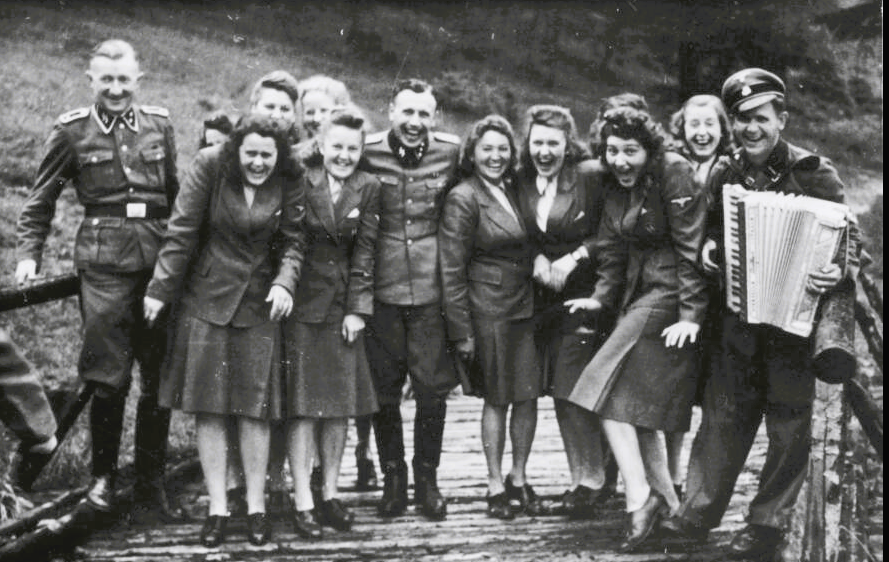
The photographs in the Höcker album capture scenes of leisure, relaxation, and camaraderie. SS officers are shown attending parties, eating meals, and taking part in group outings in the countryside. One particularly famous set of images depicts a group of officers and female auxiliaries (who worked as SS administrative assistants) relaxing at the Solahütte, a retreat located just a few miles from Auschwitz. In these photos, the SS officers are smiling, laughing, and enjoying their time off, appearing utterly detached from the atrocities they oversaw at the camp.

Karl Höcker himself is featured prominently in many of the images. As adjutant to the commandant, he played an integral role in the administration of Auschwitz. Though he was not directly involved in the killing, his duties involved overseeing the daily operations of the camp, including the transport of prisoners and the management of resources for the SS personnel.
The photographs in the album also include images of prominent figures such as Josef Mengele, the infamous camp doctor known for his cruel experiments on prisoners, mainly twins, and children. In one particularly striking photograph, Mengele is seen smiling and relaxed, mingling with other officers at the Solahütte retreat, which reinforces the idea that individuals who were directly involved in the most heinous of crimes could live lives of seeming normality and enjoy moments of pleasure and respite.
The Banality of Evil
The Höcker album is perhaps most significant for what it tells us about the nature of evil. Hannah Arendt, a German-Jewish political theorist, coined the phrase “the banality of evil” in her coverage of the trial of Adolf Eichmann, one of the principal organizers of the Holocaust. Arendt argued that Eichmann was not a monstrous figure but rather an ordinary man who simply carried out orders with little regard for the moral implications of his actions. In Arendt’s view, Eichmann’s lack of critical reflection on his role in the genocide—his bureaucratic efficiency divorced from ethical considerations—was emblematic of how ordinary people could become complicit in extraordinary crimes.

The Höcker album echoes Arendt’s thesis. The SS officers in these photographs do not appear as sadistic killers but as regular men and women enjoying life. They smile for the camera, socialize, and engage in leisure activities, seemingly oblivious to—or perhaps willfully ignoring—the horrors taking place just a short distance away. The casual demeanor of these individuals illustrates how the machinery of genocide relied not only on ideological zealots but also on individuals who were able to compartmentalize their lives, engaging in mass murder by day and enjoying picnics by night.
The album stands as a potent reminder that those responsible for the Holocaust were not always visibly monstrous figures. Instead, they were often ordinary individuals who became cogs in the larger machine of genocide, performing their roles within a system that dehumanized its victims and rendered mass murder a bureaucratic, impersonal process.
Compartmentalization and Dehumanization
The Höcker album underscores the ability of individuals to compartmentalize their roles in atrocities. SS officers, including Höcker, were able to separate their professional duties from their personal lives, participating in the administration of mass murder while maintaining an air of normalcy during their leisure time. This compartmentalization was essential to the functioning of the Nazi camp system, as it allowed perpetrators to distance themselves from the human suffering they were causing.
The dehumanization of the victims also played a critical role in this process. The Jews, Romani people, Soviet prisoners of war, and others imprisoned at Auschwitz were systematically dehumanized by Nazi ideology, which portrayed them as subhuman and unworthy of life. This dehumanization made it easier for individuals like Höcker to carry out their duties without moral qualms. In the photographs, there is no evidence of remorse or guilt on the part of the SS officers, suggesting that the process of dehumanization had allowed them to view their victims as mere numbers or obstacles to be eliminated rather than as human beings.
A Testament to Holocaust Denial
The Höcker album is also an essential document for countering Holocaust denial. Holocaust deniers have long attempted to downplay or even outright deny the scale of the atrocities committed at Auschwitz and other Nazi camps. The photographs in the Höcker album, while not directly depicting the killings, provide crucial visual evidence of the SS officers who were responsible for running the camp. They offer a glimpse into the lives of those who managed and facilitated the Holocaust, underscoring the reality of their complicity.
The album serves as a powerful reminder of the historical reality of Auschwitz and the broader Holocaust. It illustrates that the perpetrators were not faceless, anonymous figures but real individuals with personal lives, families, and hobbies—people who chose to participate in genocide and who found ways to justify or ignore their actions.

Moral Responsibility and Accountability
The Höcker album raises important questions about moral responsibility. Though Karl Höcker himself was not directly involved in the killings at Auschwitz, his administrative role was essential to the functioning of the camp. Without individuals like Höcker, who managed the logistics and day-to-day operations, the genocide could not have been carried out on such a massive scale. His photographs serve as a reminder that complicity in genocide can take many forms and that even those who do not pull the trigger bear responsibility for the crimes of which they are a part.
In postwar Germany, Höcker was eventually brought to trial and sentenced to prison for his role in the Holocaust. He served a relatively short sentence, being released in 1968 after serving five years of a seven-year sentence. His conviction and the discovery of the Höcker album later served as a stark reminder that justice for the crimes of the Holocaust could not fully account for the scope of the suffering caused.
The Karl Höcker album offers a haunting glimpse into the lives of the SS officers at Auschwitz, juxtaposing scenes of leisure and camaraderie with the genocidal violence they orchestrated just beyond the camp’s borders. It serves as a powerful testament to the banality of evil, illustrating how ordinary individuals can become complicit in great atrocities. The images force us to confront uncomfortable truths about human nature, the capacity for compartmentalization, and the dehumanization that underpinned the Holocaust.
Moreover, the album stands as an enduring historical record, reinforcing the reality of the Holocaust and offering vital evidence against Holocaust denial. By examining these photographs, we are reminded of the importance of moral responsibility, the dangers of ideological extremism, and the need for vigilance in preventing future genocides. In the end, the Höcker album is a chilling reminder of the thin line between civilization and barbarism and of how easily ordinary people can be drawn into the machinery of evil.

Karl Höcker was born on December 11, 1911, in Engershausen, Germany, a small town in the state of North Rhine-Westphalia. His early life did not exhibit any particular signs that he would go on to become involved in one of the darkest chapters of human history. Like many other young men of his generation, Höcker came of age during the period of economic hardship and political instability that followed Germany’s defeat in World War I and the Treaty of Versailles.
Höcker’s education and career prior to joining the Nazi party were relatively unremarkable. He trained as a bank clerk and worked in the financial sector. However, the rise of Adolf Hitler and the Nazi Party in the 1930s fundamentally altered his career trajectory. Drawn to the ideas of German nationalism, anti-Semitism, and the promise of restoring Germany to its former glory, Höcker joined the SS (Schutzstaffel) in 1933 and later the Nazi Party in 1937. The SS, formed initially as Hitler’s personal bodyguard, had by this time evolved into a powerful paramilitary organization responsible for enforcing Nazi policies, particularly regarding racial purity and political repression.
Höcker quickly rose through the ranks of the SS, benefiting from its expansion during the early years of the Third Reich. By the time World War II broke out in 1939, he had established himself as a competent bureaucrat within the organization.

Role in Auschwitz and the Holocaust
Höcker’s name became infamous for his role at Auschwitz, the most prominent and most notorious of the Nazi extermination camps. In May 1944, Höcker was assigned as an adjutant to Richard Baer, the commandant of Auschwitz. An adjutant in the SS camp system functioned as a sort of administrative aide, ensuring that the commandant’s orders were carried out efficiently. This position placed Höcker in close proximity to the logistical operations of mass murder.
Auschwitz-Birkenau, located in Nazi-occupied Poland, served as a central hub for the implementation of the “Final Solution”—the Nazi plan to systematically annihilate the Jewish population of Europe. It is estimated that at least 1.1 million people, the vast majority of them Jews, were murdered at Auschwitz between 1941 and 1945. Others killed at the camp included Romani people, Soviet prisoners of war, and Polish political prisoners.
Though Höcker was not directly involved in the physical acts of killing, such as gassing or shooting, his position as adjutant to the commandant placed him in a vital role in the administration of the camp. He was responsible for coordinating the influx of new prisoners, ensuring that the camp’s resources were adequately managed, and assisting with the organization of the killing process. His tasks, though bureaucratic, were integral to the efficiency of the camp’s genocidal operations.
Sources
https://allthatsinteresting.com/karl-hocker-auschwitz-photos#1
https://encyclopedia.ushmm.org/content/en/article/auschwitz-through-the-lens-of-the-ss-the-album
https://isurvived.org/2Postings/karl_hoecker.html
https://portal.ehri-project.eu/authorities/ehri_pers-000956
Donation
Your readership is what makes my site a success, and I am truly passionate about providing you with valuable content. I have been doing this at no cost and will continue to do so. Your voluntary donation of $2 or more, if you are able, would be a significant contribution to the continuation of my work. However, I fully understand if you’re not in a position to do so. Your support, in any form, is greatly appreciated. Thank you. To donate, click on the credit/debit card icon of the card you will use. If you want to donate more than $2, just add a higher number in the box left from the PayPal link. Your generosity is greatly appreciated. Many thanks.
$2.00

 History of Sorts
Leave a comment