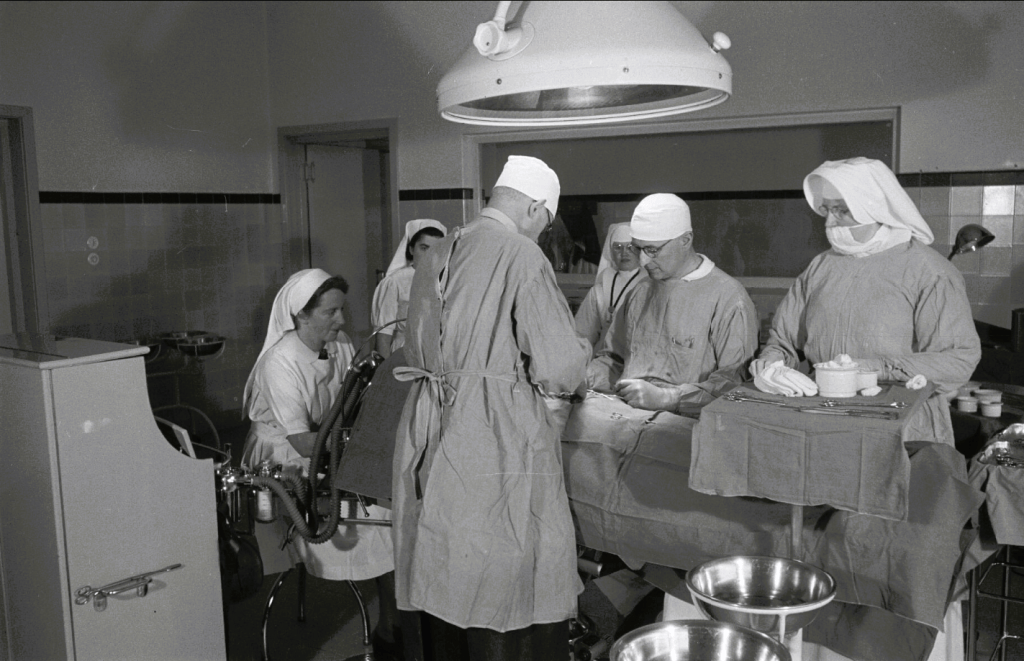
St. Antonius Hospital, located in Sneek, the Netherlands, played a significant role during World War II. Established as a healthcare institution, it became a crucial facility for both military and civilian medical care amid the war’s challenges. Nestled in the picturesque town of Sneek, St. Antonius Hospital bore witness to one of the most tumultuous periods in modern history. During World War II, this small yet vital institution became a cornerstone of resilience, adapting to the dire circumstances of a nation under occupation.
Chairman Mr. Casparie had instructed that Mother Superior should be warned with a code word if war broke out. Frits Larmené passed the code word to Mother Superior, and she immediately knew what needed to be done.
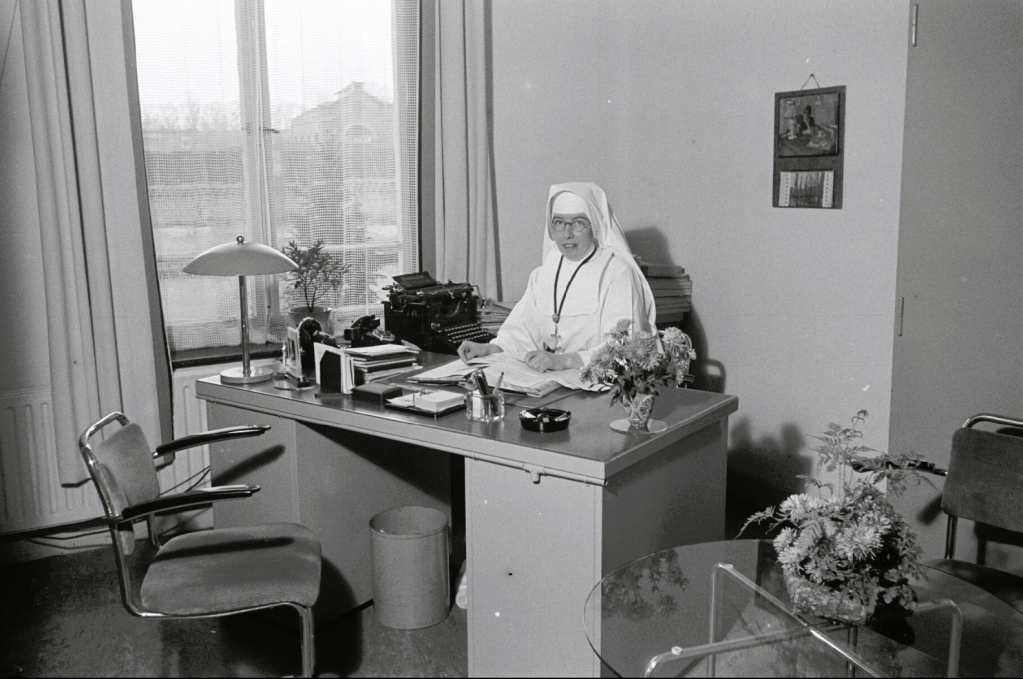
At the beginning of the war, a serious accident occurred involving a German truck on the Afsluitdijk, and the injured Germans were taken to the now-vacated infection ward on Sophiastraat. Sister Assunta was on duty alone in the pavilion that night, and at 4 a.m., a German soldier began making noise with transmission equipment. She promptly confiscated it and told everyone they had to sleep! Later, she received a fruit basket from the Germans as a thank-you for her good care.
A few months later, the Germans attempted to take over the pavilion, but the Sisters claimed it was infected with tuberculosis (T.B.C.). The Germans, terrified of infectious diseases, quickly sought accommodation elsewhere.
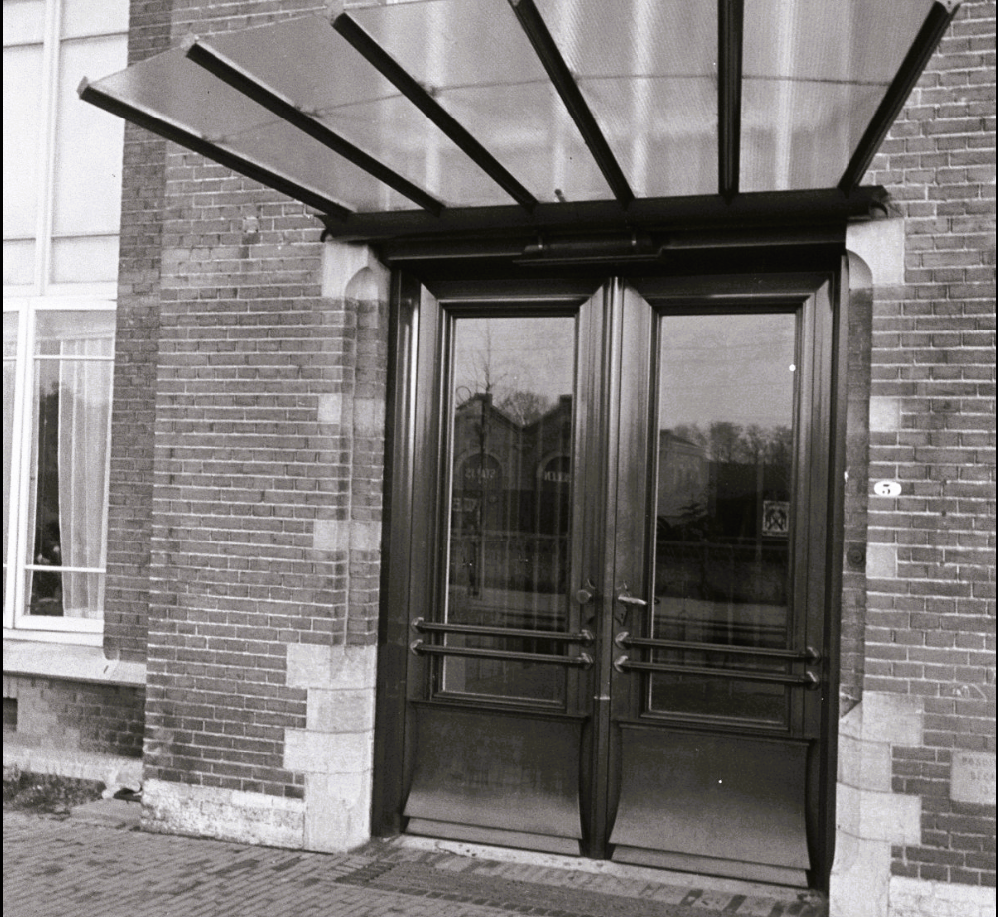
The hospital regularly hid people in hiding (onderduikers), usually in the upper corridor. Still, during house searches, they were all moved into one of the tunnels running under the boiler house, the so-called “copper tunnel.” Downed English pilots, who had facilitated food and weapon drops in the Southwest region, were also hidden there.
From 1943 until the liberation, two Jewish girls, Vera Kroon and Georgientje van Voolen, were taken in as “patients” in the children’s ward. A Jewish man, “Mr. de Bruyn,” was cared for in Room 52 under the care of Sister Ifigenia and also hidden in the children’s ward. Both the nuns, the nurses, the specialists, and the hospital director and his wife did everything they could to keep these individuals out of German hands, and they succeeded.
In December 1944, at the start of the Hunger Winter, director Disse received an urgent letter from the director of the Onze Lieve Vrouwen Gasthuis in Amsterdam, where 1,200 people were without food. In utmost secrecy, director Disse, assisted by board member Mr. Egbert de Jong (director of Douwe Egberts in Joure), ensured that the Lemmer ferry carried 60 tons (!) of potatoes, fat, flour, and legumes to Amsterdam.
Director Disse was later nominated by Georgientje’s mother for the Yad Vashem honor as “Righteous Among the Nations,” which he received in 1967.
General practitioners and specialists Dr. van der Meulen, Dr. Roberts, and Dr. Ubbink also resisted. They were required to report patients deemed “anti-German,” which they naturally refused to do. Some doctors paid for this by being imprisoned in Leeuwarden and later in Camp Amersfoort. After six weeks, they were released and returned to Sneek with shaved and tarred heads.
Specialists also used hospital beds to admit and protect “patients” such as resistance fighters and people in hiding.
The hospital had to be completely blacked out with black paper every evening, a task not always carried out meticulously, leading to noisy inspections by the Germans.
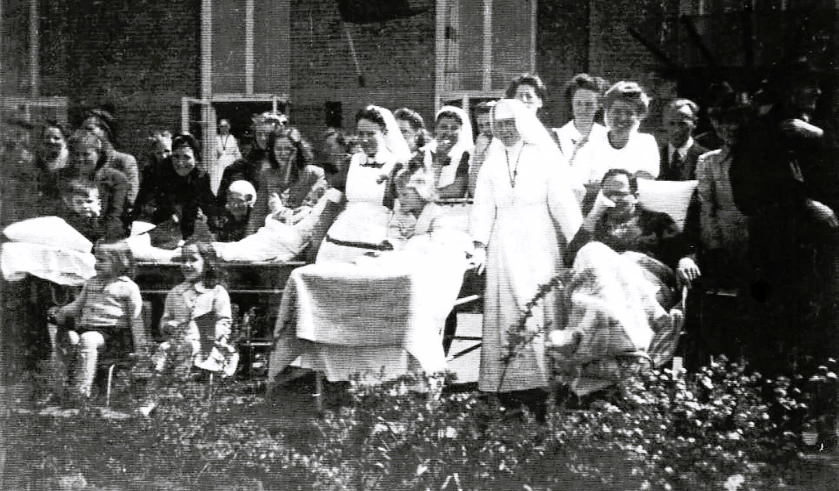
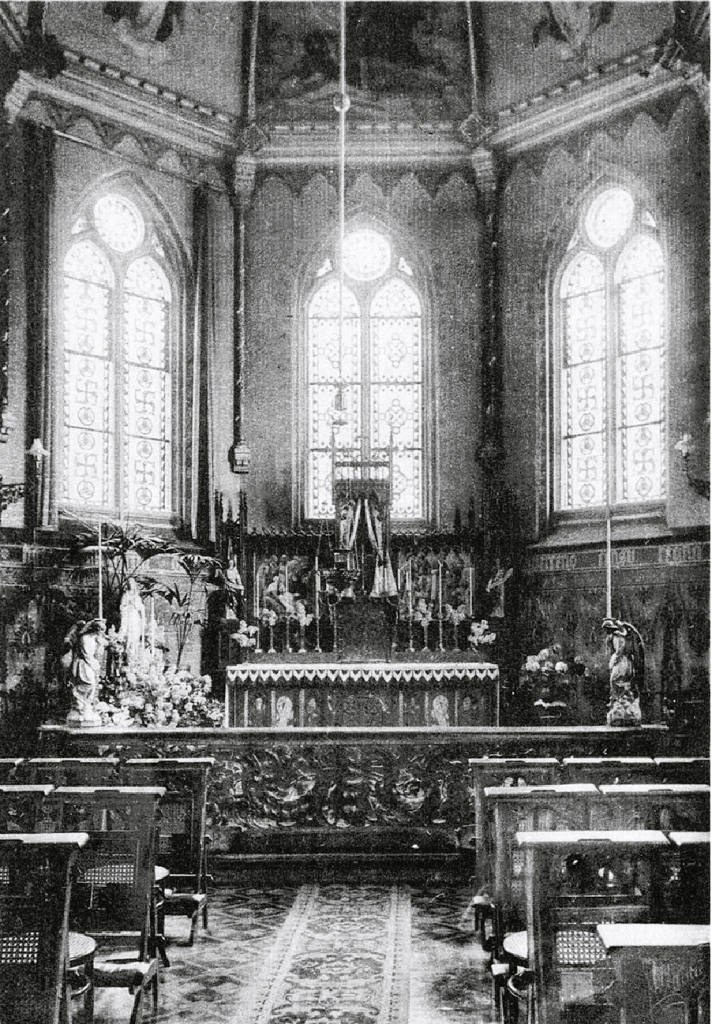
The Saint Antonius Hospital emerged materially unscathed from the war period. One of the most remarkable discoveries by the Historical Committee was that between 1936 and 1938, the stained-glass windows of the Chapel were replaced because the original windows were full of swastika symbols—the sacred symbols of Hinduism and Buddhism. Apparently, the hospital board or the Congregation found replacement necessary because Hitler had appropriated the symbol as a Nazi emblem.
From Yad Vashem
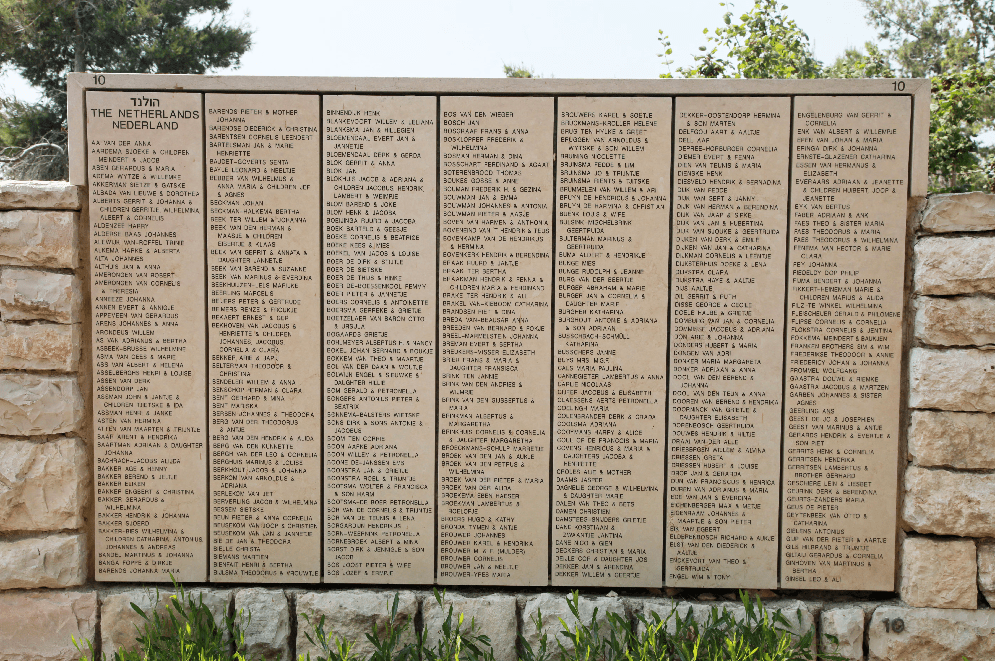
In September 1943, a four-year-old Jewish girl, Georgine Betty van Voolen, who was very ill, was brought to the St. Anthonius Catholic Hospital in the town of Sneek, Friesland. Along with her mother, Hetty van Voolen, her two sisters, and the two grandmothers, she had been arrested in a raid on May 26, 1943, and sent to Westerbork. Thanks to his connections, young Georgine’s father, who was hiding out in Amsterdam, managed to follow them eastward. The little girls became ill at the camp, and the younger daughter died. Philip Fiedeldij Dop*, a pediatrician from Amsterdam, who was brought in by the father to help, took Georgine and her mother out of the camp on a train returning from the camp to Amsterdam to get new victims. The parents went into hiding, and the kind pediatrician took the critically ill child to the Jewish CIZ hospital. When he learned that the patients were due to be evacuated at the end of the summer of 1943, Dop moved Georgine to St. Anthonius Catholic Hospital in Sneek, where she was placed under the personal supervision of Dr. Disse. She was still in critical condition, but thanks to the medical treatment of the hospital staff, Georgine slowly recovered. George Disse hid other Jews at the hospital among the patients and managed, at significant risk to his own life, to deceive the Germans when they carried out searches at the hospital. But he felt closest to the little girl and became a substitute father for her. Georgine recovered slowly and refused to let anyone else from the medical team feed her. Thus, over the 21 months that she spent in the hospital, George fed her every day. In June, after the liberation, she went back to her mother, who had spent time in different concentration camps. Her father had died shortly before the liberation. Georgine stayed in contact with George Disse and Cecile, whom he married. On April 29, 1976, Yad Vashem recognized George Franciscus Disse and his wife, Cecile Catharina Disse-Bosma, as Righteous Among the Nations.
Sources
https://collections.yadvashem.org/en/righteous/4022352
https://nl.wikipedia.org/wiki/Sint_Antonius_Ziekenhuis_(Sneek)
Donations
Your readership is what makes my site a success, and I am truly passionate about providing you with valuable content. I have been doing this at no cost and will continue to do so. Your voluntary donation of $2 or more, if you are able, would be a significant contribution to the continuation of my work. However, I fully understand if you’re not in a position to do so. Your support, in any form, is greatly appreciated. Thank you. To donate, click on the credit/debit card icon of the card you will use. If you want to donate more than $2, just add a higher number in the box left from the PayPal link. Your generosity is greatly appreciated. Many thanks.
$2.00

 History of Sorts
Leave a reply to tzipporahbatami Cancel reply