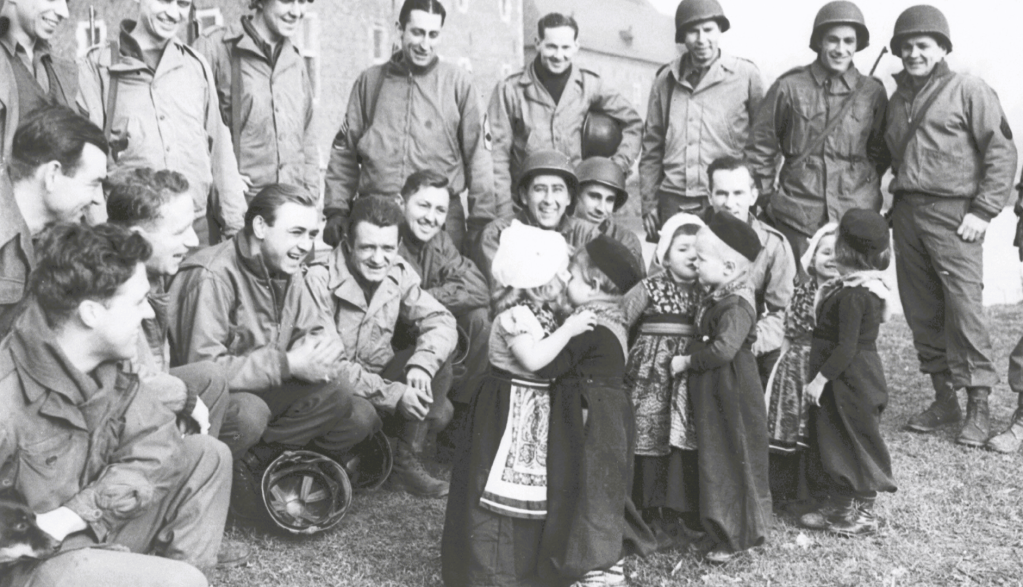
In the fall of 1944, South Limburg was liberated by American troops. Many young men subsequently volunteered for the Domestic Forces to contribute to the liberation of the Netherlands after years of occupation. Among them were veterans Cor van Wageningen (1918–2013) and Frits Faro (1921–2012). In the fall of 1944, they were assigned as guards for political prisoners who were interned at Hoensbroek Castle.
Hoensbroek Castle (in South Limburg) is one of the largest castles in the Netherlands, with a long and remarkable history. From December 1942 to 1946, the sisters of the “Congregation of the Poor Child Jesus” and state-ward children found refuge in the castle. The Congregation had been active in the coastal town of Velsen (North Holland) since 1908, operating several schools and a boarding house for approximately 160 state-ward children. In October 1942, the Germans informed the Congregation that the boarding house had to be vacated for the construction of defensive works in the dunes. Under the leadership of Mother Superior Francisca Cruce, the search for a new home began, culminating in the relocation to Hoensbroek Castle on December 23, 1942.
The children and sisters arrived at an ice-cold castle. Certainly not fairy-tale-like: it had just been fully restored but was far from suitable as a children’s home. The scullery was set up as an emergency bathhouse, the dance hall of the count’s family became the dining and living room for the sisters, and the Grand Salet was converted into a large dining hall. The children slept under strict supervision in dormitories on the first floor of the seventeenth-century wing. There was hardly any sanitation. Every day, potatoes were cooked in seven batches on two small stoves. The washing machine was only connected after two months.
In September 1944, there was a threat of German officers being stationed in the castle. The mayor issued a statement claiming that polio was rampant in the area, rendering the castle unsuitable for occupation. However, the Germans ignored this. Nearly every day, cars carrying German soldiers arrived, seeking accommodation. A group of young SS men who had fought in France and were on leave stayed at the castle’s farm for a few days. The sisters were displeased by their behavior: the SS men roamed the garden naked, swam in the moat, and threw hand grenades into the water to catch fish.

Internment of Political Prisoners
Around the time of Hoensbroek’s liberation on September 18, 1944, about fifty residents of Hoensbroek sought shelter in the castle’s cellars. They returned home once the liberation was secured. That same day, the first National Socialist Movement (NSB) members and other Dutch citizens accused of collaboration, arrested by the Domestic Forces, were imprisoned in the castle’s stables and cellars. The detainees came from all over South Limburg, with new arrests being made as more parts of the region were liberated. Arrests of suspected collaborators were not always conducted by the book. Looting of homes and theft of personal belongings from NSB members and other “suspects” were not uncommon. Detainees were sometimes publicly subjected to mental and physical abuse. Additionally, large-scale public head shavings of women accused of collaboration occurred.
Cor van Wageningen, a Rotterdam native who worked in the South Limburg mines during the occupation, joined the Domestic Forces on September 18, 1944. He had prior military experience, having completed his mandatory service in 1937–1938 and spending the mobilization period in South Limburg. Immediately after enlisting, he was deployed to Hoensbroek Castle. “We thought we would be involved in liberating the rest of the Netherlands, but we had other duties. I had to guard prisoners at Hoensbroek Castle. They were all NSB members, and I found the conditions very distressing. Yes, the prisoners were treated inhumanely.”
Van Wageningen described the harsh conditions at Hoensbroek Castle:
“First of all, they were kept in the stables on a bit of straw, without proper washing facilities, and crammed together with hundreds of people, no ventilation. The stench was overwhelming the first time you entered. They barely got anything to eat, and among them were many innocent people. That became evident later!”
Van Wageningen quickly realized that some of the detainees were innocent. “At first, they all claimed they were innocent, of course. But I had a long conversation with one detainee, a teacher from Geleen. He’d been arrested by the Marechaussee because an officer had a romantic interest in the teacher’s girlfriend. That officer accused him of being an NSB member. That teacher was later acquitted, and I spoke to him again afterward. The whole town supported his release!”
At one point, more than 450 NSB members and about 50 Reich Germans with “minor offenses in the mines” were detained in the castle. This caused significant inconvenience to the sisters and children living there. On the other hand, the detainees were used for labor, such as cleaning the castle moat and harvesting potatoes. They also worked in nearby mines, walking daily under guard to the Emma State Mine in Hoensbroek.
Like Van Wageningen, Amsterdam-born Frits Faro had taken up work in the mines to avoid forced labor in Germany. Faro was active in the resistance both in Amsterdam and South Limburg. When the Americans approached Hoensbroek, he was one of three chiefs at the Emma mine’s command post, responsible for sounding alarms during air raids. After the liberation, Faro was also involved in guarding political prisoners at Hoensbroek Castle.
“I worked with a group of NSB members digging up potatoes in a field. Potatoes were scarce in Limburg at the time, so the NSB members imprisoned at Hoensbroek Castle were assigned to this task.”
Shortly after the liberation, the mines resumed operation. Faro returned to the air raid protection service at the Emma mine, although he said there wasn’t much to do since the Germans had almost no air force left. Later, Faro joined the Corps of Interpreters, where he served for a long time.
Van Wageningen was surprised to recognize some of the detainees. “To my astonishment, a carpenter and an old colleague I had worked with in my youth were among the prisoners. I knew he was an NSB member. That colleague had mentioned their boss was also a party member. The carpenter told me he joined the NSB in 1933 because the country was in such poor shape at the time. He thought it would bring improvement, but he hated the Germans as much as I did.”
Van Wageningen secretly brought food for his two acquaintances. “After a 24-hour shift at the castle, I’d get 24 hours off. Their wives would give me stacks of bread to smuggle to my old bosses.”
After a while, Van Wageningen was reassigned to guard duties with the Americans, including protecting a fuel depot by the Meuse River near Maastricht.
Post-Liberation Life
After the liberation, American soldiers frequently visited the sisters and children at the castle, ostensibly to admire it but really to play with the children. They were especially fond of the children. The sisters organized entertainment evenings for the Americans, teaching the children dances and English songs. The repertoire included “My Old Kentucky Home,” which brought a general from Kentucky to tears. During Christmas, when the children sang “Silent Night” in English, even hardened soldiers became emotional.

The sisters knitted baby slippers and painted wooden clogs with windmill motifs for the Americans. Inspired by their love for the clogs, the sisters dressed the children in traditional Volendam costumes and had them perform. The following day, the Americans returned, asking to take photos with the “Volendam children,” and these photos spread worldwide. Eventually, maintaining permanent housing in the castle became too expensive, and the children moved to other locations, including Simpelveld. The last children and sisters left the castle on June 2, 1946.
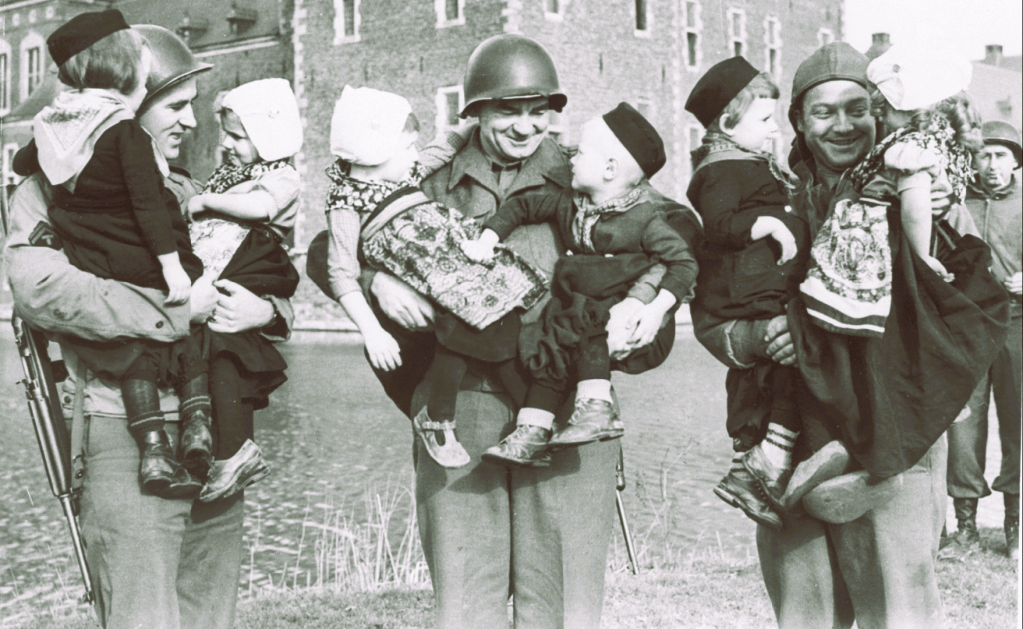
The American soldiers, the liberators, became great friends with the young castle residents. They were given guided tours of the castle in groups and cozy evenings were organized, featuring music, singing, and folk dances interspersed with short performances that sparked laughter. The toddlers dressed in Volendam costumes especially captured the audience’s attention
Sources
https://ww2insouthlimburg.nl/gemeente/hoensbroek
https://www.oorlogsbronnen.nl/thema/Kasteel%20Hoensbroek
Donations
Your readership is what makes my site a success, and I am truly passionate about providing you with valuable content. I have been doing this at no cost and will continue to do so. Your voluntary donation of $2 or more, if you are able, would be a significant contribution to the continuation of my work. However, I fully understand if you’re not in a position to do so. Your support, in any form, is greatly appreciated. Thank you. To donate, click on the credit/debit card icon of the card you will use. If you want to donate more than $2, just add a higher number in the box left from the PayPal link. Your generosity is greatly appreciated. Many thanks.
$2.00

 History of Sorts
Leave a comment