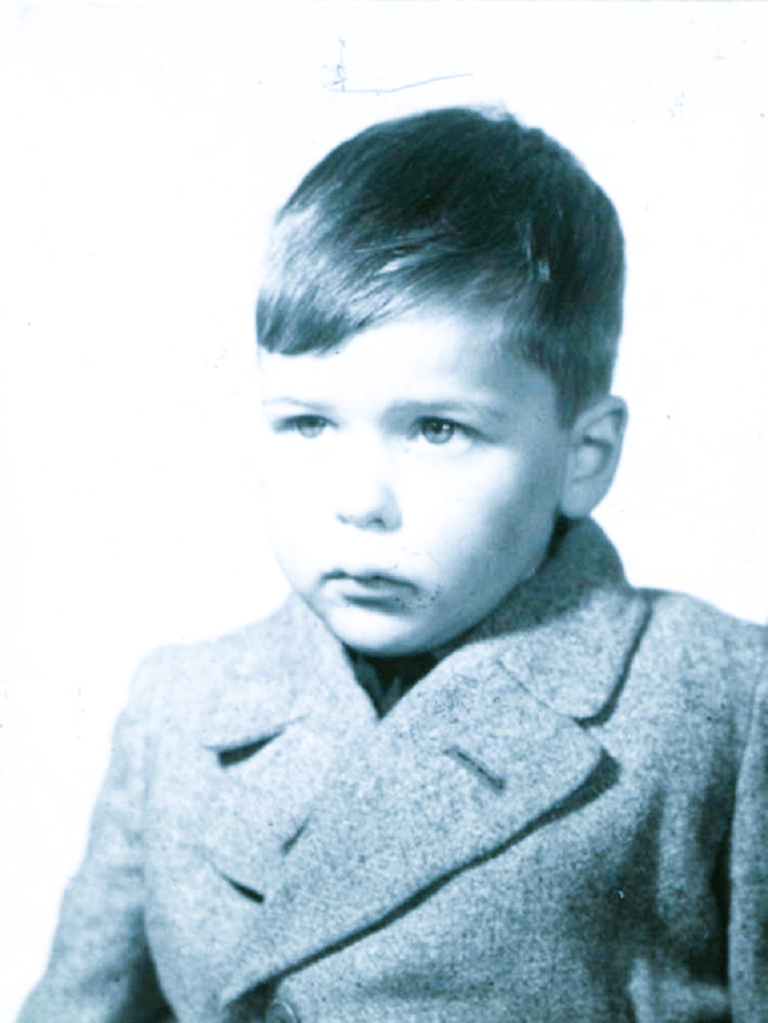
Johan Hartog
(December 26, 1939 – December 31, 1944)
A winter dawn in Eindhoven’s sky,
A child was born with a gentle cry.
Johan Hartog, a soul so new,
Unknowing of the path he’d rue.
A boy whose laughter lit the air,
Innocence woven in threads—so rare.
Small hands reached for toys, for dreams,
Eyes alight with childhood gleams.
But the world grew dark with shadows’ might,
Eclipsing love, eclipsing light.
A war machine, cold, cruel, and vast,
Tore, through his days, made peace with the past.
They stole his home, his sacred ground,
Shackled his freedom, bound and wound.
To Auschwitz, the place of human despair,
They sent him, a child too young to bear.
On the cusp of a year, as frost adorned,
The world turned colder, a life was mourned.
In Auschwitz, the heavens must have wept,
For Johan, as through dark gates, he stepped.
Yet, in the stars, his name will stay,
A beacon to light a better way.
A reminder of all we must defend—
The love, the laughter, the life of a friend.
Johan Hartog, though time moves on,
Your light remains, though you are gone.
A whisper of hope in a winter’s night,
A call—to cherish what’s good, what’s right.

Bernard (Ben) Hartog was born on September 23, 1903, in Eindhoven. He was the youngest of six children of Jonas Hartog and Clara Wertheim. His father owned a grocery store, De Kleine Winst, on Vrijstraat. In 1920, Ben was in the third year of the Municipal HBS together with Frits Philips. He married Esther (Eddie) van Bueren. Their son, Johan, was born on December 26, 1939, in Eindhoven. Bernard Hartog worked as an assistant at Philips. He had great confidence that the company would protect its Jewish employees from German persecution.
From their home on Boerhavelaan, the family was ordered by the authorities to move to Paradijslaan 38. Bernard Hartog was part of the Philips-Kommando and, together with his wife Esther and their son Johan, was interned in Kamp Vught. On June 3, 1944, they were deported to the East. Nine months later, on March 28, 1945, Bernard was murdered during a death march somewhere in Central Europe. Johan Hartog was also deported to Auschwitz on June 3, 1944. There, he was murdered on December 31, 1944, five days after his fifth birthday.
Esther Hartog-van Bueren survived the war. She was liberated from the Auschwitz concentration camp, but her health was poor. She passed away within a week of her repatriation, on June 15, 1945, in the Binnen Hospital in Eindhoven.
Sources
https://www.joodsmonument.nl/nl/page/138524/johan-hartog
https://www.oorlogsbronnen.nl/tijdlijn/Johan-Hartog/02/59464
https://www.tracesofwar.com/sights/27105/Stumbling-Stones-Boerhaavelaan-50.htm
Donations
Your readership is what makes my site a success, and I am truly passionate about providing you with valuable content. I have been doing this at no cost and will continue to do so. Your voluntary donation of $2 or more, if you are able, would be a significant contribution to the continuation of my work. However, I fully understand if you’re not in a position to do so. Your support, in any form, is greatly appreciated. Thank you. To donate, click on the credit/debit card icon of the card you will use. If you want to donate more than $2, just add a higher number in the box left from the PayPal link. Your generosity is greatly appreciated. Many thanks.
$2.00
 History of Sorts
Leave a comment