
Among the ranks of the SS were many evil men, some of whom seemed to take particular pleasure in their cruel deeds.
Otto Moll, a notorious SS officer, was arrested by the Nazis on April 29, 1945, following the liberation of Dachau by the US Army. Before his tenure at Dachau, Moll held various positions at Auschwitz and Auschwitz-Birkenau, where he oversaw the crematoria. His role in these camps marked him as one of the most brutal figures of the Holocaust.
Rather than elaborate on Moll’s actions myself, I will share the words of two survivors, the Auschwitz Commandant Rudolf Höss and Moll himself. There is a widespread belief that Moll personally killed thousands of victims.
Before reading their testimonies, observe the photograph below. It captures Moll in the front row, surrounded by fellow SS officers. The image starkly contrasts the officers’ seemingly carefree demeanor with the horrific acts they perpetrated. In the photograph, the front row includes Karl Höcker, Otto Moll, Rudolf Höss, Richard Baer, Josef Kramer (partially obscured behind Franz Hössler), Josef Mengele, Anton Thumann, and Walter Schmidetzki. Hermann Buch is central to the group, while Konrad Wiegand, head of the vehicle pool, stands in the middle.
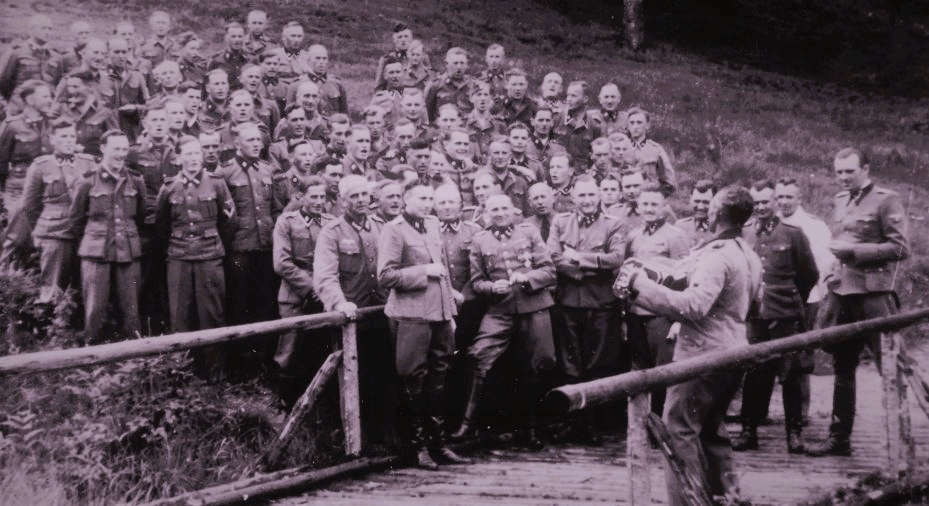
Testimonies of Sonderkommando Members on the Atrocities at Birkenau
The following are testimonies from Alter Feinsilber and Henryk Tauber, both members of the Sonderkommando at Birkenau, recounting the horrific acts committed by SS Quartermaster Sergeant Otto Moll.
Alter Feinsilber’s Testimony
“It happened that some prisoners offered resistance when about to be shot at the pit, or that children would cry, and then SS Quartermaster Sergeant Moll would throw them alive into the flames of the pit.”
This chilling account underscores the unimaginable cruelty Moll inflicted upon prisoners, especially vulnerable groups like children.
Henryk Tauber’s Testimony
“Hauptscharführer Moll was the most degenerate of them all. Before his arrival at the camp, he oversaw operations at the Bunkers, where victims of gassing were incinerated in pits. After a temporary transfer to another section, he returned in 1944 to prepare for the mass extermination of Hungarian Jews.
Under Moll’s direction, pits were dug near Crematorium V, and Bunker 2, which had been inactive, was reactivated along with its pits. Deceptive measures were employed to calm new arrivals from the transports. Notices posted in the crematoria yards falsely assured them they were being taken to the camp for work after undergoing a bath and disinfestation. Moll personally delivered these reassurances in speeches, masking the grim reality awaiting the victims.
The sheer scale of the exterminations sometimes overwhelmed the gas chambers, and in these cases, the excess victims were shot individually, often by Moll himself. On several occasions, he was seen throwing people, including children, into the flaming pits alive. He also took pleasure in shooting victims from a distance, treating the act as a twisted form of sport.
Moll’s cruelty extended to the Sonderkommando prisoners under his charge. He frequently beat and mistreated them, regarding them as less than human. Survivors recounted that he pilfered valuables from the belongings of gassed victims, fishing out gold items from the confiscated goods with a piece of wire and storing them in a briefcase. He also took furs and food, particularly fat, justifying these thefts with a smile, saying that one had to prepare for lean years ahead.
During the extermination of Hungarian Jews, the Sonderkommando was expanded to approximately 1,000 prisoners under Moll’s brutal regime. His direct oversight and personal participation in the atrocities made him one of the most notorious figures at Birkenau.”
Extract from the Interrogation of Otto Moll
Conducted by Lieut.-Colonel Smith W. Brookhart on April 16, in Nuremberg
Lieut.-Colonel Brookhart (Q): You are the same Otto Moll who appeared here this morning, and you understand that your statements here are made under oath?
Otto Moll (A): Yes. May I make a request, please?
Q: Yes.
A: In Landsberg, I made a request to be confronted with Rudolf Hoess, the commandant of the Auschwitz Camp, so that I may testify in front of him, and he may testify in front of me. I request you now to grant this. I would like Hoess to testify in my presence so I can confirm or deny his statements.
Q: Assuming you are confronted by Hoess, are you going to tell the truth, or will you continue with the same story you gave this morning?
A: No. I want Hoess to come here and state exactly what orders he gave me. I can then affirm or refute what he says.
Q: We will conduct the interrogation on our terms and focus on the subjects of our interest. You are to listen carefully, not interrupt, and remain silent until you are requested to speak. Do you understand?
A: I will remain silent and listen to him.
Q: You will have the opportunity to speak at the appropriate time.
A: Please approve this request to have Hoess repeat his testimony against me. It pains me to see that he, the commandant, is free while I am shackled to a guard.
Q: We are not concerned with your feelings on this matter.
(Rudolf Hoess, Commandant of Auschwitz, enters the room.)
Q: Are you the same Rudolf Hoess who has testified here on numerous occasions?
Rudolf Hoess (A): Yes.
Q: Do you understand that the statements you make here are under oath?
A: Yes.
Q: Do you recognize the person to your right, shackled to the guard?
A: Yes.
Q: What is his name?
A: Otto Moll.
Q: Where did you know him?
A: Initially at Sachsenhausen, and later at Auschwitz.
Q: What roles did Otto Moll serve at Sachsenhausen and Auschwitz?
A: At Sachsenhausen, he worked as a gardener. At Auschwitz, he was assigned as a leader of a work detail and later as a supervisor during various actions.
Q: By “actions,” do you mean executions and the subsequent cremations?
A: Yes.
Q: This morning, you described Moll’s first assignment in 1941, when farm buildings were converted into an extermination plant. Can you restate what you said?
A: Initially, he worked on the farm. Later, I reassigned him to the farmhouse, which was converted into a professional extermination plant.

Interrogation Questions Directed to Otto Moll and Rudolf Hoess
Lieut.-Colonel Brookhart (Q to Otto Moll): Otto Moll, is what the witness has just said true?
Otto Moll (A): Initially, I was assigned to work related to the excavation of mass graves. Hoess must know that. He is mistaken if he claims I worked in the buildings where the gassings were carried out. At first, I was involved in excavation work, and he should remember that. Hoess, do you recall Swosten, Blank, Omen, Hatford, and Garduck [sic]? Those were the individuals working in the buildings when I was working on excavations. Surely, Hoess remembers this.
Q to Rudolf Hoess: Is that correct?
Rudolf Hoess (A): Moll is correct in saying he was initially assigned to excavation work – that was before he became involved in the executions.
Q to Otto Moll: What is being asserted here, as I mentioned this morning, is that you were responsible for the operation involving the killing and destruction of the bodies in the first improvised slaughterhouse.
Otto Moll (A): My responsibility was to ensure that the corpses were burned after the people were killed. I was never in charge of supervising the killings themselves. That was always handled by the officers or medical personnel present at the time. Hoess, as my commandant, can confirm this.
Q to Rudolf Hoess: What do you say about this?
Rudolf Hoess (A): As I stated this morning, Moll is partly correct. The gas was introduced into the chamber by medical personnel, and Moll was not responsible for overseeing the entire process from the arrival of the transports to the burning of the corpses. Initially, he was responsible for only part of this process.
Q: You did state that Moll was responsible for ensuring the extermination of these people.
A: Perhaps I was misunderstood. What I meant was that Moll was responsible for the operations within the buildings where he worked. Initially, his duties included ensuring that people undressed in an orderly fashion and, after they were killed, overseeing the disposal of the bodies. Later, when the large extermination facility was completed, he was responsible for the entire plant.
Q: Can you clarify which operations in the plant Moll was responsible for?
A: He was responsible for everything up to and including leading people into the gas chambers. After the gassings, he oversaw the removal of bodies and their cremation.
Q: Will you repeat your statement about Moll shooting people through the neck?
A: As I explained this morning, individuals who were too weak to move to the gas chambers or could not be transported for other reasons were shot through the neck, either by Moll or by others using small-caliber firearms.
Q to Otto Moll: What do you say about this?
Otto Moll (A): It’s possible that I shot some individuals, but the number was relatively small. I would like to know if Hoess ever personally witnessed me doing this.
Q: I told you this morning that Hoess stated he saw you do it many times, as did others.
Questions Directed to Rudolf Hoess
Q: Hoess, isn’t that right?
A: Yes, it is true. I mentioned this morning that comparatively few were killed in that manner.
Q: You could not tell if it was a few dozen or a few hundred. That was your problem.
A: I cannot provide an exact number—that is impossible after so many years. There were many. Sometimes a few from each incoming transport, and other times none. That is why I cannot give you an exact figure.
Questions Directed to Otto Moll
Q: This is the first thing you have admitted. Now you are telling the truth about something you denied this morning. Are you ready to tell us the truth regarding your responsibilities in other operations?
A: Yes, I will tell you the truth, provided my Commandant is present. Let my Commandant explain my duties and what I did.
Q: We already know what Hoess said. What we want is your account. You requested the opportunity to tell your story, which is why we brought Hoess here.
A: No, I specifically asked to be interrogated in Hoess’s presence.
Question Addressed to Rudolf Hoess

Q: You told us this morning that Moll was considered the best man for exterminations because he handled the teams of prisoners and guards better than your other subordinates. Is that correct?
A: Yes.
Question Addressed to Otto Moll
Q: Moll, explain your method for selecting foremen from the Capos and what you found to be the best method of managing the guards in charge of the incoming transports.
A: When I was ordered to perform this work, the work details had already been selected by my superiors. My Oberführers had chosen the Capos or foremen—whatever you call them.
I carried out my duties in all kinds of weather and never shirked my responsibilities. I was never drunk on duty or when interacting with prisoners, and I never mistreated them. I achieved good results with the prisoners because I worked alongside them, helping with their tasks myself.
The prisoners respected me because I always conducted myself as an exemplary soldier. Due to this, I was often assigned to difficult tasks. May I ask Hoess to confirm this?
Question Addressed to Rudolf Hoess
Q: Is that correct?
A: Yes, that is what I stated this morning.
Questions addressed to Otto Moll:
Q: You were decorated for your work, weren’t you?
A: Yes, I received a decoration for my service. Almost all those who served for several years across Germany received such decorations. However, I did not receive any decoration for specific work like the tasks I performed at Auschwitz. I would not have wanted a decoration for that kind of work.
Q: Why not?
A: Because I did not consider that work to be honorable.
Q: Did you ever protest?
A: I asked many times why these actions had to be carried out, and why they couldn’t be stopped. I even asked Hoess, and he replied that he did not like it either, but he had strict orders, and nothing could be done about it. He, like all of us, suffered because of this work, and none of us were really sane anymore.
Questions addressed to Rudolf Hoess:
Q: Is that true, Hoess?
A: Yes, others have said the same, and this was testified to in the Reich.
Q: When do you think you lost your sanity, Hoess?
A: I believe you’re referring to when our nerves began to crack. I can confirm that I was not mentally healthy in 1942. I mentioned my leave in 1943. However, I had to carry out these duties because no one else was available to do them. There were strict orders to follow. Many others shared my feelings, and subordinates like Moll came to me expressing similar concerns.
Q: Do you think Moll is crazy?
A: No.
Questions addressed to Otto Moll:
Q: How long do you think you’ve been without your sanity?
A: I did not mean to imply that I was insane. What I meant is that my nerves cracked, and they did so repeatedly. They were particularly bad after I contracted typhus and was hospitalized. The doctors granted me a leave of absence for my nerves. I was never declared unfit for duty due to poor mental health or the so-called paragraph 51.
Q: How many victims do you estimate were involved in the operation you were responsible for?
A: I want to clarify that I do not wish to take responsibility for the actual killings. I was not responsible for the physical ending of their lives, and I won’t admit that.
Q: You didn’t pull the trigger, but you caused someone else to do it. Is that your position?
A: I don’t understand the question.
Q: How many victims were exterminated in the camp from 1941 onward?
A: I don’t know the number. I don’t think I would be able to provide an accurate figure. I believe Hoess may know that.
Q: The only thing we are interested in is what you personally know.
A: When I was in charge of the excavations, as I mentioned earlier, alongside another colleague, which Hoess confirmed today, we buried between 30,000 and 40,000 people in mass graves. It was the most horrific work imaginable.
Q: Stick to the numbers.
A: I don’t know who those people were or how they ended up there. I only excavated the graves and was responsible for burning the bodies.
Questions addressed to Rudolf Hoess:
Q: How does that figure strike you, Hoess?
A: It is impossible for Moll to know the exact figures. However, the number he provided seems much too low. The bodies in the two large mass graves, what we referred to as dugouts one and two, numbered around 106,000 or 107,000.
Questions addressed to Otto Moll:
Q: How many bodies do you estimate you handled?
A: Later, the bodies passed through my crematory plant, and I would estimate between 40,000 and 50,000. That’s the number for the crematory where I was responsible. I was not in charge of the two larger crematories, which were managed by SS officers Nussfeld and Foss. Hoess will remember that.
Q: Is that for the entire duration of your service, from 1941 to the end?
A: Yes, that’s correct.
Q: Don’t you think you’re being modest? You were known as the biggest killer in Auschwitz. The figures there run into the millions. Won’t you change your answer?
A: That is not true. I was not the greatest killer in Auschwitz.
Q: You were the greatest cremator.
A: That’s not true either. The numbers are likely exaggerated by those who want me punished with death.
Questions addressed to Rudolf Hoess:
Q: What do you think would be the correct figures, Hoess?
A: Moll cannot possibly know the number of killings related to his work, and his figures are far too low. The extermination plant’s usage varied over time, so I can’t say how many corpses were handled by Moll or others like Nussfeld.
Questions addressed to Otto Moll:
Q: How many women and children were among the bodies you handled?
A: The number of men and women was about equal. The ratio of children was roughly one in every hundred people. Sometimes transports arrived without children. I wasn’t constantly present with these transports, so I can’t speak for what happened during my absence.
Q: We’ve heard there were more children than that. Would you like to change your statement?
A: As I said, the ratio may have been one child in every hundred, or possibly more. I don’t remember the exact numbers.
Questions addressed to Rudolf Hoess:
Q: What’s your estimate, Hoess?
A: I would estimate that one-third of the victims were men, and two-thirds were women and children. The proportion of children was especially high in transports from Ukraine and Hungary.
Q: When was this?
A: This was particularly in 1943, and possibly early 1944.
Questions addressed to Otto Moll:
Q: Yesterday, you mentioned two installations with twelve large ovens and two additional units, each with two ovens, totaling twenty-eight furnaces. How many bodies could you cremate at one time?
A: Two or three bodies could be cremated in a furnace at one time, as the furnaces were designed to accommodate that.
Q: Did you operate at full capacity often?
A: I want to clarify that I was not responsible for the cremation in the furnaces. My responsibility was for burning the bodies outside. Nussfeld and Foss were responsible for the cremation inside the furnaces.
Questions addressed to Rudolf Hoess:
Q: Is that correct, Hoess?
A: Moll is slightly mistaken about the furnace details. The two large units had five double furnaces each, while the others had four double furnaces each. It is true that Nussfeld and Foss managed the furnaces, while Moll was responsible for bodies burned outside. Later, in 1944, I put Moll in charge of the entire cremation process.
Q: Was that after you returned to Auschwitz?
A: Yes, that was after my return.
Questions addressed to Otto Moll:
Q: Was your work detail ever exterminated?
A: No, the work detail I was with was never exterminated while I was there. The last detail I worked with was still alive when I left. Later, there was a mutiny, and I was not there when it was suppressed. Hoess can tell you more about that.
Q: Did you ever cremate any of your crematorium detail?
A: No.
Questions addressed to Rudolf Hoess:
Q: What can you say about Moll’s responsibility?
A: Moll’s role was to ensure that people got into the gas chambers. He was not responsible for every detail but worked as part of the team to execute the orders.
Q: Who was responsible for identifying and disposing of children?
A: It was the officer in charge of the transport who ensured all were unloaded. The doctors oversaw the killing, and the subordinates, like Moll, ensured the bodies were burned. If children were found, they were also disposed of in the gas chamber, following orders.
Questions addressed to Otto Moll:
Q: Was this part of the “hand” you lent your team?
A: I did not have anything to do with the searching of clothes or picking up babies. The officers in charge ensured that all individuals, including children, were processed properly according to the orders.
Q: Did any of your men handle this task?
A: Yes, the prisoners were responsible for handling the bodies and cleaning up the rooms after they were cleared. No SS men were allowed to handle this “property.”
Q: Did you ever have a special operation for babies? Were they thrown into the gas chambers with others?
A: This happened rarely, but if babies were found, they were disposed of like everyone else. They were thrown into the gas chamber.”
Otto Moll was executed on May 28, 1946. Thankfully justice was served.
Sources::
http://www.scrapbookpages.com/Poland/Birkenau/Birkenau03.html
https://collections.ushmm.org/search/catalog/pa1163609
https://forum.axishistory.com/viewtopic.php?t=64198
https://collections.ushmm.org/search/catalog/pa1167624
https://en.wikipedia.org/wiki/Otto_Moll#Brutality
Donations
Your readership is what makes my site a success, and I am truly passionate about providing you with valuable content. I have been doing this at no cost and will continue to do so. Your voluntary donation of $2 or more, if you are able, would be a significant contribution to the continuation of my work. However, I fully understand if you’re not in a position to do so. Your support, in any form, is greatly appreciated. Thank you. To donate, click on the credit/debit card icon of the card you will use. If you want to donate more than $2, just add a higher number in the box left from the PayPal link. Your generosity is greatly appreciated. Many thanks.
$2.00

 History of Sorts
Leave a comment