
Jewish Soldiers in the Dutch Military During World War II
When discussing Jewish war victims, fallen soldiers may not be the first to come to mind. However, hundreds of Jewish men attempted to resist the advancing Nazi regime with weapons in hand. Several dozen of them perished during the German invasion in May 1940.
The Netherlands Institute of Military History (NIMH) in The Hague maintains a database containing the names of fallen soldiers and the circumstances of their deaths. This database also records their religious affiliation. It has been established that 35 of these soldiers were Jewish. By examining the fates of these Jewish soldiers, we gain a poignant insight into the events of the early days of the war.
According to official accounts, the German offensive began on the morning of May 10, 1940, at 3:55 AM. Soldier Hartog de Rood (Amsterdam, February 10, 1919) was one of the first Dutch casualties. He was part of a border guard detachment near Zevenaar. After a brief skirmish, he was killed at 4:00 AM.
Around the same time, German bombers entered Dutch airspace. At the Alexander Barracks in The Hague, soldiers were still asleep when bombs struck. Due to mobilization, the barracks were overcrowded, with reserve troops housed in the lofts above the horse stables. These stables were hit directly. Among the dead was cavalryman Hartog van Baaren (Amsterdam, June 3, 1904). Other military targets were also attacked, such as the artillery battery in Park Leeuwenberg in Voorburg, where Salomon Bartels (Amsterdam, January 31, 1918) was fatally wounded.

Several airfields were disabled from the air. At Waalhaven Airfield near Rotterdam, this cost the lives of soldier Salomon van Praagh (The Hague, January 20, 1918) and Corporal Max Sluis (The Hague, October 21, 1917). At Valkenburg Airfield (South Holland), Henri de Rood (Haarlem, December 7, 1916) lost his life. Jozeph de Haan (Breda, February 22, 1914) and Jacques Fresco (The Hague, August 10, 1913) were at Ockenburg Military Airfield near Loosduinen when German paratroopers were dropped. Their battle, in which both perished, is documented in the Royal Decree awarding Jacques Fresco a posthumous decoration.
Around 5:00 AM, paratroopers also landed near Rotterdam. Around 8,000 Dutch troops managed to prevent the city from being captured. John Moerel (Breda, June 18, 1919) was positioned on the Boompjes, where heavy fighting took place. He was killed in action. Nearby, Raphaël Awerbach (The Hague, June 20, 1918) died while trying to defend the strategically important “White House” building.
Throughout the day, battles raged on multiple fronts. Corporal Hartog Bamberg (Hoek van Holland, May 31, 1919) fell in combat on the Hoge Morschweg in Oegstgeest, while soldier Moise Louis Sanders (St. Jans Molenbeek, March 3, 1916) was killed “after brave action” near Delft. Mozes de Jong (Dordrecht, October 2, 1909) was stationed at the Willemsdorp Covering Detachment, defending the bridge over the Hollands Diep. After fighting near the police station, he succumbed to his injuries in Dubbeldam.

Moise Louis Sanders was married to Betje Blik.During the Dutch mobilization, Moise Louis Sanders served as a soldier in the 3rd Battalion, III Regiment Grenadiers (3-III-R.GR.) of the Dutch army. He was killed in action on May 10, 1940, in Delft “after brave conduct.” His remains were buried at the Jewish cemetery in Wassenaar. His wife Betje was murdered in Sobibor on June 27,1943
Reserve Captain Max Willem Boasson (Middelburg, January 24, 1896) was a “Landing Signal Officer” dispatched to establish contact with Belgian troops. Near Lommel, Belgium, he encountered German forces. He jumped off a bridge but did not survive the fall.
In the following days, intense battles took place across different fronts of the Holland Fortress. On May 11, First Lieutenant Salomon Cauveren (Haarlem, January 1, 1899) was killed in a military vanguard near Dordrecht, while Levie van Esso (Amsterdam, June 3, 1917) died fighting in Wateringen, in the Westland region.
Dr. Ephraïm Behr (Assen, March 5, 1905) was a reserve medical officer at the front. He had volunteered for service. Eyewitnesses reported that he was killed on May 12 while “bravely and compassionately attempting to evacuate wounded soldiers from the Grebbe Line to a safer location.”
The Grebbeberg near Rhenen was a crucial stronghold in the defensive lines. On May 13, German troops had captured several outposts and were pushing further into the Dutch positions.
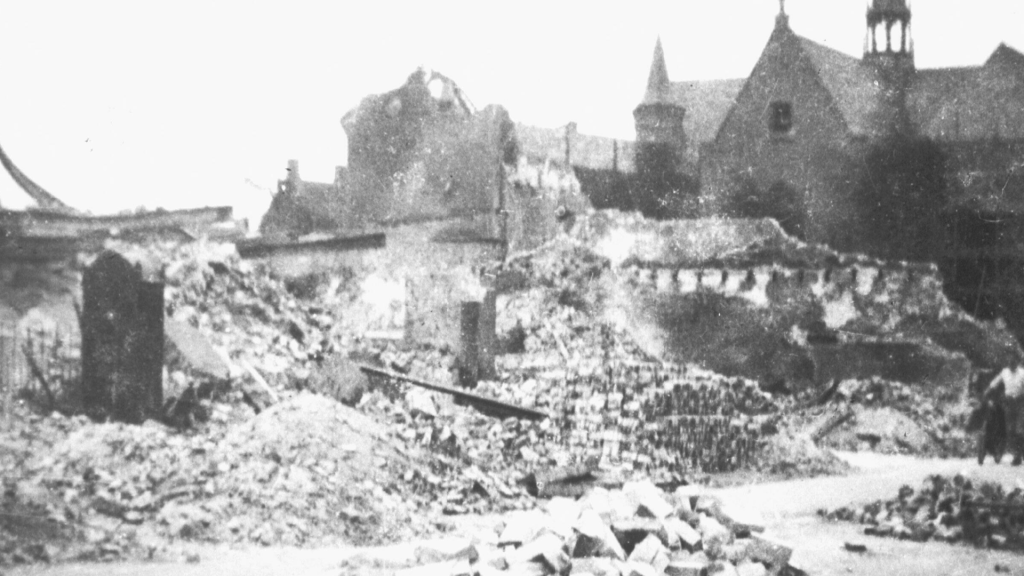
Several Jewish soldiers died in the fighting: Isaac Meijer Levie (The Hague, July 19, 1909), Simon Polak (Hoogeveen, June 3, 1912), and Corporal Salomon Löwenstein (Didam, July 22, 1918). Reserve First Lieutenant Dr. Ir. Paul Jacobus Denekamp (Delft, June 3, 1907) was traveling in a car when he was hit by enemy fire on the highway near Delft.
The end of the battle was effectively sealed with the bombing of Rotterdam at 1:30 PM on May 14. The Nazi military victory was unbearable for many. At least twelve Jewish soldiers took their own lives. Among them were two pharmacists and a doctor, who all had access to the medications they used to end their lives. They were:
- Sergeant Marcel Turksma (The Hague, December 5, 1916), military pharmacist in Rotterdam
- First Lieutenant Rudolph Philip Glaser (Tilburg, June 19, 1915), military pharmaceutical service
- Reserve medical officer Willy Albert Levy (Paramaribo, December 1, 1899)
At the military hospital in Amsterdam, several soldiers made the same decision. They were:
- Soldier Helmut Werner Ulrich Hirschfeld (Darmstadt, June 16, 1917)
- Second-class sailor Izak Trompetter (Amsterdam, September 28, 1909)
It is uncertain whether Sergeant Abraham Delmonte (Amsterdam, January 10, 1908) was in the Amsterdam hospital at the time of his death. That same day, in Haarlem, the lives of Sergeant Cornelis van Lier (Utrecht, June 5, 1912) and Reserve Major Paul Jüdell (Amsterdam, November 9, 1888) ended. Both were part of the Motor Service Corps.
The German victory was inevitable. At the General Headquarters of the military staff in The Hague, despair reigned. First Lieutenant A.H.K., Mr. Max Isidoor Mesritz (Meppel, October 1, 1902), had already ended his life on May 14.
Meanwhile, fighting continued. At the Willemstad position, Soldier Drummer Jacob Rosenberg (Rotterdam, August 31, 1912) was killed on May 15. In The Hague, Dutch troops fought for the last remaining autonomous territory. Reserve First Lieutenant Andries de Metz (Leeuwarden, August 10, 1905) defended the Ministry of Economic Affairs. Determined not to surrender, he took his own life after “heroic resistance.” In the Haarlemmermeer region, Reserve Captain Dr. Max de Vries (Amersfoort, October 2, 1895) was cornered. Seeing no other way out, he drowned himself in the Haarlemmerliede.
The last Jewish military casualties, according to the NIMH list, were Soldier Andries Brilleman (Nieuwer-Amstel, March 1, 1910) and Soldier Bernard van Bingen (Ochtrup, November 1, 1903). The former was aboard the cargo ship SS Pavon, which was bombed near Calais on May 22. The latter was likely in captivity in North Holland when he took his own life on June 5.
As far as is known, no previous attempt has been made to document the fate of Jewish soldiers in World War II.
sources
https://www.joodsmonument.nl/nl/page/228370/moise-louis-sanders
https://www.joodsmonument.nl/nl/page/343323/joodse-militairen-deel-1
Please support us so we can continue our important work.
Donation
Your readership is what makes my site a success, and I am truly passionate about providing you with valuable content. I have been doing this at no cost and will continue to do so. Your voluntary donation of $2 or more, if you are able, would be a significant contribution to the continuation of my work. However, I fully understand if you’re not in a position to do so. Your support, in any form, is greatly appreciated. Thank you. To donate, click on the credit/debit card icon of the card you will use. If you want to donate more than $2, just add a higher number in the box left from the PayPal link. Your generosity is greatly appreciated. Many thanks.
$2.00
 History of Sorts
Leave a comment