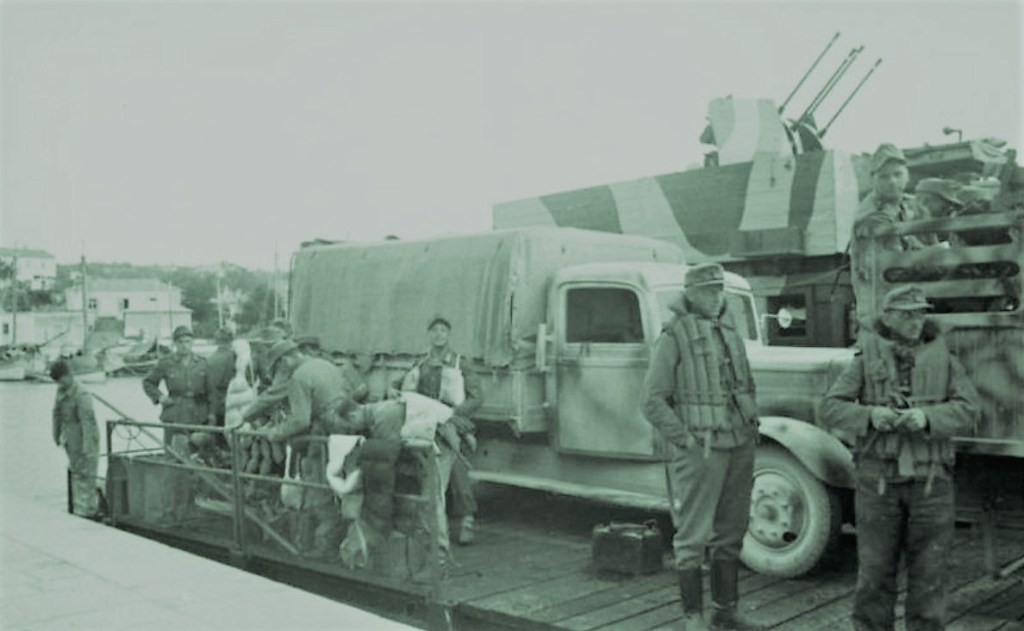
The photograph above is of an Opel Blitz troops transporter; Opel is one of the companies that provided the Nazi regime with equipment but also with funding.
But Opel was not the only company. Funding for the Nazis had already started in the early 1930s.
Nineteen representatives of industry, finance, and agriculture signed a petition on November 19, 1932, requesting that German President Paul von Hindenburg make Adolf Hitler the German Chancellor.
On February 20, a secret meeting in Berlin was held by Adolf Hitler and 20 to 25 industrialists at the official residence of the President of the Reichstag, Hermann Göring. Its purpose was to raise funds for the election campaign of the Nazi Party.
The German elections were to be held on 5 March 1933. The Nazi Party wanted to achieve two-thirds majority to pass the Enabling Act and desired to raise three million Reichsmark to fund the campaign. According to records, 2,071,000 Reichsmarks (equivalent to about €9,000,000 in 2023) were contributed at the meeting. Together with the Industrial petition, it is used as evidence to support the idea that big business played a central role in the rise of the Nazi Party.
These are just some of the men and companies that supported the Nazi regime, financially and often also in equipment and services.
• Ernst Brandi, chairman of Bergbauverein
• Karl Büren, director general of Braunkohlen- und Brikettindustrie AG, board member of Deutschen Arbeitgeberverbände
• August Diehn, board member of Wintershall AG
• Ludwig Grauert
• Guenther Heubel, director general of C. TH. Heye Braunkohlenwerke AG, board member of Deutschen Arbeitgeberverbände
• Gustav Krupp von Bohlen und Halbach
• Hans von und zu Loewenstein, executive member of Bergbauverein
• Fritz von Opel, board member of Adam Opel AG
• Günther Quandt, major industrialist, later appointed Leader of the Armament Economy (Wehrwirtschaftsführer)
• Wolfgang Reuter, director general of Demag, chairman of Vereins Deutscher
• Maschinenbau-Anstalten, presidential member of Reichsverbands der Deutschen Industrie
• August Rosterg, director general of Wintershall AG
• Hjalmar Schacht
• Georg von Schnitzler, board member of IG Farben
• Eduard Schulte, director general of Giesches Erben, Zink und Bergbaubetrieb
• Fritz Springorum, Hoesch AG
• Hugo Stinnes Jr., board member of Reichsverband der Deutschen Industrie, member of the Supervisory board of Rhenish-Westphalian Coal Syndicate
• Ernst Tengelmann, CEO of Gelsenkirchener Bergwerks AG
• Albert Vögler, CEO of Vereinigte Stahlwerke AG
• Ludwig von Winterfeld, board member of Siemens & Halske AG and Siemens-Schuckertwerke AG
• Wolf-Dietrich von Witzleben, head of the office of Carl Friedrich von Siemens
Some Other Companies and how They Contributed
• AEG Germany Forced labour from concentration camps.
• Allianz Berlin, Germany Provided insurance for facilities and workers at concentration camps.
• Associated Press New York, United States Censorship and cooperation with Nazi Germany.
• Audi Zwickau, Germany Forced labour from concentration camps.
• Bahlsen Hanover, Germany Employed about 200 forced labourers between 1943 and 1945—most of whom were women from Nazi-occupied Ukraine.
• BASF Ludwigshafen, Germany Collaborated with Degussa AG—now Evonik Industries—and IG Farben—to produce sodas used in Zyklon B—utilized in Concentration Camps to commit mass murder. The BASF built the chemical factory IG Auschwitz.
• Bayer Barmen, Germany Forced labour and medical experimentation in concentration camps, production of the chemicals and pharmaceuticals supplies of Nazi Germany.
• BMW Munich, Germany forced labor from concentration camps, produced fighting sidecar motorcycles BMW R75 and aircraft engines.
• Carl Walther GmbH Germany Produced Gewehr military carabines and Walther handguns.
• Chase National Bank Manhattan, New York, USA assisted in the sale of Nazi war bonds (Rueckwanderer Marks) to German Americans.
• Degussa AG (now Evonik Industries) Frankfurt, Germany Zyklon B pesticide production used for executions in gas chambers.
• Dehomag (a subsidiary of IBM) Germany Provided data computers for the Gestapo state police notably for arrests.
• Deutsche Bank Germany provided construction loans for Auschwitz.
• Deutsche Bergwerks und Hüttenbau Germany, mine and quarries.
• Dresdner Bank Dresden, Germany, major stakeholder in the construction company for Auschwitz.
• Eisenwerke Oberdonau Germany Steel production, part of Reichswerke Hermann Göring.
• Flugmotorenwerke Ostmark lower Austria Engine production mainly for aircraft.
• Focke-Wulf Germany, produced Focke-Wulf military planes.
• Franz Eher Nachfolger Germany, produced books and the famous Mein Kampf under the control of the Nazi party.
• General Motors United States automotive industry, provided passenger vehicles for the SS, Wehrmacht and the Nazi party.
• Hoesch AG Dortmund, Germany, mines and steel productions.
• Hugo Boss Metzingen, Germany, produced propaganda items, uniforms for Nazi State and Vichy Collaborating State.
• IBM-New York, USA, produced early computers utilized in the pursuit of the Holocaust by Nazi Germany.
• IG Farben-Frankfurt am Main, Germany, Zyklon B main manufacturer.
• Krupp (now part of ThyssenKrupp) Essen, Germany, Zyklon B was produced by the company along with other ones. Some more of the productions were Panzer Tank Series, U-boats, military ships, artillery guns.
• Maggi (now owned by Nestlé) Switzerland, benefited from slave labor.
• Mercedes-Benz Stuttgart, Germany, forced labor from concentration camps, produced turret for tanks. It also produced the limos of choice by Nazi leaders such as Hitler, Göring, Himmler, and Heydrich.
• Porsche Stuttgart, Germany, forced labor, created design for the first version of the outgunning heavy Tiger Tank series: the Tiger I despite the trials it was not retained for further production.
• Puma Herzogenaurach, Germany, as Dassler Brothers Shoe Factory, with Adidas. Shoe supplier to Hitler Youth.
• Reichswerke Hermann Göring Berlin, Germany, State-owned steelworks.
• Siemens-Kreuzberg, Berlin, Germany, forced labor, trucks and possibly other productions as trains.
• Standard Oil Cleveland, Ohio, provided fuel for U-boats.
• Steyr Arms Steyr, Austria, forced labor in the Steyr-Münichholz subcamp, production of weapons.
• Steyr-Daimler–Puch Steyr, Austria, constructed military facilities and military vehicles as the light RSO Raupenschlepper Ost (with cargo, self propelled antitank and traction versions).
• Stoewer Stettin, Germany, used forced labor in its factory. manufacturer leichter geländegängiger Einheits-PKW, a versatile four-wheel drive car, for Wehrmacht.
• Swarovski Wattens, Austria, members of the executive board were members of the Nazi Party.
• Thyssen AG (now part of ThyssenKrupp) Hamborn, Germany, produced steel, machines, weapons and steelworks.
• Topf and Sons Erfurt, Germany, designed, manufactured and installed crematoria for concentration and extermination camps.
• Volkswagen Group Berlin, Germany, forced labor from concentration camps. Produced V-1 flying bomb and Kübelwagen military vehicles.
These were not the only companies; Coca-Cola created the Fanta brand for the German Army; due to some sanctions, not all ingredients to manufacture Coca-Cola were available in Germany.
Henry Ford was a great admirer of Hitler and also funded the Nazi party; it has been alleged that Henry Ford sent Hitler a check for $50,000 on Hitler’s birthday.
Not only did these companies fund the Nazi regime and, therefore, by association with the Holocaust, they also profited from the death and destruction caused by the Nazis. Many of them went on to become global market leaders in their fields, and some are now known as manufacturers of luxury goods.
Sources
https://www.jstor.org/stable/1841917
https://dbpedia.org/page/Secret_Meeting_of_20_February_1933
https://www.ns-archiv.de/nsdap/foerderung/eingabe-hindenburg.php
Donation
Your readership is what makes my site a success, and I am truly passionate about providing you with valuable content. I have been doing this at no cost and will continue to do so. Your voluntary donation of $2 or more, if you are able, would be a significant contribution to the continuation of my work. However, I fully understand if you’re not in a position to do so. Your support, in any form, is greatly appreciated. Thank you. To donate, click on the credit/debit card icon of the card you will use. If you want to donate more than $2, just add a higher number in the box left from the PayPal link. Your generosity is greatly appreciated. Many thanks.
$2.00
 History of Sorts
Leave a comment