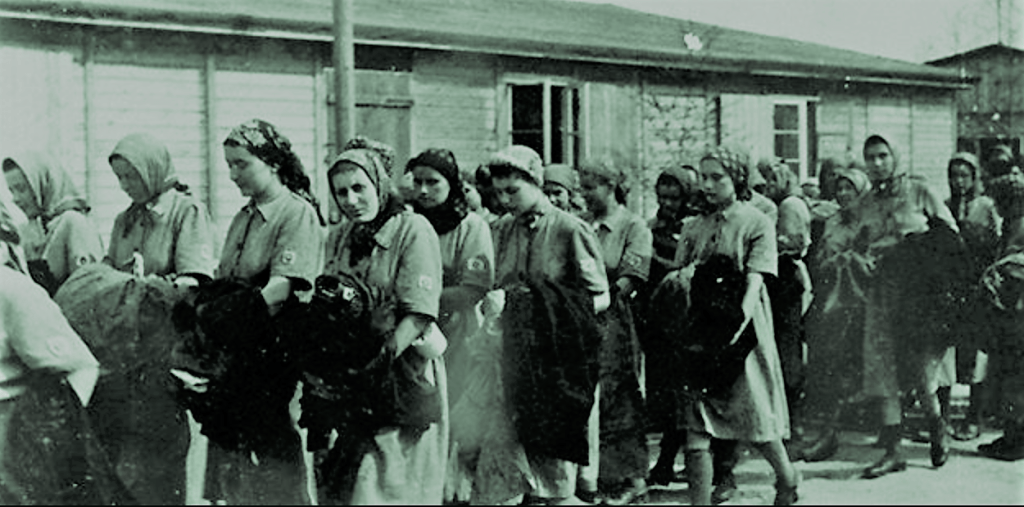
I am certain this piece will stir emotions and likely spark controversy. Some may question, “Why choose this subject?” However, to truly understand the Holocaust—both for future generations and ourselves—it is essential to explore all aspects, no matter how difficult.
Recently, I came to understand how deeply important it was for many Holocaust survivors to have children after the war. Having lost most or all of their families, they sought not to replace those they had lost, but to ensure the continuation of their bloodline. In doing so, they defied the Nazis, proving that they had survived and endured.
Yet for many women, even this act of resilience was stolen. While watching The U.S. and the Holocaust documentary, I was struck by a survivor’s testimony: in Auschwitz, she stopped menstruating. Her experience led me to investigate further.
Evidence from the Nuremberg Trials revealed that the Nazis sought methods of mass sterilization for Jewish women. Upon arrival at concentration camps, over 98% of women stopped menstruating.

Historian Anna Hájková has written about Czech physician František Bass’s research on amenorrhea—the loss of menstruation—among Jewish prisoners in Theresienstadt. His findings linked it to the shock of incarceration. Yet, much of the historical research has focused more on ovulation rather than menstruation, despite their interconnectedness.
For female Holocaust victims, menstruation—or its absence—shaped their experiences in numerous ways. Many suffered the shame of bleeding publicly, without access to sanitary materials. Others, however, were spared from sexual violence because of amenorrhea. The sudden loss of menstruation also became a source of anxiety: about fertility, life after the camps, and the possibility of having children in the future. Despite its profound impact, the causes of amenorrhea in concentration camps remain largely underexplored beyond malnutrition and trauma.

Some survivors suspected they had been intentionally sterilized. A few women noted that their menstruation ceased only after consuming certain foods in the camps. Two survivors detected a white powder in the “soup” or “coffee” at Auschwitz but were too hungry to refuse it. Others later learned they had been subjected to sterilization experiments. One survivor reported sterilization by radiation, while two others underwent surgical procedures on their reproductive organs.
Interviews conducted by Peggy J. Kleinplatz and Paul Weindling examined survivors’ reproductive histories, including amenorrhea, difficulties conceiving, miscarriages, and stillbirths. Their findings were devastating:
98% of interviewed women were unable to conceive or carry to term the number of children they desired.
Of 197 confirmed pregnancies, at least 48 (24.4%) ended in miscarriage, 13 (6.6%) in stillbirth, and 136 (69%) in live births—though the true rate of pregnancy loss was likely even higher.
Only 16.1% (15 of 93 women) were able to carry more than two babies to term, despite desperately wanting more children.
The uniform and sudden onset of amenorrhea among Jewish women entering concentration camps suggests more than just trauma and malnutrition at play. Survivor testimonies, combined with historical evidence, point to the administration of exogenous hormones—likely without their knowledge—to induce amenorrhea and contribute to long-term infertility.
The stripping of identity in the camps further deepened these losses. Women had their heads shaved, their bodies emaciated, and their femininity erased. Holocaust survivor Erna Rubinstein, in her memoir The Survivor in Us All (1986), reflected on this dehumanization:
“What is a woman without her glory on her head, without hair? A woman who doesn’t menstruate?”
For young girls, the trauma was different but equally harrowing. Many experienced their first periods in the camps, alone and separated from their families. In these moments, older women became surrogate mothers and sisters, offering guidance and stolen scraps of paper to absorb the blood. Yet, before long, most lost their cycles entirely.
The impact of reproductive trauma extended beyond the camps. Among the women who had given birth before the war and lost their children to the genocide, three out of four struggled to conceive again—even in their 20s and 30s. In total, the 93 women studied gave birth to only 136 children after 1945. Twenty women were unable to carry any children to term. Most had just one or two children.
I recognize that this is a deeply sensitive and complex subject. I do not claim to be an expert, and I have relied on scientific research to ensure accuracy. However, it is a crucial aspect of Holocaust history that deserves more attention. In understanding these hidden traumas, we honor the resilience of those who endured them.
sources
https://www.sciencedirect.com/science/article/abs/pii/S0277953622005561?via%3Dihub
https://pubmed.ncbi.nlm.nih.gov/36007428/
https://www.historytoday.com/archive/feature/menstruation-and-holocaust
Please support us so we can continue our important work.
Donation
Your readership is what makes my site a success, and I am truly passionate about providing you with valuable content. I have been doing this at no cost and will continue to do so. Your voluntary donation of $2 or more, if you are able, would be a significant contribution to the continuation of my work. However, I fully understand if you’re not in a position to do so. Your support, in any form, is greatly appreciated. Thank you. To donate, click on the credit/debit card icon of the card you will use. If you want to donate more than $2, just add a higher number in the box left from the PayPal link. Your generosity is greatly appreciated. Many thanks.
$2.00
 History of Sorts
Leave a comment