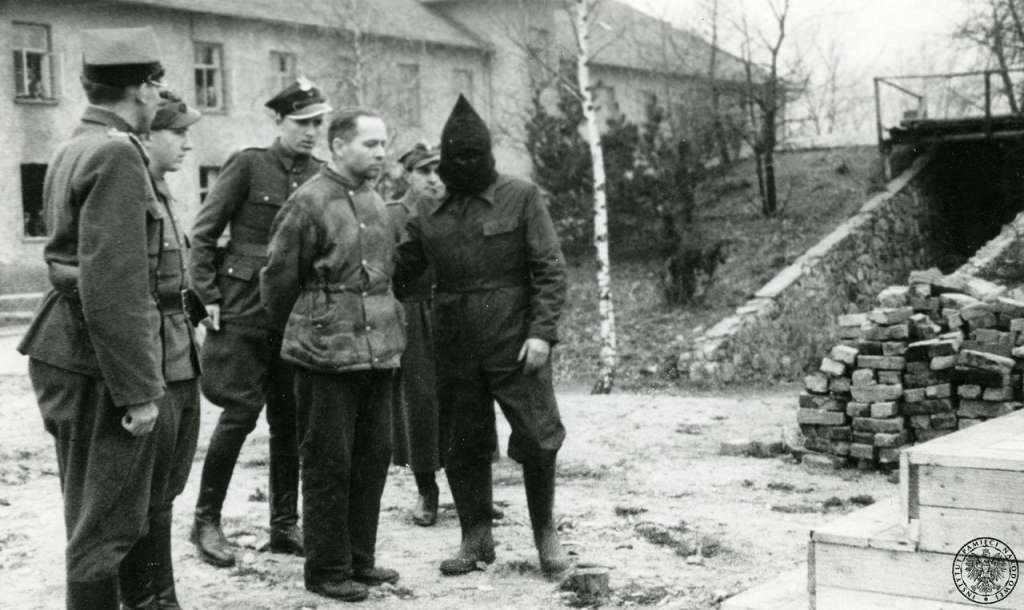
On April 16, 1947, in the shadow of Auschwitz—a name now synonymous with human suffering and industrial-scale murder—justice was served in one of the most symbolically powerful moments of the post-war reckoning. Rudolf Höss, the former commandant of Auschwitz concentration camp and one of the principal architects of the Holocaust, was executed by hanging.
The Man Behind the Machine
Rudolf Höss (often spelled Hoess) was born in Germany in 1901 and joined the Nazi Party in the early 1920s. Rising through the ranks of the SS, he was appointed as the first commandant of Auschwitz in 1940. Under his command, Auschwitz evolved from a detention camp into the largest extermination center of the Nazi regime.
Höss was a cold, methodical bureaucrat of genocide. By his own admission during post-war testimony, he was responsible for the deaths of approximately 2.5 million people, though historians estimate that about 1.1 million were murdered at Auschwitz. He oversaw the implementation of Zyklon B gas chambers and the efficient disposal of bodies—turning mass murder into logistics.
Captured and Tried
Following Germany’s defeat in 1945, Höss fled and assumed a false identity. He was eventually captured by British soldiers in March 1946, after being tracked down by Polish and British investigators. His trial before the Supreme National Tribunal in Warsaw began in March 1947.
Höss showed little remorse during the trial. He confessed to his crimes with a chilling lack of emotion, offering detailed and bureaucratic explanations of how the extermination process was carried out. His demeanor was not one of denial or passionate ideological defense, but rather cold detachment.
He was found guilty of crimes against humanity, including the murder of hundreds of thousands of men, women, and children—primarily Jews, but also Poles, Roma, Soviet prisoners of war, and others.
A Symbolic Execution
The sentence: death by hanging. The location: Auschwitz.
On the morning of April 16, 1947, a gallows was erected between the ruins of Crematorium I and the former SS administration building. The symbolism could not have been more stark—Höss was executed in the place where he had overseen the mechanized murder of over a million souls.
Witnesses described the moment as somber and heavy. There was no cheering crowd, only the silent presence of Polish officials, witnesses, and guards. As the trapdoor opened beneath him, Rudolf Höss met the end he had long escaped, in the very epicenter of the evil he had commanded.
Justice or Closure?
The execution of Rudolf Höss was not just the punishment of a war criminal—it was a statement. It said that the machinery of genocide would not outlive its engineers. It said that names and faces would be held accountable, even amid the vast scale of Nazi atrocities.
But did it bring closure? For many survivors and families of victims, no act could truly balance the scales of what had been done. Still, the execution served as one of the few tangible moments of justice in a post-war world still grappling with the depth of the Holocaust’s horror.
Today, the gallows used to hang Höss no longer stands, but the memory of that moment—of justice delivered at Auschwitz—remains a potent reminder that history sees, remembers, and, in some small ways, seeks to redress.
sources
https://www.annefrank.org/en/timeline/120/the-execution-of-auschwitz-commander-rudolf-hoss/
https://www.britannica.com/biography/Rudolf-Franz-Hoss
https://en.wikipedia.org/wiki/Rudolf_H%C3%B6ss
https://www.nationalarchives.gov.uk/education/resources/holocaust/confession-rudolf-hoss/
Donation
Your readership is what makes my site a success, and I am truly passionate about providing you with valuable content. I have been doing this at no cost and will continue to do so. Your voluntary donation of $2 or more, if you are able, would be a significant contribution to the continuation of my work. However, I fully understand if you’re not in a position to do so. Your support, in any form, is greatly appreciated. Thank you. To donate, click on the credit/debit card icon of the card you will use. If you want to donate more than $2, just add a higher number in the box left from the PayPal link. Your generosity is greatly appreciated. Many thanks.
$2.00


Leave a Reply