
Sometimes, you come across stories and are amazed that they are not widely known. We all have heard about Oskar Schindler because of Steven Spielberg’s “Schindler’s List.” Still, Otto Weidt’s story is probably just as amazing.
It is a story that is close to me because I am half blind and will likely become utterly blind at some point in the future. I hope it will be a long time in the future. At one stage, I was actually blind for about six months, so I have an idea of how it feels not to be able to see.
Otto Weidt’s decreasing eyesight forced him to give up his job in wallpapering. He adapted and learned the business of brush making and broom binding.
Otto Weidt and Else Nast met in Berlin in 1931 and married five years later, on September 22, 1936. This was Otto Weidt’s third marriage; he had two sons from his first marriage.
In 1936, Otto Weidt opened a workshop for the blind in Kreuzberg, Berlin; Else Weidt worked there with him. Otto Weidt took significant risks in trying to help his Jewish workers persecuted by the Nazis; his wife gave him constant support. After Otto Weidt died on December 22, 1947, Else Weidt took over the management of the workshop. She died aged 72 on June 8, 1974.
In 1936, he established a company called “Otto Weidt’s Workshop for the Blind” in the basement of Großbeerenstraße 92 in the Kreuzberg district of Berlin. From 1940 on, the Workshop was based at Rosenthaler Straße 39 in the Mitte district, occupying the entire first floor of the side wing of the building. As one of his customers was the Wehrmacht, Weidt managed to have his business classified as vital to the war effort.
Up to 30 blind and deaf Jews were employed at his shop between the years of 1941 and 1943. When the Gestapo began to arrest and deport his Jewish employees, he fought to secure their safety by falsifying documents, bribing officers, and hiding them in the back of his shop. But in February and March 1943, many were arrested and deported to concentration camps during the police raids known as “Operation Factory.”
Aside from the blind, Weidt also employed healthy Jewish workers in his office. This was strictly forbidden, as all Jewish workers had to be mediated through the labor employment office, which would ordinarily post them to forced labor assignments. However, Weidt managed to hire them by bribery.
The Jewish Inge Deutschkron was among the eight healthy Jews employed at the Workshop. Inge and her mother were living in hiding. Weidt arranged an Aryan work permit for Deutschkron, which he had acquired from a prostitute who had no use for it. Unfortunately, the permit had to be discarded three months later when the police arrested the prostitute.
One of Weidt’s most spectacular exploits involved the rescue of a Jewish girl who had been deported to the camps in Poland. In February 1943, Otto Weidt hid the Licht family in a storage room in the Workshop for the Blind at Neanderstraße 12 in Berlin-Mitte. The Gestapo arrested the family in October 1943 and deported them to the Theresienstadt ghetto on November 15, 1943.
There, Weidt could support them with food parcels. All of 150 parcels arrived. After 6 months, Alice and her parents were deported to KZ Birkenau. Alice managed to send a postcard to Weidt, who promptly traveled to Auschwitz in an attempt to help her.

Weidt found out that as Auschwitz was emptied, Alice was moved to the labor camp/ammunition plant Christianstadt. He hid clothes and money for her in a nearby pension to aid her return. Through one of the civilian workers, he contacted Alice and made her run away and return to Berlin if possible.
Alice eventually returned to Berlin in January 1945 and lived in hiding with the Weidt until the end of the war. She learned that both of her parents were murdered in Auschwitz-Birkenau.
From March 1943 until the end of the war, only a few employees remained in Weidt’s workshop. Apart from three non-Jewish workers, there were Jews married to non-Jews or people who had one Jewish parent, as well as several people in hiding, like Inge Deutschkron, Alice Licht, Erich Frey, and Chaim and Max Horn. Of the 33 employees only seven survived.
After the war, Otto Weidt supported the establishment of the Jewish Home for Children and the Aged at Moltkestraße 8-11 in the Berlin district of Niederschönhausen. After Liberation, it was the first secure place for children and elderly people who escaped Nazi persecution.
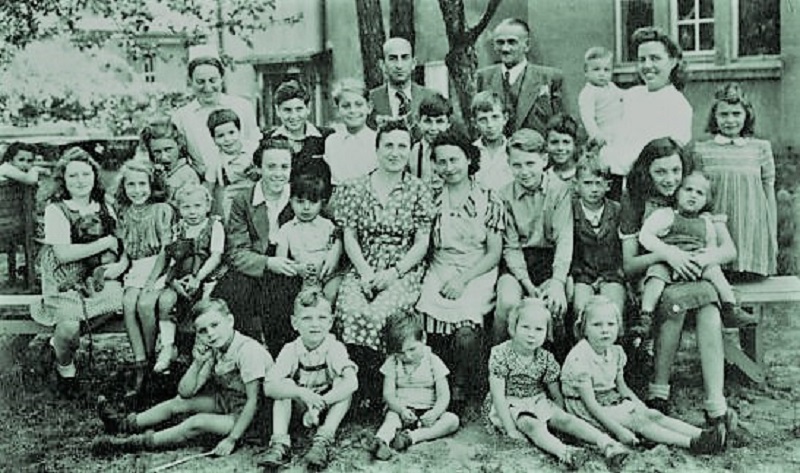
All of this makes Otto Weidt a hero, in my opinion. Just think of it, not only did he help Jews, he helped blind and deaf Jews. They were seen as lesser human beings in two of the categories as per the Nuremberg Laws.
Otto Weidt died of heart failure in 1947 at the age of 64. On September 7, 1971, Yad Vashem recognized him as Righteous Among the Nations.

Sources
https://www.museum-blindenwerkstatt.de/en/first-of-all/
https://www.yadvashem.org/righteous/stories/weidt.html
Donation
Your readership is what makes my site a success, and I am truly passionate about providing you with valuable content. I have been doing this at no cost and will continue to do so. Your voluntary donation of $2 or more, if you are able, would be a significant contribution to the continuation of my work. However, I fully understand if you’re not in a position to do so. Your support, in any form, is greatly appreciated. Thank you. To donate, click on the credit/debit card icon of the card you will use. If you want to donate more than $2, just add a higher number in the box left from the PayPal link. Your generosity is greatly appreciated. Many thanks.
$2.00
 History of Sorts
Leave a comment