The one thing I can be sure of after posting this blog is that my contact details will be checked a lot, especially by the likes of the “‘Polish League Against Defamation,” and will probably be followed with threats.
Unfortunately, there are groups in Poland who will go to great lengths to get any bit of information about Polish involvement during the Holocaust silenced.
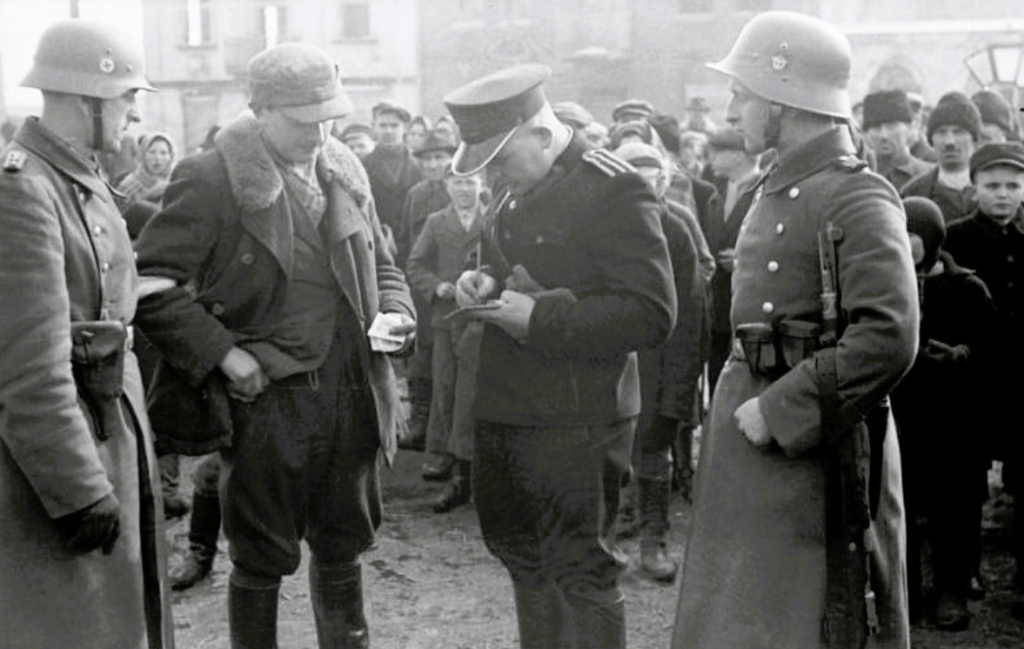
The Blue Police (Policja Granatowa), also known as the Granatowa Policja due to the blue color of their uniforms, represents a complex and often controversial chapter in the history of World War II. Formed under Nazi German occupation, the Blue Police was a force mainly composed of pre-war Polish police officers who were compelled to serve under German orders. Their role in occupied Poland was multifaceted, involving tasks that ranged from maintaining public order to participating in Nazi operations, including the persecution of Jews. This blog explores the origins, roles, and legacy of the Blue Police, examining their actions within the broader context of Nazi occupation and the moral dilemmas they faced.
The Blue Police was established soon after Nazi Germany invaded Poland in September 1939. The Germans quickly dismantled the pre-war Polish state apparatus. Still, they recognized the need for a local police force to maintain order in the occupied territories. To this end, they reconstituted the pre-war Polish police force, forcing its officers to serve under German command. The force primarily operated in the General Government, a semi-colonial administrative region that the Nazis established in central Poland, which included significant cities like Warsaw and Kraków.

The Blue Police was composed of Polish officers who had served in the national police force before the war. These officers were compelled to work under the Germans, sometimes under threat of severe punishment or deportation to concentration camps. Despite being a Polish force, they were subordinate to the German Ordnungspolizei (Order Police). They were expected to carry out Nazi policies, particularly those related to maintaining public order and supporting German security efforts.
The duties of the Blue Police were diverse. Still, they were primarily tasked with routine law enforcement activities, such as crime prevention, traffic control, and the enforcement of German regulations. However, their role extended far beyond ordinary policing. The Blue Police were often involved in activities that directly supported the Nazi regime’s oppressive policies, particularly against Jews and other targeted groups.
One of the most controversial aspects of the Blue Police’s role was their involvement in the persecution of Jews. They were required to enforce anti-Jewish measures, such as curfews and restrictions on movement. More troublingly, they were involved in rounding up Jews for deportation to ghettos and, later, to extermination camps. The Blue Police were also tasked with guarding ghettos, preventing escapes, and sometimes even participating in mass executions.
In addition to their role in anti-Jewish operations, the Blue Police were involved in combating the Polish underground resistance. The resistance, which included groups like the Home Army (Armia Krajowa), sought to undermine German control and was involved in various forms of sabotage, intelligence gathering, and armed resistance. The Blue Police were expected to assist the Germans in suppressing these activities. However, their level of commitment to this task varied widely among officers.
The legacy of the Blue Police is marked by moral ambiguity. On one hand, they were a tool of the Nazi occupation, complicit in the enforcement of oppressive and genocidal policies. Their involvement in the persecution of Jews, in particular, has led to harsh criticism and condemnation. However, the situation was complex, and not all members of the Blue Police were willing collaborators.
Some officers joined the force out of necessity, coerced by the threat of violence or imprisonment. Others attempted to navigate their roles in ways that minimized harm or even actively undermined German efforts. There are documented cases of Blue Police officers who secretly aided the Polish resistance, provided intelligence, or helped Jews escape from ghettos. These actions were incredibly risky, as the Germans would punish disobedience or betrayal with death.
The duality of the Blue Police’s role is best understood within the broader context of life under Nazi occupation. Polish society was subjected to extreme repression, and individuals often faced impossible choices. The Blue Police, as a force composed of ordinary Polish citizens, reflected the broader spectrum of behaviors seen under occupation—from collaboration and complicity to resistance and defiance.
After World War II, the legacy of the Blue Police was controversial. In the immediate post-war period, some former members were prosecuted for their wartime activities, particularly those who had been involved in the persecution of Jews or had collaborated closely with the Nazis. However, the broader perception of the Blue Police remained complex, shaped by the difficult circumstances under which they operated.
In post-war Poland, which fell under Soviet influence, the narrative surrounding the Blue Police was further complicated by the Communist regime’s portrayal of wartime collaboration. The regime often emphasized the Blue Police’s collaboration with the Nazis as part of a broader effort to discredit any association with pre-war Polish institutions and to legitimize the new Communist order.
In recent years, historical research has sought to provide a more nuanced understanding of the Blue Police, recognizing the diversity of experiences and motivations among its members. While the involvement of the Blue Police in Nazi atrocities cannot be denied, it is also essential to acknowledge the moral dilemmas faced by individuals under occupation and the instances where members of the force resisted or subverted German orders.

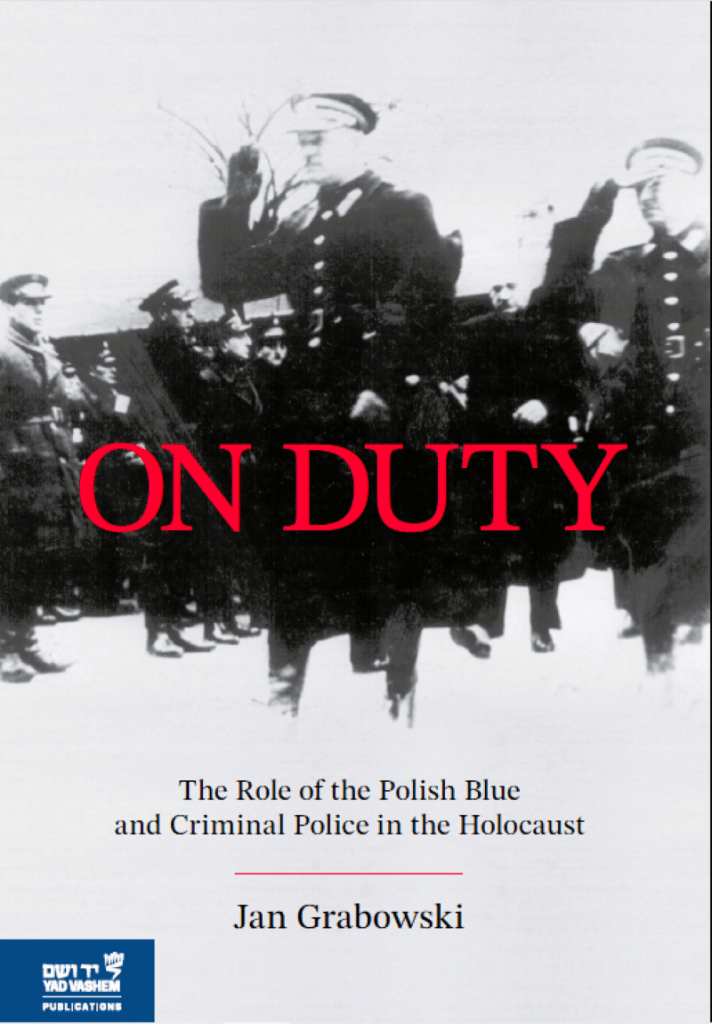
This blog was just a broad overview of the Blue Police; if you would like to learn more, I can recommend looking up information by Jan Grabowski.
He has been a courageous and acutely well-informed voice in the ‘history wars’ over the role of Poles under German occupation in the Holocaust. On Duty meticulously documents the increasing complicity of the Polish Blue and Criminal Police, as well as other seemingly innocuous organizations such as the construction service, firefighters, and village night guards, first in the enforcement of initial Nazi anti-Jewish policies, then in ghetto liquidation, and finally and most fatefully in the hunt for hidden and passing Jews.
Grabowski also demonstrates how, in the face of looming German defeat, many police officers established ties with the Polish underground to secure their future while still continuing to aid the German campaign to kill all surviving Polish Jews. Grabowski establishes beyond doubt that while Poles were victims of brutal German occupation, many were simultaneously victimizers of Polish Jews, as per Christopher R. Browning, Frank Porter Graham Professor of History Emeritus, University of North Carolina at Chapel Hill.
Sources
https://store.yadvashem.org/he/on-duty-2
chrome-extension://efaidnbmnnnibpcajpcglclefindmkaj/https://www.ushmm.org/m/pdfs/20170502-Grabowski_OP.pdf
Donation
Your readership is what makes my site a success, and I am truly passionate about providing you with valuable content. I have been doing this at no cost and will continue to do so. Your voluntary donation of $2 or more, if you are able, would be a significant contribution to the continuation of my work. However, I fully understand if you’re not in a position to do so. Your support, in any form, is greatly appreciated. Thank you. To donate, click on the credit/debit card icon of the card you will use. If you want to donate more than $2, just add a higher number in the box left from the PayPal link. Your generosity is greatly appreciated. Many thanks.
$2.00

 History of Sorts
Leave a reply to tzipporahbatami Cancel reply