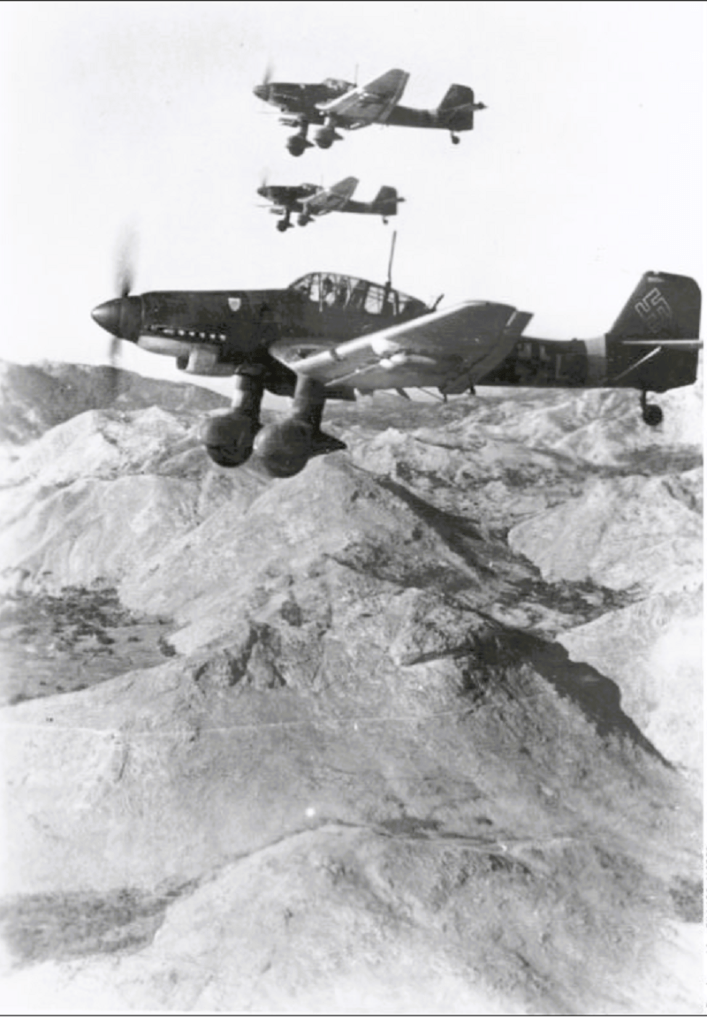
It is a lesser-known, or perhaps lesser-acknowledged, fact that the entire Wehrmacht, including the Navy and Luftwaffe, was involved in the Holocaust. It wasn’t only the SS.
The Luftwaffe was directly involved through bombardments and indirectly through experiments carried out on their behalf.
The aerial bombardment of the village of Vorizia by the Luftwaffe is a lesser-known but tragic event that took place during World War II on the island of Crete. This event occurred in the context of the broader conflict in Crete following the German invasion, known as the Battle of Crete, and the subsequent occupation of the island by Nazi forces.
Background: The German Occupation of Crete
The island of Crete was strategically significant during World War II due to its location in the eastern Mediterranean. After the Battle of Crete in May 1941, the island fell under German occupation. The local population of Crete, however, did not passively accept the occupation. Resistance movements quickly formed across the island, and Cretans engaged in guerrilla warfare against the occupying forces.
The German response to this resistance was brutal. The Nazis implemented harsh reprisals against the civilian population, which included massacres, destruction of villages, and other forms of collective punishment. These actions were intended to suppress the resistance and instill fear among the local populace.
The Bombardment of Vorizia
Vorizia, a small village located in the southern part of Crete near Mount Psiloritis, became a target of German aggression because of its involvement in the resistance movement. The village was known for its strong support of the resistance fighters, who often found refuge in the surrounding mountains.
On August 27, 1943, in retaliation for resistance activities and to weaken local support for the guerrilla fighters, the Luftwaffe launched an aerial bombardment on Vorizia. The village was subjected to intense bombing, which resulted in the destruction of homes, infrastructure, and farmland. The bombardment was devastating; Vorizia was almost completely razed to the ground.
In addition to the destruction of the village, many residents were killed or injured in the attack. Those who survived faced dire conditions, with their homes destroyed and livelihoods shattered. The Luftwaffe’s bombardment of Vorizia was a stark example of the broader German strategy of terror and collective punishment aimed at crushing resistance on Crete.
In reprisal for the help of locals to the partisans, General Müller ordered German forces to surround Vorizia on August 27, 1943. The villagers were led to the churchyard; three of them were summarily shot that day and two the next day. Later on, the others were driven out of the village, and seven Ju 87 Stuka dive bombers appeared, dropping a total of 21 bombs. Following the bombing, the village ruins were doused with petrol and set on fire.
Aftermath and Legacy
The destruction of Vorizia was one of many atrocities committed by German forces on Crete during the occupation. Other villages, such as Anogeia and Kandanos, also suffered similar fates. The bombardment and subsequent suffering of Vorizia’s residents are remembered as part of the broader narrative of Cretan resistance and the brutal measures employed by the Nazis to maintain control over the island.
Today, Vorizia, like many other Cretan villages, honors the memory of those who died and the resilience of those who survived. The story of the village’s destruction is a testament to the harsh realities of war and the enduring spirit of resistance among the Cretan people.
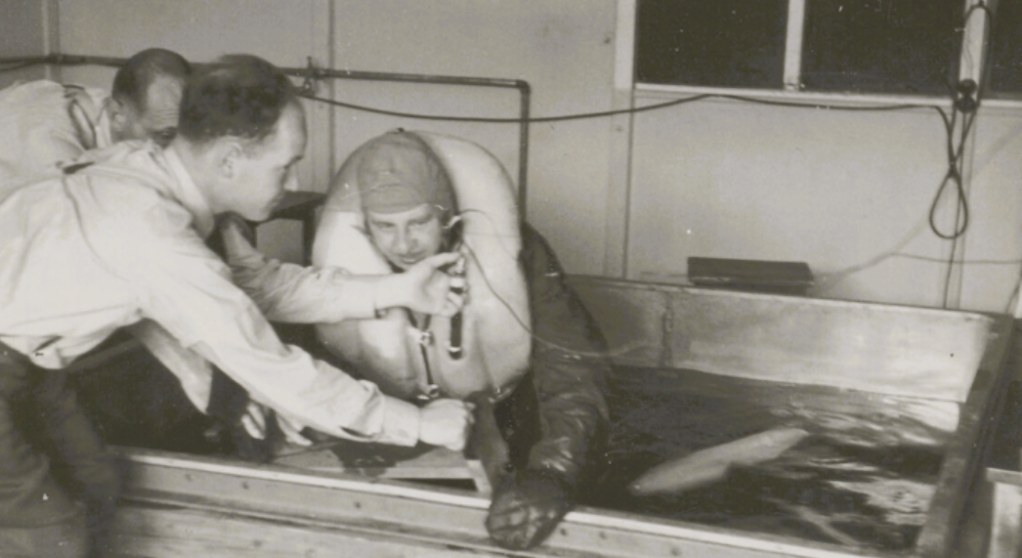
The Dachau hypothermia experiments were a series of inhumane and unethical medical experiments conducted by Nazi doctors on prisoners at the Dachau concentration camp during World War II. These experiments carried out between 1942 and 1943, were part of a broader program of medical research aimed at aiding the German military. The experiments focused on understanding the effects of extreme cold on the human body and finding ways to prevent or treat hypothermia, a condition of dangerous body temperature drop that was a significant threat to German soldiers fighting in cold environments.
Background and Purpose
The hypothermia experiments at Dachau were driven by the German military’s concern over the high number of soldiers who died from exposure to cold in the brutal conditions of the Eastern Front, where temperatures could drop well below freezing. The Luftwaffe (German Air Force) was particularly interested in these studies because of the risk to pilots who were shot down over the North Sea and other cold environments.
Dr. Sigmund Rascher, a physician and SS officer, led the hypothermia experiments. He sought to determine how long humans could survive in freezing conditions and what methods might be effective in reviving those who were suffering from extreme cold.
The Experiments
The hypothermia experiments at Dachau were conducted on prisoners, primarily political prisoners, Jews, and other groups targeted by the Nazi regime. These individuals were subjected to horrific and often lethal experiments without their consent.
The experiments typically involved immersing prisoners in ice-cold water or exposing them to freezing outdoor temperatures for extended periods. Some prisoners were placed in vats of icy water, sometimes for hours, to simulate the conditions of soldiers who might fall into the North Sea. Others were left outside in the cold without clothing to observe the effects of exposure.
The researchers meticulously recorded the prisoners’ body temperature, heart rate, and other physiological responses as they experienced the onset of hypothermia. Many of the prisoners lost consciousness, and some died during the experiments. Those who survived were often subjected to further experiments to test various methods of rewarming, including immersion in hot water, body-to-body rewarming with female prisoners, and other brutal techniques.
The experiments produced little, if any, valuable scientific data. The results were tainted by the cruelty of the methods used and the lack of proper scientific controls. Moreover, the experiments failed to yield effective treatments for hypothermia that could be applied in real-world situations.
Aftermath and Legacy
After World War II, the Dachau hypothermia experiments were exposed during the Nuremberg Trials, specifically in the Doctors’ Trial, where Nazi physicians and officials involved in human experimentation were prosecuted for war crimes and crimes against humanity. Dr. Sigmund Rascher, the primary figure behind the hypothermia experiments, was arrested and executed by the Nazis in 1945 for unrelated reasons. Still, his actions at Dachau were nonetheless central to the prosecution of Nazi medical crimes.
Sources
https://isitaholidaytoday.com/events/world-war-ii-aerial-bombardment
https://en.wikipedia.org/wiki/Razing_of_Vorizia
https://www.calendarz.com/on-this-day/august/27/world-war-ii-1
https://journals.library.columbia.edu/index.php/bioethics/article/view/6469
https://www.nejm.org/doi/full/10.1056/NEJM199005173222006
https://encyclopedia.ushmm.org/content/en/article/nazi-medical-experiments
Donation
Your readership is what makes my site a success, and I am truly passionate about providing you with valuable content. I have been doing this at no cost and will continue to do so. Your voluntary donation of $2 or more, if you are able, would be a significant contribution to the continuation of my work. However, I fully understand if you’re not in a position to do so. Your support, in any form, is greatly appreciated. Thank you. To donate, click on the credit/debit card icon of the card you will use. If you want to donate more than $2, just add a higher number in the box left from the PayPal link. Your generosity is greatly appreciated. Many thanks.
$2.00
 History of Sorts
Leave a comment