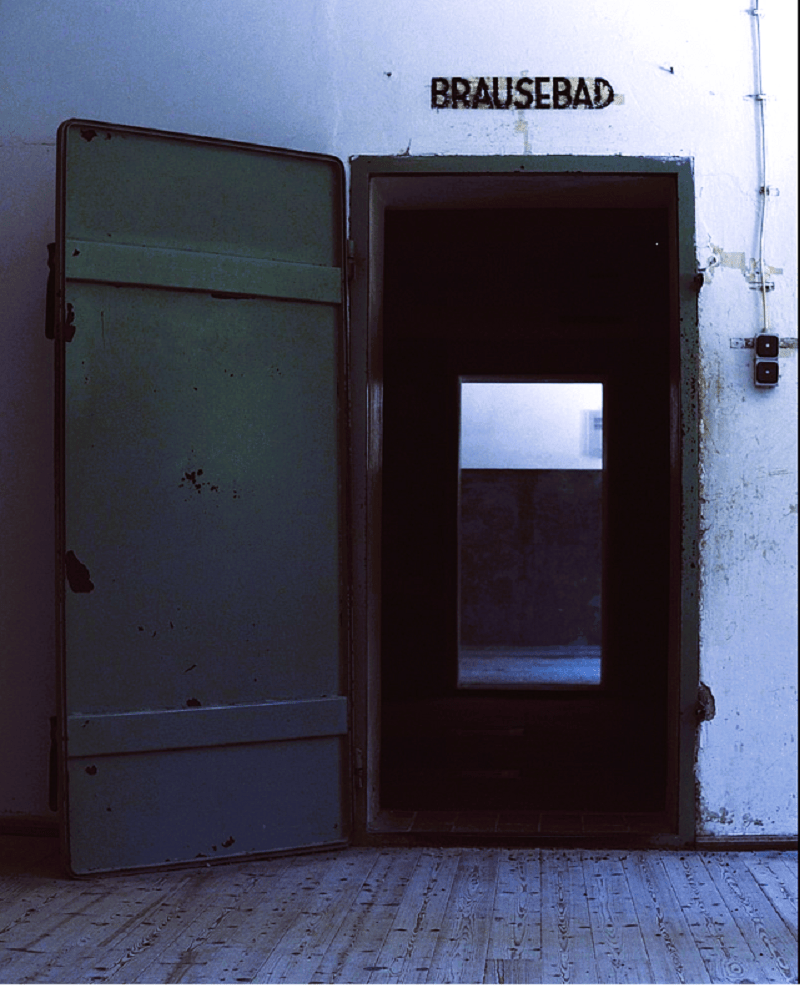
When I visited Dachau in June,2023, I decided I would not take pictures of the gas chamber. To me, it felt wrong. However, I don’t judge people who have taken photographs in the past, like the one above.
The gas chamber in Dachau was not used for mass murder. According to one eye witness account, some prisoners were killed by poison gas in 1944.
However, standing in the middle of the gas chamber gave me some idea of the dimensions of the gas chambers used in other camps. The ceiling was quite low. I could easily touch it, although—I am 6 ft. 2 in. Even if it was used as a shower (it would have been very uncomfortable standing naked with strangers) in such a small, cramped space.
It made me think, why did they call them showers? Was it some twisted sense of cleansing? It was ethnic cleansing. That was one of the more cynical parts of the Nazi ideology, the covering up brutal crimes and murder—by using innocent descriptions, like shower or work sets you free.

I did take a photo in the crematoria area of the ovens. Between 1933 and 1945, around 41,500 persons died of hunger, exhaustion, and disease, as the direct result of being tortured or brutally murdered in the Dachau concentration camp and its subcamps. Many of their bodies would have been burned in the ovens.
Karl Adolf Gross was a prisoner in Dachau. He said the following about the crematoria area.
“The crematorium can hardly cope with the heaps of corpses laden stark naked like logs on carts, which resemble dung carts, and driven through the gate to be thrown to the embers without a prayer and chiming bells. Even the barbarians were not guilty of displaying such disrespect to the dead.”
Four women were shot facing the front of the ovens—as an extra insult to their murder—so they would see where their bodies would end up. All four women were officers of the British forces and part of the Special Operations Executive (SOE). The branch was used for spying and sabotage.
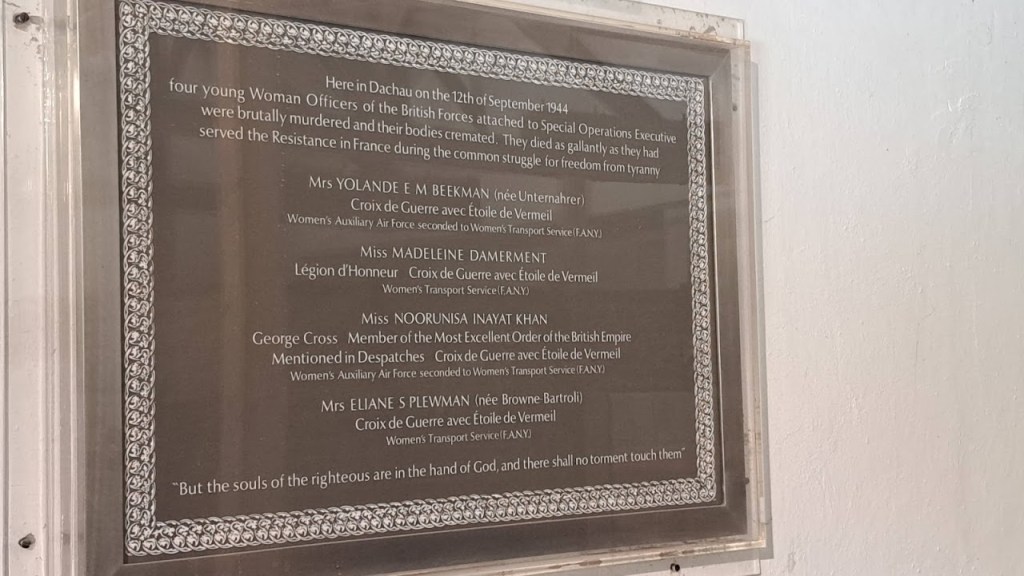
Yolande Elsa Maria Beekman, Madeleine Damerment, Noor Inayat Khan and Eliane Plewman
A Gestapo man named Max Wassmer was in charge of prisoner transports at Karlsruhe and accompanied the women to Dachau. Another Gestapo man, Christian Ott, gave testimony to the American investigators after the war about the fate of the four women. Ott was stationed at Karlsruhe and volunteered to accompany the four women to Dachau, as he wanted to visit his family in Stuttgart on the return journey. [Though not present at the execution, Ott told investigators what Wassmer had told him.
The four prisoners had come from the barrack in the camp, where they had spent the night. In the yard, where the shooting was to be done, he [Wassmer] had announced the death sentence to them. Only the Lagerkommandant and the two SS men had been present. The German-speaking English woman (the major) had told her companion of this death sentence. All four had grown pale and wept; the major asked whether they could appeal. The Kommandant declared that no protest could be made against the sentence. The major had then asked to see a priest. The Camp Kommandant refused on the grounds that there was no priest in the camp.
The four prisoners now had to kneel with their heads towards a small mound of earth and were killed by the two SS, one after the other by a shot through the back of the neck. During the shooting, the two English women held hands, and the two French women likewise. For three of the prisoners, the first shot caused death, but for the German-speaking English woman [Beekman], a second shot had to be fired as she still showed signs of life after the first shot.
After the shooting of these prisoners, the Lagerkommandant told the two SS men that he took a personal interest in women’s jewelry and it should be taken into his office.
Dachau was the first Concentration camp built by the Nazis. The first person to be murdered in Dachau, and technically the first victim of the Holocaust, was Arthur Kahn, a 21-year-old Jewish German medical student who had enrolled in Edinburgh University in Scotland and had returned to Germany to pick up his student records at the University of Wurzburg.

Arthur Kahn, with Ernst Goldmann, Rudolf Benario, and Erwin Kahn (not related), had been arrested around the 22nd of March 1933 for being communist party members and were sent to Dachau. Although Arthur Kahn had no Communist affiliation, he had, at one point, been involved in an anti-Nazi organization.
Upon arrival in Dachau, the men were identified as Jews and tortured. On 12 April, a group of drunken SS officers handed the four young men shovels and made them march to the outskirts of the camp. That is where they were executed—Arthur Kahn was the first person shot, making him the first Holocaust victim, according to historian Timothy Ryback. Goldman and Benario followed and died immediately. They also put a bullet in Erwin Kahn—who died four days later from his injuries at a nearby hospital. He did get a chance to make a statement disputing that the 4 men had tried to escape, for that was the reason given for the executions.
Postwar investigation established that Robert Erspenmüller, the Deputy Commander of Dachau, and two other SS guards, Hans Burner and Max Schmidt, committed the murders.
Sources
Donation
Your readership is what makes my site a success, and I am truly passionate about providing you with valuable content. I have been doing this at no cost and will continue to do so. Your voluntary donation of $2 or more, if you are able, would be a significant contribution to the continuation of my work. However, I fully understand if you’re not in a position to do so. Your support, in any form, is greatly appreciated. Thank you. To donate, click on the credit/debit card icon of the card you will use. If you want to donate more than $2, just add a higher number in the box left from the PayPal link. Your generosity is greatly appreciated. Many thanks.
$2.00

 History of Sorts
Leave a comment