
By mid-September 1944, the Allies had made substantial progress in their liberation of Western Europe following the successful Normandy landings in June. Operation Market Garden, launched on September 17, was a large-scale Allied offensive aimed at quickly advancing through the Netherlands, securing key bridges, and eventually entering Germany to end the war sooner. This operation combined airborne assaults with ground advances, with the primary objective of capturing bridges over the Rhine River.
While Operation Market Garden focused on advancing towards Arnhem and Nijmegen, Allied ground forces under British General Bernard Montgomery’s 21st Army Group also moved through southern Limburg. Geleen, located close to the strategic industrial city of Maastricht, became one of the many towns targeted for liberation as the Allies advanced northwards.
On September 18, 1944, my hometown of Geleen was liberated. Geleen is a town in the southeast of the Netherlands, located in the province of Limburg, in the narrowest part of the province between Belgium and Germany.

The liberation of Geleen is notable for its peaceful nature—remarkably, no shots were fired. The story of Geleen’s liberation is largely one of chance and miscommunication. The Germans, who had been hiding in preparation for the advancing Allied troops, were misled into thinking the Americans had already arrived. This confusion was sparked by a friar from a nearby monastery who, thinking the Germans had fled, raised an orange banner (a traditional Dutch symbol of resistance and independence). Residents followed by hanging Dutch flags and national colors in celebration.
Upon seeing the flags and banners, the Germans believed that the Americans were already in the town or very close by, and in their panic, they fled. In reality, the Allied forces had not yet reached Geleen. However, the Germans’ hasty retreat left the town liberated without a single shot being fired.

This peaceful liberation stands as a unique and remarkable moment in the history of the war.
Below are some impressions of that day—the liberation day when not a single shot was fired.
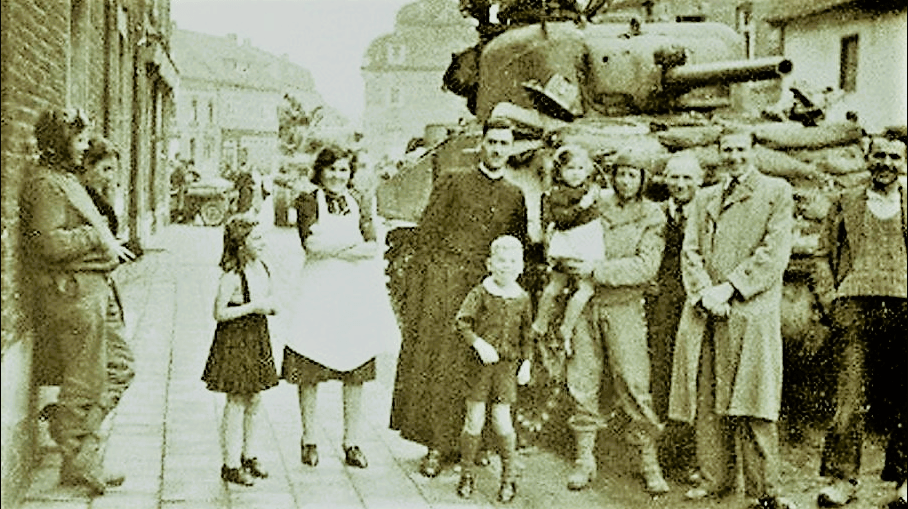

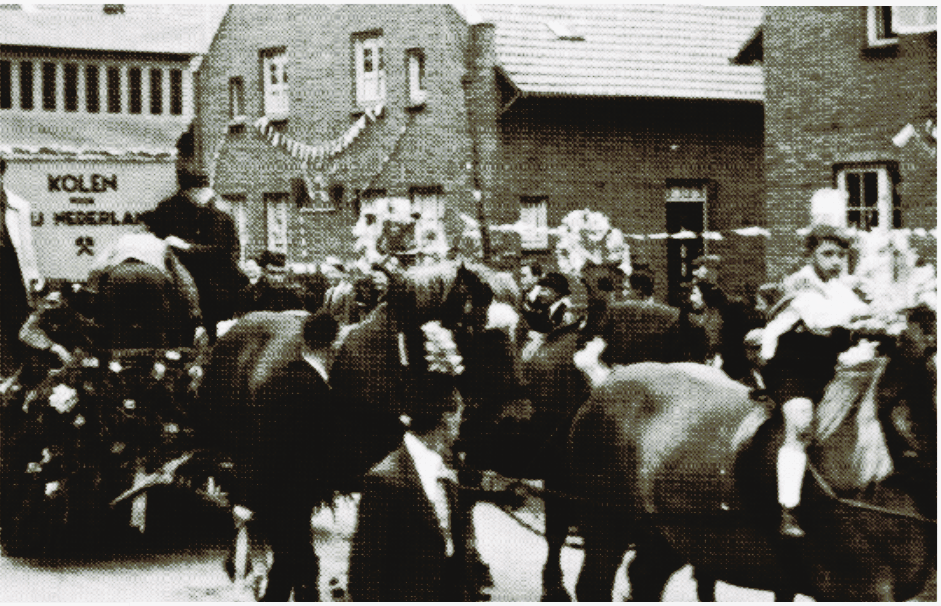
Below is an image of Vincent DiPaquale of the 116th Infantry Regiment, born in Buffalo, New York. He was one of the liberators.
Vincent DiPaquale served in the 116th Infantry Regiment, part of the 29th Infantry Division during World War II. This unit has a long and distinguished history, originating in the Virginia National Guard and earning the nickname “The Stonewall Brigade” during the Civil War. During World War II, the 116th Infantry Regiment played a crucial role, particularly in the D-Day landings on Omaha Beach on June 6, 1944. The regiment faced intense German resistance, suffering significant casualties but ultimately helping to secure the beachhead for the Allied invasion of Normandy.

Sources
https://www.4en5mei.nl/oorlogsmonumenten/zoeken/2634/geleen-hell-on-wheels
https://www.oorlogsbronnen.nl/bronnen?term=Bevrijding+Geleen
https://www.oorlogsbronnen.nl/thema/Bevrijding%20Geleen
https://www.kerkgebouwen-in-limburg.nl/kerken/geleen/kapel-norbertijnenstraat
Donation
Your readership is what makes my site a success, and I am truly passionate about providing you with valuable content. I have been doing this at no cost and will continue to do so. Your voluntary donation of $2 or more, if you are able, would be a significant contribution to the continuation of my work. However, I fully understand if you’re not in a position to do so. Your support, in any form, is greatly appreciated. Thank you. To donate, click on the credit/debit card icon of the card you will use. If you want to donate more than $2, just add a higher number in the box left from the PayPal link. Your generosity is greatly appreciated. Many thanks.
$2.00
 History of Sorts
Leave a comment