
We all know who Eva Braun was, yet so little is known about her family. I’ve always been intrigued by the fact that Eva’s parents—Eva, who was just 17 when she first met Adolf Hitler—didn’t seem to object to her involvement with a man whose intentions were clearly malevolent. Some might argue that Eva herself didn’t recognize the evil in Hitler, since love can be blind. But her parents and sisters? They must have seen the world unfolding around them.
Did they benefit from their connection to Hitler? Did they feel guilt or unease? Or did they simply go along, rendering themselves complicit in one of history’s darkest chapters?
In this blog, I aim to explore Eva Braun’s family—or at least attempt to shed some light on their story—while keeping emotion aside and focusing on the facts as objectively as possible.
Eva Braun (1912–1945), the longtime companion and short-term wife of Adolf Hitler, was born to Friedrich “Fritz” Braun and Franziska “Fanny” Braun. Here is what is known about them from established historical sources:
Friedrich “Fritz” Braun (1879–1964)
Profession: A schoolteacher and later a Realschule administrator (a type of German secondary school).
Military service: Served in the German Army during World War I.
Personality/history: Described as strict, conservative, and somewhat authoritarian within the family.
Later life: Lived through the postwar years quietly; unlike many Nazis’ families, he was not a political figure and remained relatively obscure.
Franziska “Fanny” Kronberger Braun (1885–1976)
Profession: A seamstress before marriage; later a homemaker.
Personality/history: Often noted as warmer and more indulgent with her children.
Marriage: She and Fritz had a turbulent relationship and separated for a time during Eva’s childhood, though they later reunited.
Longevity: Outlived most of her family, dying in 1976.
Family background
The Brauns were middle-class and Catholic, originally from Munich.
Eva was the middle of three daughters: Ilse (b. 1909) and Gretl (b. 1915).
The family had no political prominence, and neither parent was known to be actively involved in Nazism, though like many Germans in the period they were affected by the political climate.
Friedrich “Fritz” Braun

Friedrich “Fritz” Braun was born in Munich in 1879, at a time when Bavaria still carried the imprint of an older, quieter Germany—Catholic, rural at the edges, and steeped in tradition. He grew up in a society that valued discipline and civic duty, and these traits would shape both his career and his family life.
As a young man, Fritz became a teacher, a respectable and steady profession. He took pride in order, precision, and the moral seriousness that he believed education required. Those who knew him later often described him as rigid, a man of stern habits and clear expectations. But in early photographs he appears self-possessed rather than severe—a man who believed the path to a good life was straight and narrow.
In 1908, he married Franziska “Fanny” Kronberger, a seamstress from a small town near the Austrian border. The two were temperamentally mismatched from the very start: Fanny warm, social, and affectionate; Fritz proper, structured, and emotionally guarded. Yet they began building their household in Munich’s middle-class quarters, soon welcoming three daughters: Ilse in 1909, Eva in 1912, and Gretl in 1915.
World War I abruptly drew Fritz into uniform. Like many German men of his generation, he served dutifully and returned from the conflict older and more worn, carrying the disappointments of Germany’s defeat with him. His postwar years found him working in school administration—an occupation that suited his sense of order but offered little excitement. It was during this period that his marriage came under strain. Fanny found him controlling; he felt she was too indulgent with the girls. They separated briefly, then reconciled, settling back into a version of domestic life that worked largely because both accepted its limits.
Fritz Braun never expected notoriety, and he certainly did not seek it. When his middle daughter, Eva, became involved with Adolf Hitler, Fritz viewed the relationship with a mixture of discomfort and resignation. He neither embraced Nazism nor openly rejected it; like many middle-class Bavarians, he tried to keep politics as distant from his home as possible. Hitler’s ascending power, however, made that impossible. The Braun family received privileges—housing, financial help—largely through Eva’s position. Fritz benefited, though grudgingly and quietly, always careful to keep himself out of the Party’s machinery.
During the later 1930s and the war years, Fritz maintained the appearance of a respectable civil servant. He visited the Berghof—the alpine home where Hitler hosted Eva—but remained something of an outsider, tolerated rather than welcomed. He observed much and spoke little, a man who sensed that history had swept his family into a current he could neither approve nor resist.
When the Third Reich collapsed, he survived the end more or less untouched. Interrogated by the Allies, he was found to be politically insignificant and was released. His later years were quiet, lived in the shadow of a daughter whose name had become inseparable from one of history’s darkest figures. Fritz Braun never tried to reshape the narrative or clear his own reputation; he simply returned to an unremarkable life, just as he had once hoped for himself and his family.
He died in 1964 at the age of 84—an ordinary man linked to extraordinary events by the fate of his middle child, leaving behind a legacy defined not by what he did, but by who he was connected to.
Franziska “Fanny” Braun
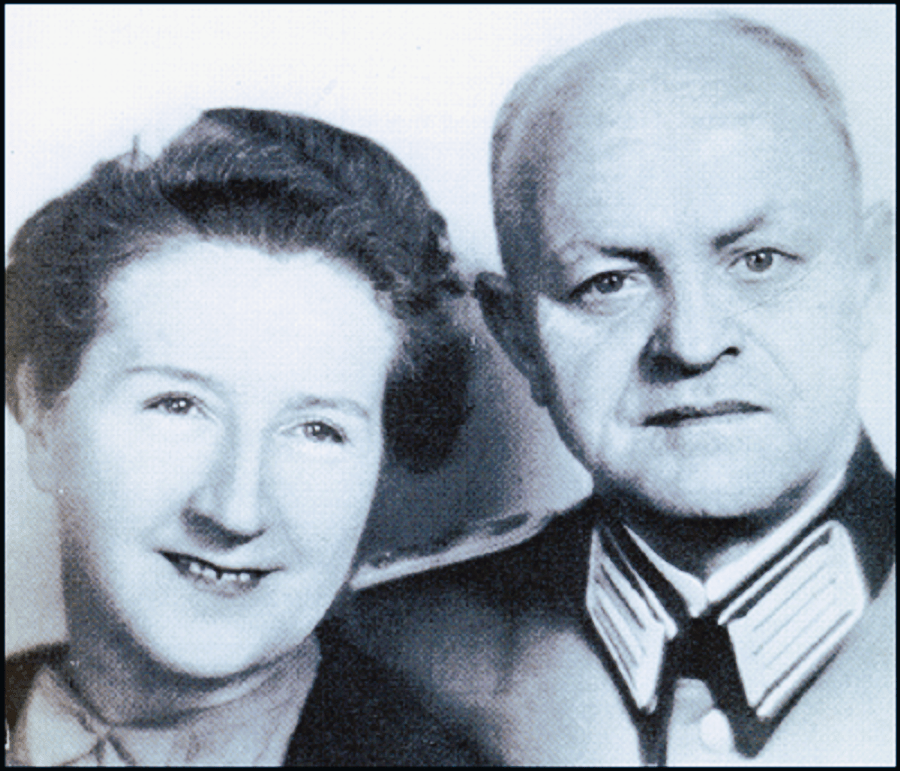
Franziska “Fanny” Kronberger was born in 1885 in Simbach am Inn, a modest Bavarian town positioned right against the Austrian border. Her early life was shaped by the rhythms of a small Catholic community—tight-knit, practical, and guided by family obligations. Unlike Fritz, who gravitated toward structure and formal education, Fanny was a creature of warmth and work: sociable, perceptive, and attuned to the unvoiced emotions of those around her.
As a young woman she trained as a seamstress, a profession that required patience and artistry. She had an eye for beauty—fabric, form, small embellishments—and carried that sensibility into her adult life. When she moved to Munich and married Friedrich “Fritz” Braun in 1908, she entered a marriage that offered stability but little natural harmony. Fritz wanted order; Fanny wanted connection. He believed in rules; she believed in people.
Their household was lively from the beginning: Ilse, then Eva, then little Gretl. Fanny embraced motherhood wholeheartedly. She worried, she fussed, she soothed scraped knees and jealous squabbles, and she worked quietly to soften her husband’s sharper edges when he became too stern. Where Fritz could be rigid, Fanny was pliant. Her daughters gravitated to her not just as caretaker but as confidante—the parent who listened first and judged last.
Yet the marriage was not easy. By the 1920s, strain had grown between them. Fanny resented Fritz’s inflexibility; he felt she lacked discipline. Their brief separation left its mark on the household, though they eventually reconciled, settling into a kind of truce that revolved around the children. Fanny continued to stitch together family life as best she could, holding the seams even when the fabric threatened to tear.
It was Fanny who sensed, earlier than her husband, that Eva’s connection to Adolf Hitler was something more than a passing fascination. At first she tried to dissuade her daughter, not out of political conviction but maternal intuition: she saw the imbalance in the relationship, the enormous emotional risks. But Eva was determined, and the Brauns were gradually drawn into the orbit of a man they neither chose nor fully understood.
Fanny’s visits to the Berghof were marked by a blend of discomfort and maternal loyalty. She enjoyed the mountain setting, disliked the stiff formality, and understood that she saw only the surface of her daughter’s strange, circumscribed life. She remained outwardly polite, inwardly uneasy. Unlike some families who capitalized openly on connections to power, the Brauns did so reluctantly and quietly.
During the war years, Fanny stayed rooted in Munich, maintaining a household that grew quieter as her daughters’ lives pulled them elsewhere. Letters from Eva, trips to the mountains, and occasional gestures from Hitler—flowers, gifts—kept a line of contact open but never eased Fanny’s underlying worry.
The end of the Third Reich broke the spell entirely. Fanny learned of Eva’s death in 1945 with a grief compounded by secrecy and shame. Interrogated by the Allies, she was cooperative and found to have played no political role. Her remaining years were marked by a complex mix of love, loss, and the delicate work of living with a past she had not chosen.
She lived until 1976—long enough to see several generations grow up in a Germany reshaped by memory and reckoning. Those who knew her in old age described her as kind, reserved, and quietly dignified, a woman who carried both sorrow and resilience in equal measure. In the end, her legacy was that of many mothers: she tried to protect her children, loved them fiercely, and endured the weight of history because she had no choice but to carry it.
Ilse Braun

Ilse Braun was the eldest of the Braun daughters—the one who arrived before the world grew strange around her family name. Born in 1909, she grew up in the familiar patterns of Munich’s middle-class life: church on Sundays, schoolwork during the week, family dinners governed by her father’s expectations and softened by her mother’s warmth. As the oldest, she learned early how to smooth conflicts and set an example. She was the daughter who carried herself with composure, whose quiet intelligence shaped her world more than ambition ever did.
As a young woman, Ilse found work in Heinrich Hoffmann’s photography studio, the same place where her sister Eva would later meet Adolf Hitler. Hoffmann’s studio was bustling, creative, and politically entangled, but Ilse navigated it with pragmatic detachment. She was competent, organized, and uninclined to seek the spotlight. While Eva’s presence in the studio turned into a fateful connection, Ilse remained a background figure—professional, observant, and increasingly aware that her family was being pulled into a current she did not control.
Ilse had her own brush with the Nazi elite when she became romantically involved with Carl Freiherr von Eberstein, a high-ranking SS officer. Their relationship, serious for a time, ultimately waned—perhaps because Ilse was wary of becoming too entangled, or perhaps because she sensed the volatility of political proximity. Either way, she withdrew quietly, the relationship fading without scandal.
As Eva became more deeply tied to Hitler, Ilse watched with a mixture of concern and resignation. She did not share her sister’s infatuation, nor did she publicly oppose it; she simply carried on, maintaining the steady presence she had always offered. She visited the Berghof occasionally, but unlike Gretl—who reveled in the social world that surrounded Eva—Ilse remained a reserved observer, careful never to be captured by its glamour.
After the war and Eva’s death, Ilse endured interrogation by Allied authorities but was deemed politically uninvolved. She slipped into a quieter life, far from the mythologized shadows that clung to her sister’s memory. She lived until 1979, an unassuming survivor who spent her later years respecting silence—about the Reich, about Eva, about the strange twist of history that had brushed against her but never defined her.
Ilse lived like a person determined to reclaim ordinary life, and in that determination she succeeded.
Margarete “Gretl” Braun

If Ilse was the steady eldest and Eva the restless middle child, Gretl Braun was the spirited youngest—the lively, social daughter whose charm earned her a favored place in the family. Born in 1915, she grew up indulged by her mother and admired by her sisters for her effortless brightness. Gretl had the kind of open, cheerful nature that made people draw near, and she flourished in company.
As she entered adulthood, Gretl became Eva’s closest confidante. Where Ilse held back, Gretl leaned in. She accompanied Eva to parties, to gatherings at the Berghof, to holidays in the Alps. She was welcomed warmly, for she brought ease to rooms heavy with hierarchy. Eva trusted her with secrets, relied on her laughter, and found in her the familial closeness that Hitler’s inner circle otherwise lacked.
It was at one of these social crosscurrents that Gretl met Hermann Fegelein, an ambitious SS officer who combined charm, opportunism, and ruthlessness in equal measure. Fegelein saw in Gretl both genuine appeal and political advantage, and Gretl—young, romantic, eager for joy—fell for him quickly. Their 1944 wedding at the Berghof was one of the last great celebrations before the Reich began to collapse. Hitler attended; Himmler was Fegelein’s best man; Eva glowed with pride. The event was less a marriage than a moment of theatrical spectacle on the edge of catastrophe.
Gretl’s happiness was short-lived. Fegelein, whose survival instincts outweighed his loyalty, attempted to flee Berlin in April 1945. He was arrested and executed on Hitler’s orders. Gretl, pregnant at the time, gave birth to their daughter in the ruins of a defeated Germany.
Unlike Ilse, whose postwar life was shaped by restraint, Gretl reinvented herself. She remarried in 1954, choosing a man far from politics and far from the darkness of her youth. She lived in Bavaria for the rest of her life, raising her daughter and maintaining a conspicuous privacy. Though the world knew her name, she rarely spoke of her past. She had lived through luxury, catastrophe, widowhood, and reinvention, and her silence seemed a way to preserve the ordinary life she had finally managed to build.
Gretl died in 1987, the last surviving Braun sister, leaving behind a life that had been pulled into the gravity of power and then spun outward again into something more quietly human.
The Psychological Portrait of the Braun Family
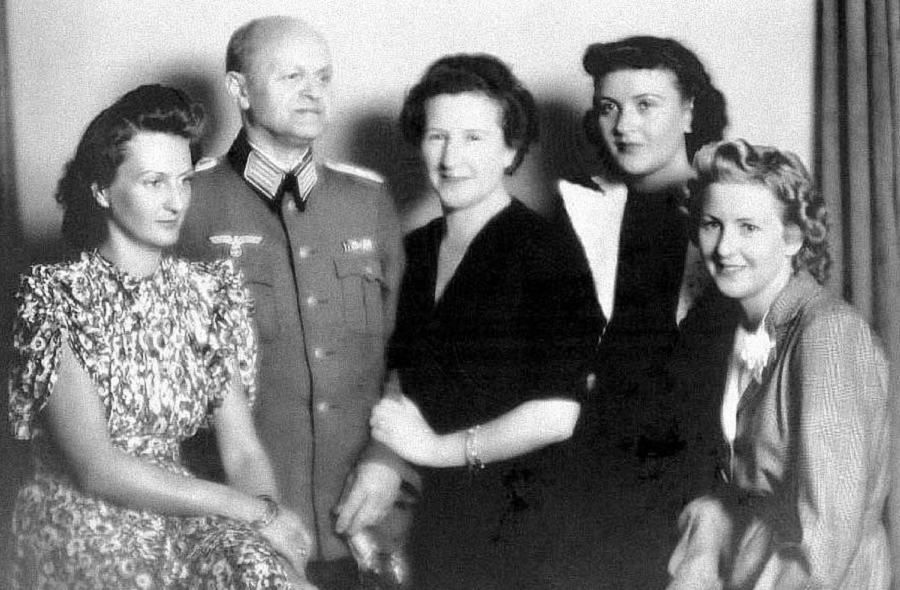
The Braun family was a study in contrasts: the tension between discipline and warmth, conformity and curiosity, authority and affection. These contrasts shaped the emotional landscape in which Eva and her sisters grew up.
Friedrich “Fritz” Braun: Authority and Order
Fritz was the archetype of middle-class Bavarian discipline. As a teacher and later school administrator, he believed in structure, rules, and moral rectitude. Psychologically, he was a man of control: controlling his environment, his household, and, often, his daughters’ behavior. He valued achievement and respectability, which led to tension with the more expressive members of his family.
Strengths: Responsibility, steadiness, consistency.
Weaknesses: Rigidity, emotional reserve, occasional authoritarianism.
Impact on children: Fritz’s sternness instilled discipline but may have encouraged Eva’s secretive and independent tendencies, as she often sought approval while simultaneously creating her own inner world.
Franziska “Fanny” Braun: Nurturance and Emotional Intelligence
Fanny served as the emotional anchor of the family. Warm, perceptive, and socially attuned, she counterbalanced Fritz’s rigidity. She nurtured her daughters, soothed conflicts, and fostered intimacy in a household otherwise governed by rules. Psychologically, Fanny embodied empathy and resilience.
Strengths: Compassion, emotional intelligence, flexibility.
Weaknesses: Over-indulgence, occasional conflict avoidance.
Impact on children: Fanny’s warmth gave the daughters a safe emotional base, especially Eva, who relied heavily on maternal support. Fanny’s influence likely shaped Gretl’s sociability and Ilse’s capacity for empathy.
Ilse Braun: Observation and Self-Restraint
The eldest daughter, Ilse, was reflective and measured. Psychologically, she was cautious, pragmatic, and reserved, often acting as a stabilizing figure. She absorbed the dynamics of her family and the outside world without drawing undue attention.
Strengths: Prudence, patience, discretion.
Weaknesses: Emotional withdrawal, risk-aversion.
Behavioral pattern: Ilse maintained a low profile, both personally and socially, perhaps as a coping mechanism to navigate a household dominated by Fritz’s authority and the unpredictability of Eva’s ambitions.
Eva Braun: Secrecy and Ambition
The middle daughter, Eva, was lively, ambitious, and emotionally complex. She oscillated between craving maternal affection and seeking escape from her father’s control. Psychologically, she demonstrated high resilience and adaptability, combined with a strong desire for approval and recognition, which ultimately led her into Hitler’s orbit.
Strengths: Determination, charm, adaptability.
Weaknesses: Dependency on powerful figures, emotional secrecy, risk-taking.
Behavioral pattern: Eva’s private nature and pursuit of validation were likely shaped by the family’s blend of rigidity and warmth. Her need for a safe, approving environment made her both loyal and discreet in her adult relationships.
Gretl Braun: Sociability and Emotional Resilience
The youngest daughter, Gretl, was cheerful, engaging, and outwardly confident. Psychologically, she sought connection and validation through interpersonal relationships. Unlike Eva, she was less secretive and more socially flexible, but she shared her sister’s resilience and capacity to endure adversity.
Strengths: Charm, adaptability, relational intelligence.
Weaknesses: Naivety, susceptibility to influence.
Behavioral pattern: Gretl’s warmth and sociability allowed her to navigate the dangerous social currents surrounding the family, yet her later life demonstrates strong psychological recovery after personal and historical trauma.
Family Dynamics: Patterns and Influences
Control vs. Freedom: Fritz’s authoritarianism and Fanny’s indulgence created a tension that shaped the daughters’ personalities. Eva internalized both—seeking approval while secretly exercising autonomy.
Affection and Emotional Safety: Fanny’s nurturance mitigated the rigidity of Fritz, providing a psychological refuge that allowed the daughters to develop resilience and social competence.
Sibling Roles: Ilse as the cautious observer, Eva as the ambitious middle child, and Gretl as the sociable youngest show a classic pattern of birth-order influence, magnified by the family’s social pressures.
Response to External Stress: The family’s encounters with Nazi society illustrate contrasting coping mechanisms: Fanny and Ilse remained cautious and private, Eva sought proximity to power, and Gretl navigated social engagement with resilience.
Overall Psychological Portrait
The Brauns were a microcosm of middle-class Bavarian life under pressure: structured yet affectionate, private yet exposed to history’s unfolding drama. Each family member’s personality reflects the balance of authoritarianism and warmth, secrecy and sociability, ambition and caution. Together, they formed a family unit shaped not just by genetics or upbringing, but by the extraordinary historical circumstances into which they were born.
Some images are AI generated
sources
https://spartacus-educational.com/Ilse_Braun.htm
https://en.wikipedia.org/wiki/Ilse_Braun
https://www.findagrave.com/memorial/139887128/franziska_katharina-braun
https://en.wikipedia.org/wiki/Gretl_Braun
https://www.findagrave.com/memorial/139887559/otto_wilhelm_friedrich-braun
https://www.findagrave.com/memorial/126497030/margarete_berta-berlinghoff
https://www.findagrave.com/memorial/126497030/margarete_berta-berlinghoff
https://allthatsinteresting.com/gretl-braun
https://www.biography.com/history-culture/eva-braun
Donation
Your readership is what makes my site a success, and I am truly passionate about providing you with valuable content. I have been doing this at no cost and will continue to do so. Your voluntary donation of $2 or more, if you are able, would be a significant contribution to the continuation of my work. However, I fully understand if you’re not in a position to do so. Your support, in any form, is greatly appreciated. Thank you. To donate, click on the credit/debit card icon of the card you will use. If you want to donate more than $2, just add a higher number in the box left from the PayPal link. Your generosity is greatly appreciated. Many thanks.
$2.00
 History of Sorts
Leave a comment