I could post thousands of photographs of victims every day or share disturbing and graphic images—some so horrific that we instinctively turn away. We avert our eyes because we cannot fathom the depth of the evil displayed before us. It seems impossible to comprehend how any human being could commit such atrocities against another.
And yet, that is the uncomfortable truth: both the victims and the perpetrators were human beings. It is easy and tempting to label those who committed these unspeakable acts as monsters. But to do so is a mistake, for it offers them an excuse. What do we expect from monsters? We expect them to commit terrible deeds—it’s in their nature.
The truth is far more unsettling. Many of those who carried out these horrors were ordinary people: clerks, bakers, butchers, painters, husbands, wives, mothers, and fathers. They were not all political leaders or dictators. Often, it was the everyday person who became complicit. And their victims? Innocent human beings who happened to be Jewish, Jehovah’s Witnesses, homosexuals, disabled, Roma, or individuals who dared to stand against a brutal regime. They were victims of hatred and warped ideologies.
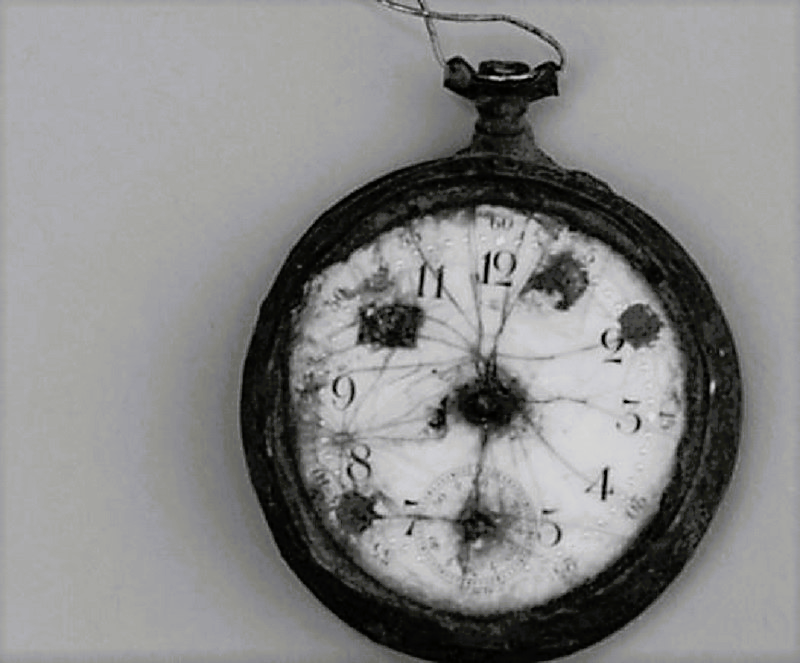
Consider something as small and personal as a pocket watch found among the belongings of inmates at Auschwitz. Its owner once had an anticipation of time—a birthday to celebrate, a friend to meet, a lunch to share, or a moment to read the newspaper. And then, in an instant, that anticipation was stolen. Time itself was reduced to a cruel countdown: the days, hours, minutes, or seconds left to live.
As human beings, as citizens of the world, it is our duty to remember this shared humanity. We have the capacity to inflict unspeakable harm and chaos, but we also hold the power to be the solution. If we allow such horrors to happen again, we have failed—not just the victims of the past but also ourselves. Tragically, it seems we are already beginning to repeat the same mistakes.
The Silent Witness
In shadows deep, a relic lay,
Its tarnished face marked time’s decay.
A pocket watch, its chain long torn,
Its golden gleam—now faded, worn.
What stories slept within its shell?
What truths did it know but could not tell?
A heartbeat stilled, a life erased,
Yet here, its echoes faintly traced.
The hands once turned with steady grace,
Marking moments, time’s embrace.
Perhaps it ticked in joyful air,
A gift of love, a mother’s care.
But silence claimed its ticking breath,
Amid the march of senseless death.
In Auschwitz, where all shed hope,
The watch bore witness to the dead.
Did its owner clutch it tight,
A fragile link to days of light?
Or did it fall, unseen, unknown,
As footsteps led to fields of stone?
Now it rests, a solemn thread,
Binding living to the dead.
A memory held in metal’s chill,
A fragment of a broken will.
Oh, silent watch, your face—is scarred,
Your meaning—heavy, edges charred.
Yet in your quiet, you remain,
A timeless cry, a ghost of pain.
You mark not hours, nor days, nor years,
But human loss and endless tears.
A relic lost, a witness found,
Your story whispers—deep, profound.
Source


Leave a Reply