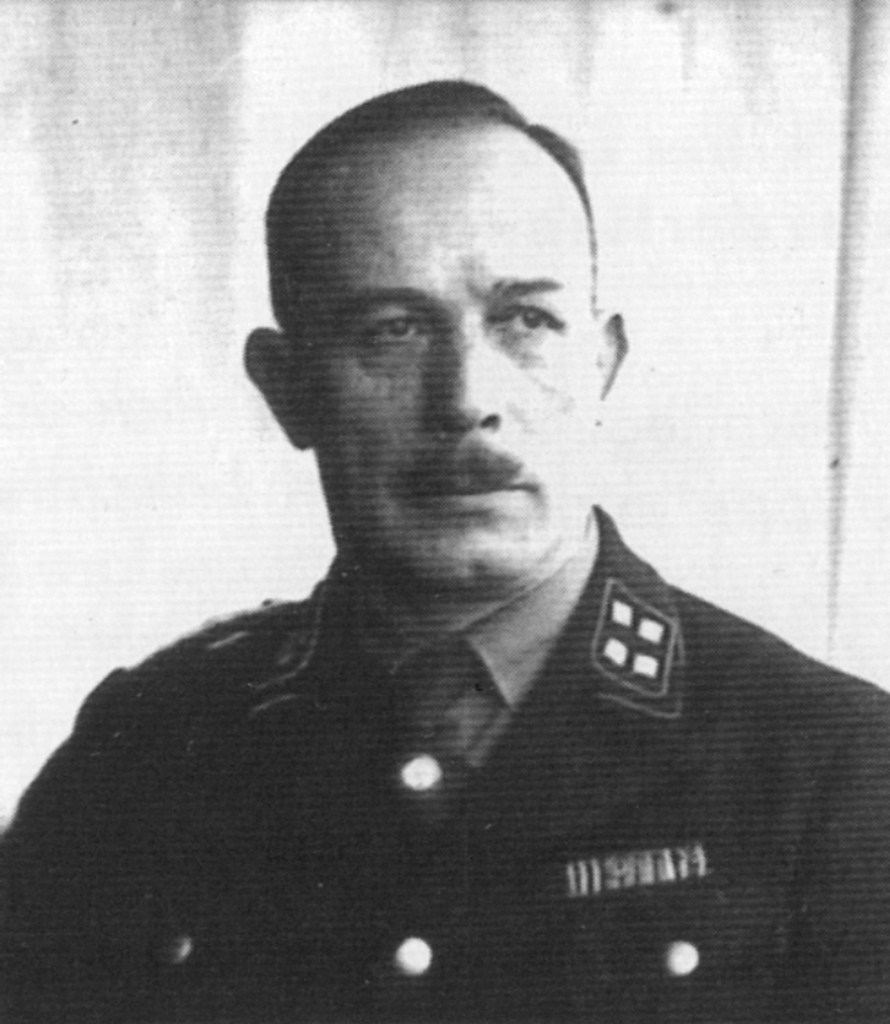
5 Months=137,346 deaths, that is the disturbing mathematical equation that could be made from the Jäger report. Not human beings, just numbers on a spreadsheet created by a man who claimed “I was always a person with a heightened sense of duty”
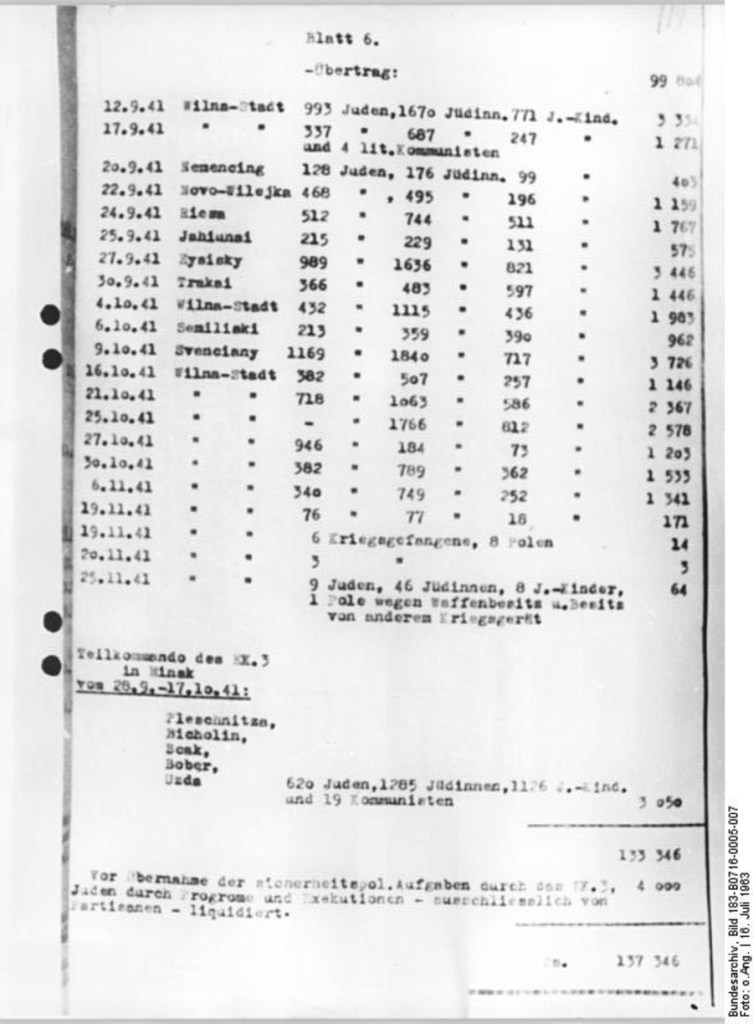
The Jäger Report (full title: Complete tabulation of executions carried out in the Einsatzkommando 3 zone up to December 1, 1941) is arguably the most chilling document of the Holocaust. Written by SS-Standartenführer Karl Jäger, commander of Einsatzkommando 3 (a sub-unit of Einsatzgruppe A), it provides a meticulous, day-by-day bureaucratic tally of the mass murder of 137,346 people—the vast majority of whom were Lithuanian Jews.
The report is historically significant not just for its scale, but for its clinical, cold-blooded depiction of genocide as a successful “administrative task”.
It is the most detailed and precise surviving chronicle of the activities of one individual Einsatzkommando, and a key record documenting the Holocaust in Lithuania as well as in Latvia and Belarus.
The report emerged from the violent campaign that followed Operation Barbarossa, launched on June 22, 1941. As German forces advanced into Soviet territory, special SS units known as the Einsatzgruppen were tasked with eliminating individuals considered enemies of the Nazi regime—primarily Jews, but also Communist officials, Roma, and other targeted groups.
One of these units, Einsatzkommando 3, operated mainly in Lithuania and parts of Belarus. Under the command of Karl Jäger, the unit carried out mass shootings at numerous sites throughout the region between July and November 1941.
These killings were frequently conducted with the assistance of local collaborators and auxiliary police forces. Victims were typically gathered in ghettos or villages, transported to execution sites—often forests or large pits—and then shot in mass executions.
Karl Jäger, an SS-Standartenführer and mid-ranking official in the SS of Nazi Germany, commanded Einsatzkommando 3. Among the many surviving Nazi documents describing mass murder and other atrocities, the so-called Jäger Report stands as one of the most chilling. The document provides a meticulous record of the killing operations carried out by this unit in Nazi-occupied territories of the Soviet Union.
The report carefully itemizes the victims, typically categorizing them as “Jewish men,” “Jewish women,” and “Jewish children.” It begins with the heading:
“Secret Reich Business!
5 copies
Complete list of executions carried out in the EK 3 area up to 1 December 1941.”
What follows is a day-by-day listing of executions. Typical entries include:
20 September 1941 – Nemencing
128 Jews, 176 Jewesses, 99 Jewish children
22 September 1941 – Novo-Wilejka
468 Jews, 495 Jewesses, 196 Jewish children
24 September 1941 – Riess
512 Jews, 744 Jewesses, 511 Jewish children
25 September 1941 – Jahiunai
215 Jews, 229 Jewesses, 131 Jewish children
27 September 1941 – Eysisky
989 Jews, 1,636 Jewesses, 821 Jewish children
In the report, Jäger describes the execution process with stark administrative detachment. Victims were rounded up, transported to remote areas, and systematically shot—men, women, and children alike. As the report states:
“Depending on the number of Jews, a place for the graves had to be found and the graves dug. The distance from the assembly point to the graves was on average four to five kilometers. The Jews were transported in detachments of 500 to the execution area, with a distance of at least two kilometers between them.”
Jäger continued by explaining how the extermination campaign had been organized. According to his account, the objective of making Lithuania “free of Jews” required the deployment of a mobile killing unit commanded by SS First Lieutenant Hamann, whose task was to coordinate operations with Lithuanian collaborators and local authorities.
He described the killings primarily as a logistical and organizational problem. Each operation required careful preparation and reconnaissance of the local area. Jewish residents were first assembled at designated gathering points. Depending on their numbers, pits were dug at nearby execution sites—usually several kilometers away. Victims were then marched to these locations and shot.
As Jäger explained:
“The implementation of such activities is primarily a question of organization. The decision to systematically make every district free of Jews necessitated exhaustive preparation of each individual operation and reconnaissance of the prevailing circumstances in the district. The Jews had to be assembled at one or several locations. Depending on the number, a place for the required pits had to be found and the pits dug. The marching route from the assembly place to the pits amounted on average to four to five kilometers. The Jews were transported to the place of execution in detachments of 500, at intervals of at least two kilometers.”
He even described the killings in terms of operational difficulty, citing a specific example:
“In Rokiskis, 3,208 people had to be transported 4.5 kilometers before they could be liquidated. To accomplish this task in 24 hours, more than 60 of the 80 available Lithuanian partisans had to be allocated for transportation and cordoning-off duty.”
The chilling effect of the document lies not only in the scale of the atrocities it records, but also in the detached administrative language used to describe them. Mass murder is reduced to logistical planning, manpower allocation, and operational efficiency—revealing how genocide was bureaucratically organized and systematically implemented during the early phase of the Holocaust following Operation Barbarossa.

After the end of World War II, Karl Jäger managed to evade capture by the Allied authorities. Living under a false identity, he returned to civilian life and worked as a farm laborer for several years.
His role in the mass killings carried out by Einsatzkommando 3 remained largely unknown until March 1959, when the Jäger Report was rediscovered by investigators. The document provided detailed evidence of the systematic murder of tens of thousands of Jews in Lithuania and surrounding regions during 1941.
Following this discovery, Jäger was arrested and charged with crimes related to his actions during the Holocaust. While awaiting trial, he took his own life, hanging himself in prison in Hohenasperg Prison in June 1959.
sources
https://collections.ushmm.org/search/catalog/irn502488
https://pages.uoregon.edu/dluebke/NaziGermany443/JaegerReport.htm
https://www.tandfonline.com/doi/abs/10.1080/17504902.2022.2058727
https://en.wikipedia.org/wiki/J%C3%A4ger_Report
https://fcit.usf.edu/holocaust/resource/document/DocJager.htm
Donation
Your readership is what makes my site a success, and I am truly passionate about providing you with valuable content. I have been doing this at no cost and will continue to do so. Your voluntary donation of $2 or more, if you are able, would be a significant contribution to the continuation of my work. However, I fully understand if you’re not in a position to do so. Your support, in any form, is greatly appreciated. Thank you. To donate, click on the credit/debit card icon of the card you will use. If you want to donate more than $2, just add a higher number in the box left from the PayPal link. Your generosity is greatly appreciated. Many thanks.
$2.00

 History of Sorts
Leave a comment