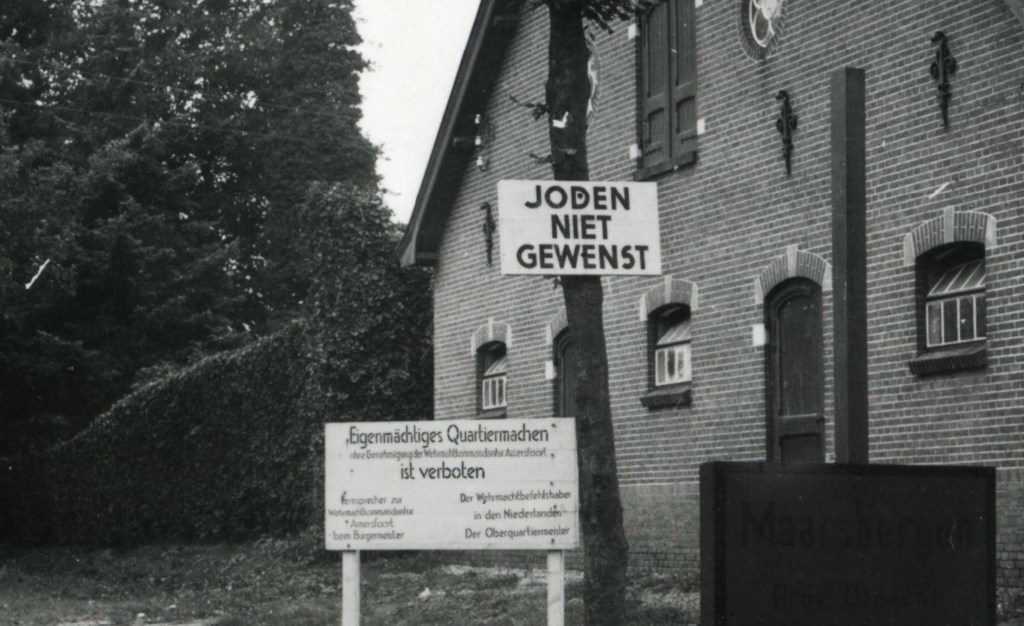
Sign ‘Jews not welcome’, Maarsbergen
On the eve of World War II, the Jewish population of the Netherlands numbered approximately 140,000–150,000 people, representing about 1.5 percent of the country’s total population.
The community was highly urbanized, with Amsterdam serving as its undisputed cultural and demographic center. Known affectionately by its Hebrew-derived nickname Mokum (“place” or “city”), Amsterdam was home to nearly half of all Dutch Jews—approximately 75,000 to 80,000 individuals. Significant Jewish communities also existed in Rotterdam, The Hague, and several provincial textile centers, including Enschede.
A Century of Integration and Emancipation
The foundations of modern Dutch Jewish life were laid in 1796, when the Batavian Republic granted Jews full legal and civil equality. This emancipation occurred earlier than in many other European countries and facilitated a gradual but profound integration into Dutch society.
By the 1930s, roughly 85 percent of Dutch Jews belonged to families that had lived in the Netherlands for generations, often for centuries. Most identified strongly as Dutch citizens who happened to be Jewish, rather than as members of a separate national or ethnic community.
This long period of stability encouraged significant assimilation. Secularization was widespread, intermarriage rates were increasing, and Jews participated actively in mainstream Dutch political, cultural, and economic life. Many were particularly prominent within liberal and socialist movements, reflecting the broader political currents of Dutch society.
Cultural and Economic Diversity
Although united by a shared Dutch civic identity, the Jewish community retained the legacy of two major historical traditions.
Sephardic Jews
The Sephardim, often referred to as Portuguese Jews, arrived primarily during the late sixteenth and seventeenth centuries after fleeing persecution and forced conversion under the Spanish and Portuguese Inquisitions. They established one of Europe’s most distinguished Jewish communities and became closely associated with Amsterdam’s emergence as a global commercial center.
Historically, Sephardic Jews occupied prominent positions in international trade, finance, scholarship, and publishing, forming much of the community’s cultural and economic elite.
Ashkenazi Jews
The Ashkenazim arrived somewhat later, migrating from Central and Eastern Europe to escape persecution, economic hardship, and legal restrictions. Over time they came to vastly outnumber the Sephardim.
While some Ashkenazi families achieved considerable wealth and influence, the majority formed a dynamic urban working and middle class. Many lived in Amsterdam’s traditional Jewish neighborhoods and worked in industries such as diamond cutting, textiles, manufacturing, and market trade. Their institutions, cultural organizations, and political movements contributed significantly to the vitality of Jewish life in the Netherlands.
The Refugee Crisis of the 1930s
The character of Dutch Jewry began to change following the rise of Adolf Hitler and the Nazi regime in Germany in 1933.
Throughout the 1930s, an estimated 24,000 to 30,000 Jewish refugees fled Germany and Austria and sought refuge in the Netherlands. Among these refugees was the family of Anne Frank, whose story would later become one of the most widely known accounts of the Holocaust.
The established Dutch Jewish community organized extensive relief networks to provide housing, financial assistance, education, and social support for the newcomers. As refugee numbers increased, the Dutch government sought to centralize their accommodation and administration. In 1939, it established the Westerbork Transit Camp in the northeastern Netherlands as a refugee reception center.
Tragically, after the German occupation, this facility was transformed into the principal transit camp from which Dutch Jews were deported to Nazi concentration and extermination camps.
The Historical Paradox
One of the great tragedies of Dutch Jewish history lies in the paradox that many of the qualities that had enabled the community to flourish before the war were later exploited by the occupiers. The Netherlands possessed highly efficient municipal administration, comprehensive population registers, and a population accustomed to cooperating with public institutions. Dutch Jews themselves were deeply integrated into this civic framework.
After 1940, Nazi authorities systematically used these administrative structures to identify, register, isolate, and deport Jewish citizens with devastating efficiency. The result was catastrophic: approximately 75 percent of the Jewish population of the Netherlands was murdered during the Holocaust—the highest proportion of Jewish victims in Western Europe.
The Gradual Extermination
Like in Germany, the Holocaust in the Netherlands did not occur overnight. It was the result of a gradual, deliberate, and systematic process through which Jewish citizens were progressively isolated, deprived of their rights, excluded from public life, and ultimately deported to their deaths. Step by step, the German occupation authorities implemented anti-Jewish measures that transformed a well-integrated community into a persecuted and vulnerable population. What began with registration, discrimination, and social segregation eventually culminated in mass deportation and extermination.
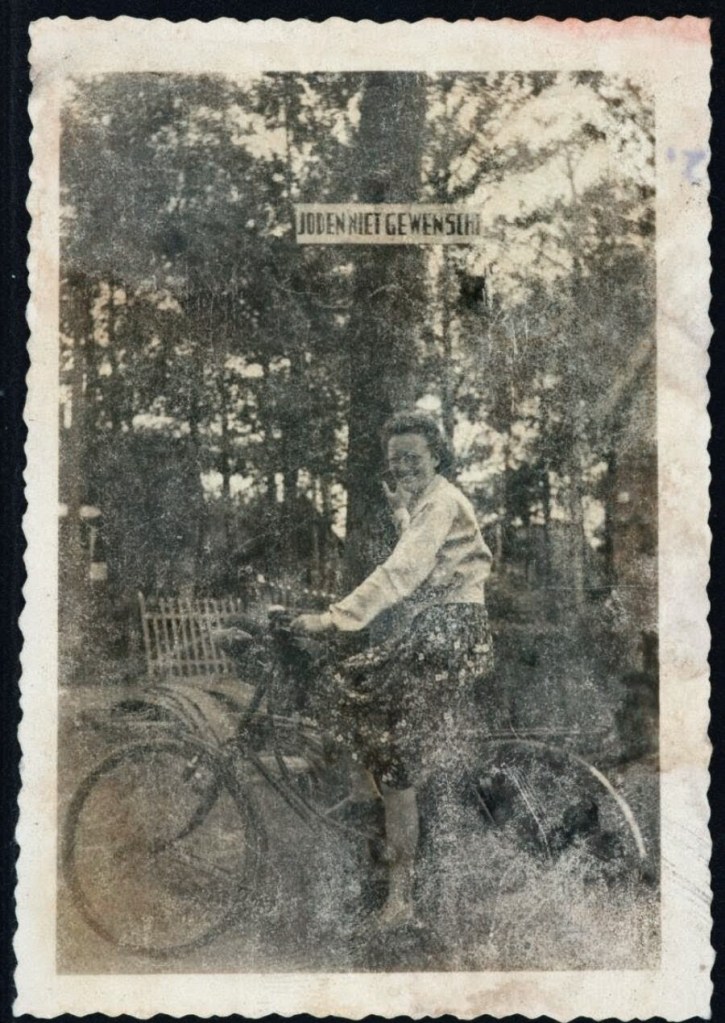
The youth organization of the NSB
Since early 1941, Jews in the Netherlands had been confronted with new measures that interfered with their lives almost every week.
A small selection:
10 April 1941: Jews are not allowed to move away from Amsterdam.
15 April 1941: Jews have to turn in their radios.
1 May 1941: Jewish doctors, pharmacists, midwives, estate agents, translators, and lawyers may only serve other Jews.
1 May 1941: Jews are not allowed to enter the stock exchange.
2 May 1941: Jews can no longer work in journalism.
6 May 1941: Certain streets in Amsterdam are classified as ‘Jewish streets’ and ‘Jewish canals’.
15 May 1941: Jewish musicians are fired from orchestras.
31 May 1941: Jews are not allowed on the beach, to parks, swimming pools, or hotels.
27 June 1941: Jewish shops have to close on Sundays.
15 September 1941: ‘Forbidden for Jews’ signs appear on libraries, restaurants, sports fields, markets, reading rooms, and museums.
15 September 1941: Jews must ask permission to change their place of residence.
5 September 1941: ‘Jewish premises’ signs appear on Jewish bars and theatres that are off-limits to non-Jews.
10 October 1941: Jewish shops must make themselves known as such.
22 October 1941: Jews need a permit for every profession.
22 October 1941: Jews may not be members of associations and sports clubs with non-Jewish members.
23 October 1941: Jews are not allowed to emigrate.
24 October 1941: Jews are not allowed to works for non-Jews.
1 November 1941: German Jews lose their German nationality.
7 November 1941: Jews are not allowed to travel or move without a permit.
26 November 1941: Jewish stamps and antiques shops are closed.
5 December 1941: Non-Dutch Jews have to report for voluntary emigration.
1 January 1942: Non-Jews are not allowed to work for Jews.
23 January 1942: Jews are not allowed to drive cars.
20 March 1942: Jews are not allowed to sell furniture or other household goods.
25 March 1942: Jews are not allowed to marry at City Hall.
25 March 1942: Jews and non-Jews are not allowed to marry.
24 April 1942: Most Jewish butchers are closed down.
29 May 1942: Jews are not allowed to go fishing.
5 June 1942: Jews are not allowed to travel without prior permission.
12 June 1942: Jews are not allowed to buy fruit and vegetables at non-Jewish shops.
12 June 1942: Jews have to hand in their bicycles and other means of transport.
12 June 1942: Jews are not allowed to play sports.
30 June 1942: Jews are not allowed to be on the streets after 8 o’clock in the evening and before 6 o’clock in the morning.
30 June 1942: Jews are not allowed to work as street vendors or deal in rags, used metal, or waste.
30 June 1942: Jews are not allowed to use payphones.
30 June 1942: Jews are only allowed in non-Jewish shops between 3 and 5 pm.
6 July 1942: Jews are not allowed to visit non-Jews.
1 August 1942: Jewish street names are changed.
August 1942: Jews are not allowed to have telephones.
15 September 1942: Jewish students are excluded from schools and universities.
sources
https://www.annefrank.org/en/timeline/219/forbidden-for-jews
https://www.kampwesterbork.nl/en/education
https://www.yadvashem.org/righteous/stories/netherlands-historical-background.html


Leave a Reply