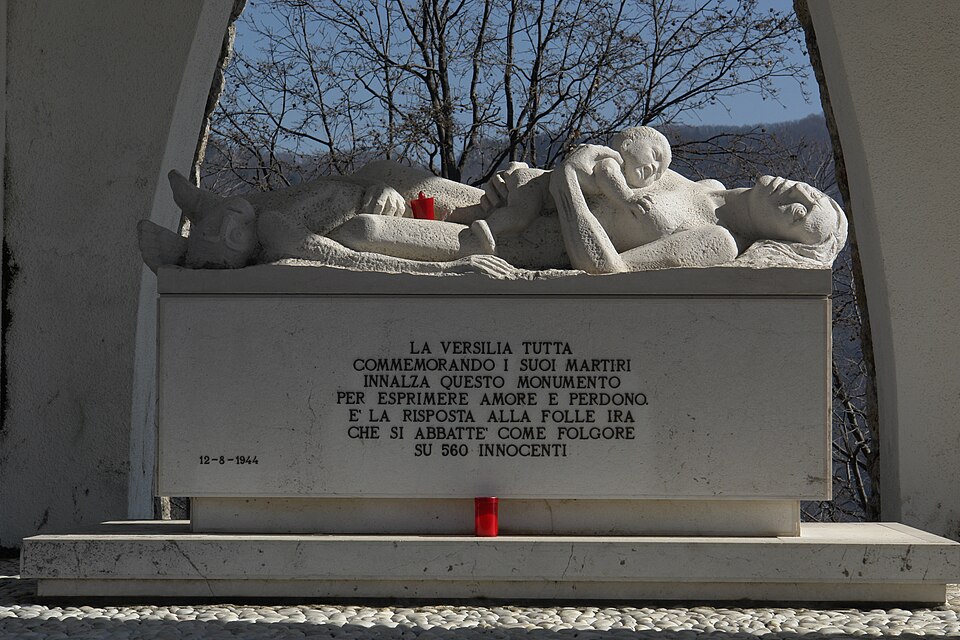
The Sant’Anna di Stazzema massacre remains one of the most egregious and devastating war crimes committed against civilians on Italian soil during the Second World War. On the morning of August 12, 1944, the small mountain village of Sant’Anna di Stazzema, nestled in the Tuscan Apennines, became the scene of a systematic slaughter. Over the course of several hours, Nazi forces murdered an estimated 560 civilians, overwhelmingly women, children, and the elderly. For decades, the memory of the atrocity was obscured by geopolitical considerations and institutional silence, transforming the village into a profound symbol both of the horrors of total war and of the long, arduous struggle for historical justice.
Historical Context and the Gothic Line
By the summer of 1944, the Italian Campaign had reached a critical turning point. As Allied forces advanced northward up the Italian peninsula, the German army began a fighting retreat toward the Gothic Line, a formidable defensive network stretching across the Apennine Mountains. Sant’Anna di Stazzema lay within this volatile zone, only a few kilometers from active front-line positions.
Because of its isolated location, accessible primarily by narrow mountain paths, the village had become a refuge for thousands of displaced civilians from the coastal plains of Versilia. Many believed that the remote settlement would offer protection from Allied bombing and the intensity of the fighting. As a result, the local population swelled from roughly 400 inhabitants to more than 1,500.
At the same time, Italian partisan groups were active throughout the surrounding forests and mountains, posing a threat to German supply and communications routes. German occupation authorities responded with increasingly brutal anti-partisan measures. Field Marshal Albert Kesselring had authorized severe reprisals against populations suspected of aiding resistance movements. Historical research, including that of historian Paolo Pezzino, indicates that the operation at Sant’Anna was not simply a spontaneous act of retaliation for a specific partisan attack. Rather, it formed part of a broader campaign of systematic repression intended to destroy the human and material resources that could sustain the resistance.
The Morning of August 12, 1944
At dawn on August 12, approximately 300 soldiers from the 16th SS Panzergrenadier Division Reichsführer-SS surrounded Sant’Anna di Stazzema. Divided into several columns and accompanied by Italian Fascist collaborators who served as guides, the SS units advanced into the main village and surrounding hamlets.
The operation quickly descended into systematic violence. Many adult men, believing that the Germans were conducting a roundup for forced labor, fled into the surrounding woods. Their departure left behind women, children, and elderly relatives who believed they would be spared. Instead, the SS troops entered homes, dragged civilians into gathering points, and herded them into squares, stables, barns, and other buildings before opening fire with machine guns and other weapons.
The scale of the killing was horrific. Civilians were massacred in multiple locations throughout the village and surrounding hamlets, and buildings were set ablaze with victims still inside. Among the estimated 560 dead were more than 100 children, including infants only weeks old.
Amid the slaughter, individual acts of extraordinary courage emerged. The parish priest, Don Innocenzo Lazzeri, reportedly pleaded with the SS to spare his parishioners and was subsequently killed. Survivors such as Cesira Pardini and Milena Bernabò risked their lives to protect and rescue children amid the violence.
By the time the perpetrators withdrew, much of Sant’Anna had been destroyed. Homes and buildings had been burned, livestock had been killed, and hundreds of families had been shattered. The massacre was not an isolated incident: the SS units continued their operations through the surrounding valleys as part of a wider campaign of violence against the civilian population.

The “Cupboard of Shame” and the Belated Search for Justice
Despite the scale of the massacre, the survivors of Sant’Anna di Stazzema were denied meaningful legal accountability for decades. After the war, documentation concerning Nazi-Fascist massacres in Italy was placed in military archives and effectively removed from public scrutiny.
A major breakthrough came in 1994, when a military prosecutor discovered a locked cabinet in the Palazzo Cesi-Gaddi in Rome. The cabinet contained hundreds of files documenting Nazi-Fascist atrocities committed throughout Italy, including the massacre at Sant’Anna di Stazzema. The discovery became known as the armadio della vergogna, or “Cupboard of Shame.”
The files had been effectively shelved during the post-war period, a decision historians have linked to the political and diplomatic circumstances of the early Cold War. The reluctance to pursue prosecutions reflected, among other factors, Italy’s desire to avoid destabilizing relations with West Germany and the broader political imperative of confronting neither the country’s Fascist past nor the full extent of wartime collaboration.
The discovery reopened the possibility of legal proceedings. In 2004, a trial began before the Military Tribunal of La Spezia. In June 2005, ten former members of the SS were convicted in absentia and sentenced to life imprisonment for their roles in the massacre. Among those convicted were Gerhard Sommer, Heinrich Schendel, and Werner Bruss.
Yet the verdicts brought little practical punishment. Germany did not extradite the convicted men, and a parallel investigation by German prosecutors in Stuttgart was eventually closed in 2012 on the grounds that there was insufficient evidence to establish the individual criminal responsibility of the suspects. As a result, none of those convicted in Italy ultimately served a prison sentence.
Legacy and the National Park of Peace
Although the judicial process failed to deliver tangible punishment for the perpetrators, Sant’Anna di Stazzema transformed its collective trauma into a powerful mission of remembrance and education. Survivors and their descendants worked for decades to reconstruct the history of the massacre, preserve testimonies, and ensure that the victims would not be forgotten.
In 2000, the Italian Parliament established the National Park of Peace (Parco Nazionale della Pace) at Sant’Anna di Stazzema. Today, a path through the village leads toward the Ossuary Monument on the Col di Cava, where the remains of many of the victims are commemorated. The monument and surrounding landscape have become places of remembrance, mourning, and reflection.
The former village school now houses the Historical Museum of the Resistance, preserving documents, photographs, multimedia archives, and survivor testimonies. The site has also become an important center for historical education, welcoming visitors and young people and hosting initiatives devoted to democracy, human rights, and the dangers of totalitarianism.
Sant’Anna di Stazzema therefore stands not only as a memorial to one of the darkest episodes of the Italian campaign, but also as a reminder of the enduring struggle to establish historical truth. Its history demonstrates how the consequences of war can persist long after the guns fall silent—and how remembrance itself can become an act of resistance against denial, political expediency, and historical amnesia.
Survivor Enrico Pieri
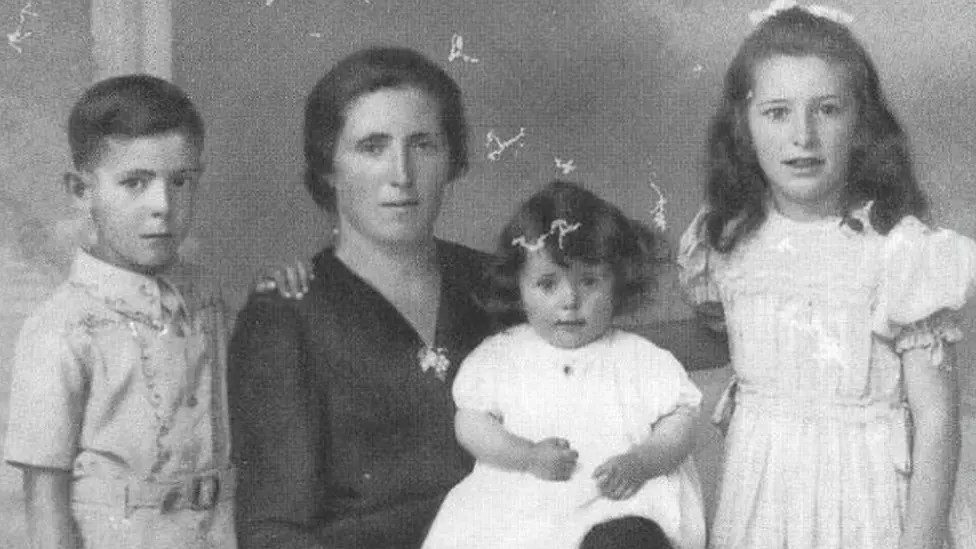
Enrico Pieri was ten years old on the day of the Sant’Anna di Stazzema massacre. On the morning of August 12, 1944, he survived the massacre alongside two other children, Grazia and Gabriella Pierotti. Orphaned by the atrocity, Enrico grew up in Sant’Anna under the care of his uncle, Duilio.
Enrico lived in the area known as Franchi with his father, Natale, his mother, Irma Bartolucci, and his two sisters, Alice and Luciana. Only a short time elapsed between the alarm announcing the arrival of the German soldiers and their appearance at the family home. Enrico recalled seeing around ten armed men in camouflage uniforms. He was rounded up with other civilians and forced toward the church square.
Suddenly, however, the soldiers changed direction and led the group to the nearby home of the Pierotti family. Around thirteen or fourteen people were gathered in the kitchen when the soldiers opened fire. Enrico managed to hide beneath the stairs with one of the Pierotti sisters, a young girl. When the shooting stopped, he saw the soldiers throw burning grain into the room. Realizing that the house was being set on fire, he understood that they had to escape.
Only then did Enrico realize that another child was still alive: Gabriella, the second Pierotti sister. Enrico, Grazia, and Gabriella managed to flee and hide in a small shed where beans were stored. There, terrified and in complete silence, the three children waited for nightfall.
Grazia and Gabriella eventually emerged from hiding and returned to their home, where they discovered that their family members had been killed. Enrico had lost his father, mother, two sisters, and grandfather. Grazia and Gabriella had lost their father, mother, two brothers, and an aunt.
After making a futile attempt to extinguish the fire, the three children fled toward Valdicava, where they encountered other survivors. Enrico subsequently grew up in Sant’Anna with his uncle Duilio, who played an important role in the postwar reconstruction of the community. Among his initiatives was the construction of a road serving the village in the late 1960s.
Like many other young survivors, Enrico left Sant’Anna in search of work and opportunity. In 1951, he first moved to Valdicastello and later to Viareggio. That same year, he went to Switzerland, where he lived and worked for 32 years. After retiring, he returned to Sant’Anna di Stazzema, the place where he had survived the massacre and lost nearly his entire immediate family.
In the decades that followed, Enrico devoted himself to preserving the memory of August 12, 1944. He became one of the most important living witnesses to the massacre, speaking about its victims and survivors and ensuring that their stories were passed on to younger generations. Yet his testimony was not solely one of suffering. Over the years, Enrico became a powerful advocate for peace, reconciliation, and forgiveness, while insisting that forgiveness could never mean forgetting.
For his lifelong commitment to remembrance, peace, and the transmission of historical memory, Enrico Pieri was appointed Commendatore dell’Ordine al Merito della Repubblica Italiana in 2020. He passed away on 10 December 2021
His life embodied a remarkable transformation: from a ten-year-old survivor who lost his family in one of the darkest episodes of the Italian campaign to an elder statesman of remembrance who dedicated the rest of his life to ensuring that the victims of Sant’Anna di Stazzema would never be forgotten.
Sources
https://www.ns-taeter-italien.org/en/massacres/santanna-di-stazzema
https://en.wikipedia.org/wiki/Sant’Anna_di_Stazzema_massacre
https://www.liberationroute.com/en/pois/97/santanna-di-stazzema
https://www.bbc.com/news/world-europe-33143473
https://www.liberationroute.com/en/stories/322/enrico-pieri
Please support us so we can continue our important work.
Donation
Your readership is what makes my site a success, and I am truly passionate about providing you with valuable content. I have been doing this at no cost and will continue to do so. Your voluntary donation of $2 or more, if you are able, would be a significant contribution to the continuation of my work. However, I fully understand if you’re not in a position to do so. Your support, in any form, is greatly appreciated. Thank you. To donate, click on the credit/debit card icon of the card you will use. If you want to donate more than $2, just add a higher number in the box left from the PayPal link. Your generosity is greatly appreciated. Many thanks.
$2.00


Leave a comment