There are moments in football when the game changes without anyone in the stadium quite realizing it.
On 21 September 2016, football history was made in the Netherlands. During the KNVB Cup match between Ajax and Willem II, it became clear almost immediately what Video Assistant Refereeing (VAR) could mean for the game.
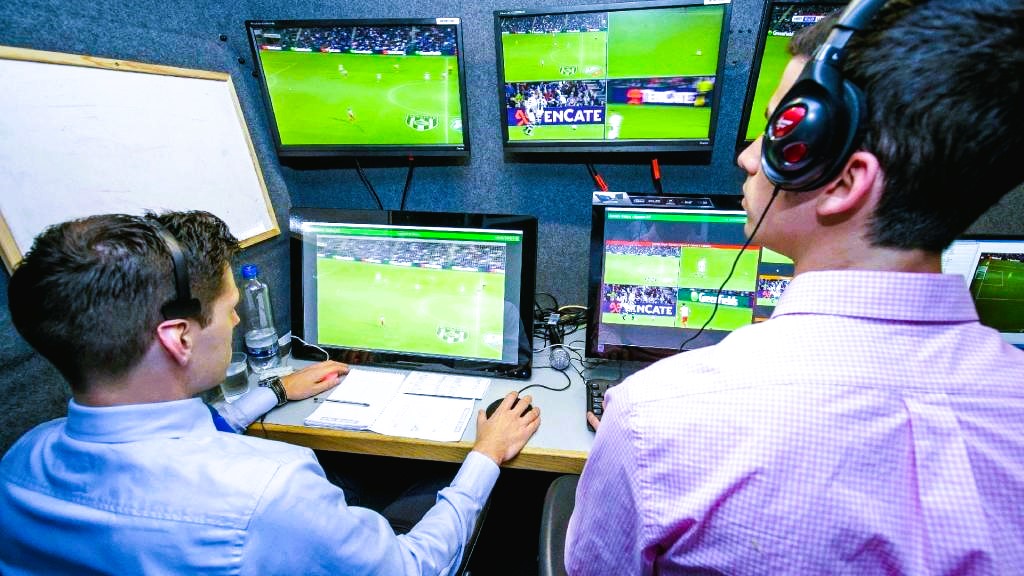
Referee Danny Makkelie initially showed Willem II midfielder Anouar Kali a yellow card for a foul. In the video operation room, VAR Pol van Boekel reviewed the incident and advised Makkelie to change the punishment to a red card. Makkelie followed the recommendation, and the first live VAR intervention in a competitive match had taken place.
But that moment was the culmination of years of preparation.
In 2013, the Royal Dutch Football Association (KNVB) launched its Refereeing 2.0 project to investigate how video footage could be used to assist referees with important decisions. Before the technology was used live, the system was tested in more than ninety matches, initially without any communication between the video assistant and the referee on the pitch.
The Netherlands was consequently among the international pioneers of video refereeing. On 1 September 2016, VAR technology was tested live for the first time during an international match between Italy and France. Dutch referee Björn Kuipers officiated the match, while Danny Makkelie and Pol van Boekel worked from the video operation room.
Just twenty days later, the experiment moved from international football to a competitive Dutch match. During Ajax–Willem II, the VAR made its first intervention, marking the beginning of a new era in refereeing.
Officially Incorporated
In March 2018, VAR was officially incorporated into the international Laws of the Game. In the Netherlands, all professional football clubs subsequently agreed to introduce the system into the Eredivisie.
From the 2018/19 season onwards, a VAR was present for all 306 Eredivisie matches. During that inaugural season, the technology helped correct 87 incorrect decisions.
Since then, VAR has become an established part of professional football. The technology itself has also continued to evolve. Additional camera angles, virtual offside lines and more information about VAR reviews inside stadiums have gradually been introduced. In 2025, the KNVB also experimented with on-field announcements, allowing referees to explain their decisions following a VAR review.
Development in Figures
“Technology helps football, but it does not take over.”
The statistics suggest that VAR has reduced the number of significant incorrect decisions, although it has not eliminated them.
There were 26 incorrect decisions involving VAR in both the 2023/24 and 2024/25 seasons. In 2025/26, that number fell to 21.
Across the 306 Eredivisie matches played during the 2025/26 season, VAR intervened 105 times. In 84 of those cases, the intervention prevented an incorrect decision. At the same time, the 21 remaining errors demonstrate the limits of the technology.
VAR is particularly complicated when dealing with subjective or interpretative decisions, such as fouls and handball incidents. Video footage can provide additional information, but it cannot remove the need for human judgement. Ultimately, both the referee and VAR must still interpret what they see.
The ambition therefore remains not to eliminate every mistake, but to reduce the number of clear errors that have a significant impact on a match.
The Referee Remains Responsible
Despite the growing presence of technology, the referee on the pitch remains the primary decision-maker. VAR functions as a safety net for clear and significant errors rather than as a second referee who continuously reviews every decision.
The VAR protocol has also been expanded in several areas. For example, the VAR can intervene when a clearly incorrect second yellow card results in a red card. A demonstrably incorrect corner decision can also be corrected, provided the correction can be made immediately and does not delay the restart of play.
These extensions are not intended to produce more interventions. The fundamental principle remains unchanged: VAR should correct clear errors with significant consequences while avoiding unnecessary interruptions to the flow of the game.
The Next Step
After almost a decade of practical experience, the emphasis is increasingly shifting from introducing VAR to improving the way it is used.
Referees and VARs train together to develop a more consistent approach to similar incidents. Work is also continuing on making reviews faster and improving communication so that players, coaches and spectators have a clearer understanding of why a decision has been changed.
As Raymond van Meenen, manager of professional football refereeing affairs, explains:
“The VAR has developed enormously over the past ten years. The fact that the number of incorrect decisions decreased last season is positive, but we continue to work on improvement. This is mainly about consistency, speed and clarity. The starting point remains the same as it was ten years ago: the referee remains the primary decision-maker and the VAR is the safety net. Technology helps football, but it does not take over.”
That principle lies at the heart of VAR’s development. The technology was never intended to replace the referee. Its purpose is to give the referee another set of eyes when a crucial decision may have gone wrong.
Ten years after Anouar Kali’s yellow card became a red following a review at Ajax–Willem II, video refereeing has become an ordinary part of the modern game. Yet the central figure remains the same: the referee standing on the pitch, making the final decision.
Sources:
https://en.wikipedia.org/wiki/Video_assistant_referee
https://www.knvb.com/news/themes/new-rules-play/1529/ten-years-var-dutch-football
https://refereeingworld.blogspot.com/2018/06/the-inside-story-of-how-var-was-born.html


Leave a Reply