
In 1798, the English poet Samuel Taylor Coleridge published The Rime of the Ancient Mariner, one of the best-known poems in the English language. Among its most famous lines are:
“Water, water, every where,
Nor any drop to drink.”
The words describe the terrible irony of being surrounded by water while being unable to drink it. More than a century later, those same words would acquire an especially grim resonance at Dachau concentration camp, where prisoners were subjected to seawater experiments between July and September 1944.
There, men were deliberately deprived of normal food and drinking water and forced to consume seawater, treated or untreated, as part of experiments intended to determine whether seawater could be made potable.
For Coleridge’s Ancient Mariner, the words expressed the torment of thirst at sea. At Dachau, the same paradox became a deliberate experiment inflicted upon human beings: water was everywhere, but it could not quench their thirst.
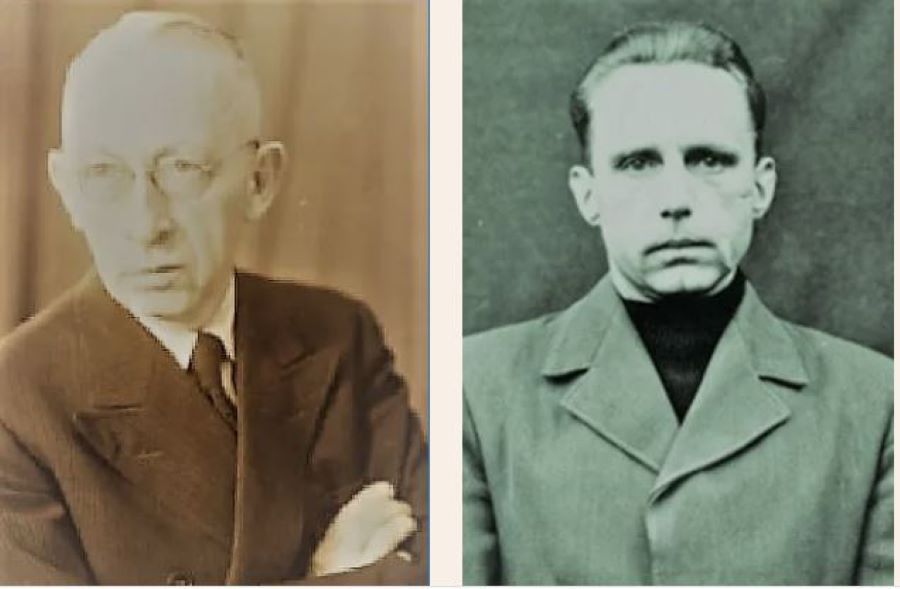
This knowledge did not stop Dr. Hans Eppinger(left) and Dr. Wilhelm Beiglböck.(right)
Between July and September 1944, prisoners at Dachau concentration camp were used as unwilling subjects in a series of experiments intended to determine whether seawater could be made drinkable.
The research was connected to a practical problem faced by the German armed forces: how to provide drinking water for sailors and airmen who might find themselves stranded at sea. Instead of testing the proposed methods on volunteers, the researchers turned to concentration-camp prisoners, people who had no possibility of refusing.
The subjects were divided into groups and subjected to different forms of chemically treated seawater. Some received seawater that had been processed in an attempt to make it potable, while others were given untreated seawater. The prisoners were deprived of normal food and water, leaving their bodies increasingly dependent on the liquids provided by the experimenters.
The consequences were predictable and devastating.
Seawater contains far more salt than the human body can safely process. Rather than relieving thirst, drinking it can increase dehydration as the kidneys attempt to eliminate the excess salt. The prisoners suffered from extreme thirst, dehydration and severe physical distress. As the experiments continued, some developed serious neurological and physical symptoms. Their bodies were being pushed towards a point at which vital organs could no longer function normally.
What makes these experiments particularly disturbing is that the suffering was not an accidental consequence of research. The prisoners themselves were the experimental material.
They had names, families and lives before Dachau, but within the concentration-camp system they were reduced to numbers and categories. Their hunger, thirst and physical deterioration were observed as part of a scientific investigation in which their consent was considered irrelevant.
The seawater experiments were among a number of medical experiments conducted on concentration-camp prisoners during the Nazi period. Others involved hypothermia, high-altitude conditions, infectious diseases, drugs and methods intended to treat injuries sustained by German military personnel. The common thread was the deliberate removal of the normal ethical barriers that are supposed to separate medical treatment from abuse.
After the war, the experiments became part of the evidence presented during the Doctors’ Trial, formally the United States of America v. Karl Brandt et al., held at Nuremberg between 1946 and 1947. Twenty-three physicians and other medical personnel were placed on trial for their involvement in medical crimes and related offences.
Among those charged with responsibility for, or participation in, the seawater experiments were Karl Brandt, Siegfried Handloser, Oskar Schröder, Karl Gebhardt, Rudolf Brandt, Joachim Mrugowsky, Wolfgang Poppendick, Wolfram Sievers, Hermann Becker-Freyseng, Konrad Schäfer and Wilhelm Beiglböck. Hans Eppinger had committed suicide at that stage.
The prosecution’s case demonstrated how the language of medicine and scientific research could be used to disguise something fundamentally different: the deliberate infliction of suffering upon people who had been stripped of their ability to say no.
The prisoners at Dachau were not volunteers. They were not patients who had sought treatment. They were inmates of a concentration camp, placed into an experiment from which there was no meaningful escape.
The seawater experiments therefore remain more than a disturbing episode in the history of Nazi medicine. They illustrate what can happen when scientific curiosity, military necessity and an ideology that denied certain people their basic humanity were allowed to override the most fundamental principles of medical ethics.
The question was supposedly whether seawater could be made drinkable.
For the prisoners, the reality was much simpler: they were made to endure thirst, suffering and the gradual failure of their bodies so that others could obtain an answer.
Donation
Your readership is what makes my site a success, and I am truly passionate about providing you with valuable content. I have been doing this at no cost and will continue to do so. Your voluntary donation of $2 or more, if you are able, would be a significant contribution to the continuation of my work. However, I fully understand if you’re not in a position to do so. Your support, in any form, is greatly appreciated. Thank you. To donate, click on the credit/debit card icon of the card you will use. If you want to donate more than $2, just add a higher number in the box left from the PayPal link. Your generosity is greatly appreciated. Many thanks.
$2.00
Sources:
https://encyclopedia.ushmm.org/content/en/article/nazi-medical-experiments
https://jewishvirtuallibrary.org/sea-water-experiments


Leave a Reply