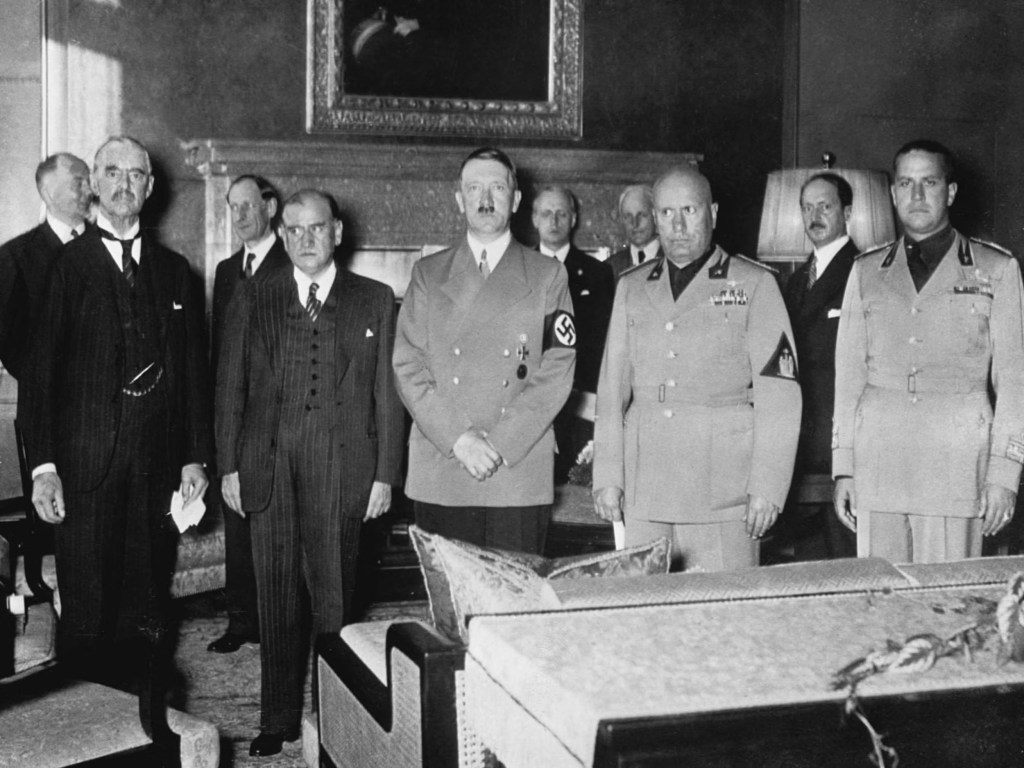
On 30 September 1938, the leaders of Great Britain, France, Italy and Nazi Germany signed the Munich Agreement, handing the Sudetenland—the predominantly German-speaking border regions of Czechoslovakia—to Adolf Hitler’s Germany.
The Czechoslovaks themselves were not parties to the agreement.
It was presented as a settlement intended to prevent another European war. British Prime Minister Neville Chamberlain, returning to London the following day, famously spoke of having secured “peace for our time.” Yet the agreement did not preserve peace. Less than six months later, German troops entered Prague, destroying what remained of Czechoslovakia as an independent state.
Munich would become perhaps the most enduring symbol of the policy of appeasement: the attempt to satisfy some of Hitler’s territorial demands in the hope that doing so would prevent a wider war.
The tragedy of Munich was not simply that the agreement failed. It was that, in trying to avoid war, the European powers helped create conditions in which Hitler became stronger and Czechoslovakia became weaker.
The Road to Munich
Hitler’s attention turned increasingly toward Czechoslovakia following the Anschluss of Austria in March 1938. His immediate focus was the Sudetenland, where approximately three million ethnic Germans lived.
The Sudeten German Party, led by Konrad Henlein, had become increasingly radical and closely aligned with Nazi Germany. Berlin portrayed the grievances of the Sudeten Germans as evidence of Czechoslovak oppression. Yet the issue of minority rights was only part of the story.
The Sudetenland had enormous strategic importance.
Czechoslovakia had constructed an extensive system of border fortifications there, supported by difficult mountainous terrain. The region also contained important industrial resources and communications networks. Surrendering it would remove much of Czechoslovakia’s natural and military protection.
For Hitler, therefore, the Sudetenland was not simply about Germans living outside Germany. It was also a gateway into the heart of Czechoslovakia.
And Czechoslovakia was far from helpless.
Its army was well equipped, its defensive system was formidable, and its armaments industry was significant. But its position depended heavily upon its alliances.
France was formally committed to assist Czechoslovakia in the event of aggression, but the French government was deeply reluctant to enter another major European war without British support. Britain, meanwhile, was still rearming and Chamberlain believed that a negotiated settlement might prevent a catastrophe comparable to the First World War.
The Soviet Union also had a treaty relationship with Czechoslovakia, but Soviet assistance was conditional upon France acting first. There was also the practical problem of Soviet troops requiring passage through neighbouring countries, particularly Poland and Romania, neither of which was prepared to facilitate such a movement.
The diplomatic crisis therefore became increasingly difficult to resolve.
Hitler’s Demands
Throughout September 1938, Hitler intensified his demands.
He insisted that the Sudetenland be transferred to Germany and threatened military action if this did not happen. The possibility of a general European war became increasingly real.
Chamberlain, desperate to find a peaceful solution, travelled to Germany three times during September. He met Hitler at Berchtesgaden, then at Bad Godesberg, and finally at Munich.
It was an extraordinary sequence of events: the British prime minister was negotiating personally with the German dictator in an attempt to prevent a war that many feared could engulf Europe.
On 29 September, the final conference opened in Munich.
Around the table sat:
- Neville Chamberlain, Prime Minister of Britain
- Édouard Daladier, Prime Minister of France
- Benito Mussolini, Fascist dictator of Italy
- Adolf Hitler, Führer of Nazi Germany
Missing from the table were the people whose country was being divided.
Neither Edvard Beneš, President of Czechoslovakia, nor a representative of the Soviet Union was allowed to participate in the negotiations.
The agreement was effectively imposed upon Prague.
A Country Divided
The terms required Czechoslovakia to evacuate the Sudetenland between 1 and 10 October 1938. German forces would then occupy the territory.
In return, Hitler offered assurances concerning the future territorial integrity of Czechoslovakia and promised that remaining disputes would be settled peacefully.
Czechoslovakia had little realistic choice.
Its Western allies had negotiated its territorial surrender without allowing it a meaningful voice in the process. Beneš accepted the settlement rather than face the possibility of fighting Germany alone.
For the people living in the Sudetenland, the consequences were immediate. German troops entered the ceded territories to scenes of celebration among some sections of the German population, while many Czechs fled their homes.
The map of Central Europe had been redrawn without a general war.
For the moment.
“Peace for Our Time”
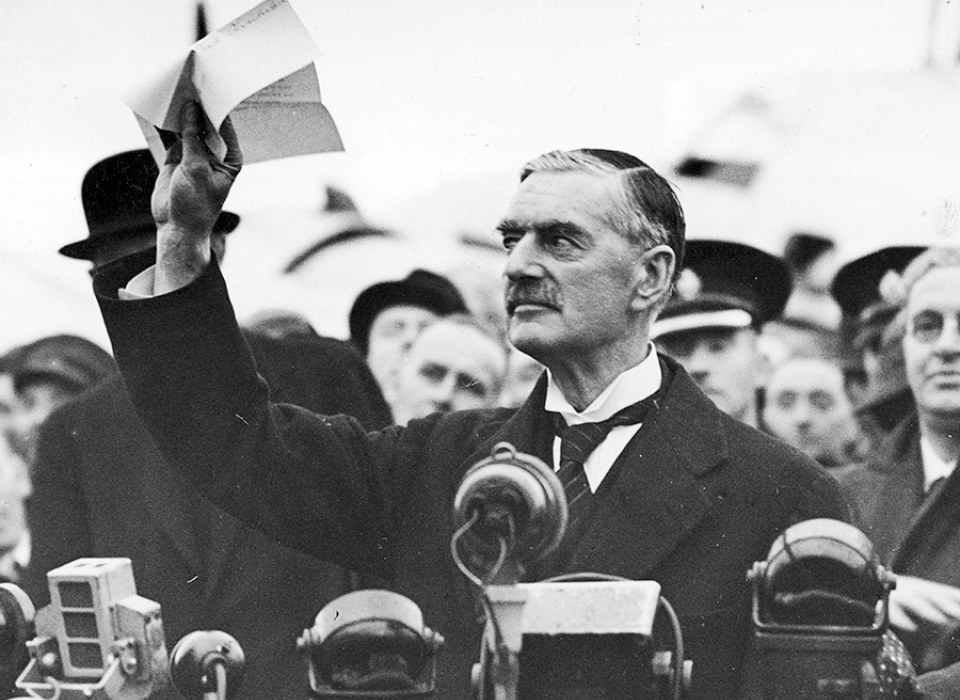
When Chamberlain returned to Britain on 30 September, he was greeted by crowds relieved that war had apparently been avoided.
Standing at Heston Aerodrome, he held up the Anglo-German declaration he had obtained from Hitler and spoke of the agreement as representing a guarantee of peaceful intentions.
His famous phrase—“peace for our time”—would become one of the most remembered expressions of the twentieth century.
But there were already people who understood that the settlement had not necessarily secured peace.
Winston Churchill, then a prominent critic of appeasement, condemned the agreement in the House of Commons. He argued that Britain and France had suffered a serious strategic defeat without having fought a war.
The issue was not simply territory.
It was power.
Czechoslovakia had lost its defensive frontier, its fortifications and a substantial part of its industrial capacity. Germany, meanwhile, had gained strategically valuable territory without having to fight for it.
And Hitler had learned something important: threats and diplomatic pressure could produce enormous territorial gains.
The Disintegration of Czechoslovakia
Munich did not end the dismantling of Czechoslovakia.
In October 1938, Poland occupied the Zaolzie region, while the First Vienna Award in November transferred substantial areas of southern Slovakia and Carpathian Ruthenia to Hungary.
Czechoslovakia had been weakened, territorially reduced and politically destabilised.
Then, on 15 March 1939, the final blow came.
German troops entered Prague.
There was no Sudeten German crisis to resolve this time. No plebiscite. No claim of self-determination. No plausible argument that Germany was merely gathering ethnic Germans into the Reich.
Bohemia and Moravia were transformed into the Protectorate of Bohemia and Moravia, while Slovakia became a nominally independent state under a government closely aligned with Nazi Germany.
The meaning of Munich was now unmistakable.
Hitler’s ambitions had never been limited to the Sudeten Germans.
The destruction of Czechoslovakia demonstrated that Nazi expansion was imperial rather than merely national.
The Price of Appeasement
Munich remains controversial because the alternatives facing Chamberlain and Daladier were not simple.
Britain and France were not prepared for another continental war in September 1938. Memories of the First World War remained painfully fresh. Rearmament was incomplete, and the possibility of another conflict involving millions of people was terrifying.
There was also a genuine desire among many Europeans to believe that territorial grievances could be settled without another catastrophic war.
Yet the consequences were severe.
Czechoslovakia lost territory, population, fortifications and industrial resources. Germany gained strategically important assets and, in March 1939, acquired control of the Czech lands.
The German military subsequently benefited from captured Czechoslovak weapons and equipment, while the Škoda Works became part of the industrial base available to the German war effort.
Munich also damaged confidence in the Western powers. The Soviet leadership increasingly doubted whether Britain and France were prepared to confront Hitler. Less than a year later, the Soviet Union signed the Molotov-Ribbentrop Pact with Nazi Germany.
That agreement, signed in August 1939, contained a secret protocol dividing much of Eastern Europe into German and Soviet spheres of influence.
The road to war was becoming shorter.
The Paradox of Munich
There is, however, an important paradox.
Munich did not necessarily make war inevitable, nor can the agreement alone be said to have caused the Second World War. But it changed the strategic balance in Hitler’s favour and demonstrated the limits of appeasement.
At the same time, the additional year gained before the outbreak of war allowed Britain to continue its rapid rearmament. The Royal Air Force expanded Fighter Command, strengthened its aircraft inventory and developed the radar network that would become so important during the Battle of Britain.
Thus Munich occupies an uncomfortable place in history.
It was both a diplomatic failure and, indirectly, a period in which Britain gained valuable time to prepare for the conflict that eventually came.
But that preparation came after another country had been sacrificed in the hope that the sacrifice would be enough.
It wasn’t.
On 1 September 1939, Germany invaded Poland.
Two days later, Britain and France declared war on Germany.
The peace that had been celebrated at Munich had lasted less than a year.
The agreement of 30 September 1938 therefore became more than a failed diplomatic settlement. “Munich” entered the political vocabulary as a warning about the dangers of making concessions to an expansionist power.
But perhaps the darkest lesson is found in the words spoken at the time.
Europe had not avoided war.
It had merely postponed it—and in doing so, had left Czechoslovakia to pay the price.
Sources:
https://en.wikipedia.org/wiki/Munich_Agreement
https://encyclopedia.ushmm.org/content/en/film/agreement-reached-at-munich-conference


Leave a comment