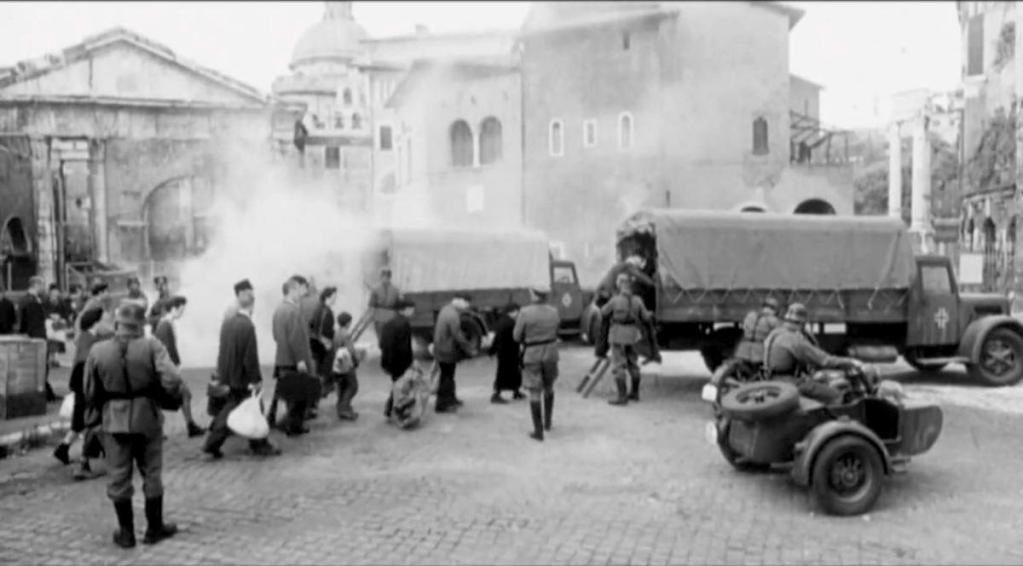
Rome, 16 October 1943. Before dawn, German troops and security police surrounded the ancient Jewish quarter of the Italian capital. Within hours, hundreds of Jewish men, women and children had been torn from their homes. They were taken away in trucks, held temporarily at a military college, and deported to Auschwitz-Birkenau. Most would never return. It was one of the darkest chapters in the long history of Rome’s Jewish community, a community that had existed for more than two thousand years.
A Jewish community older than Christianity
The Jewish community of Rome is among the oldest Jewish communities in Europe. Its roots reach back to the second century BC, when Jewish merchants, diplomats and migrants began settling in the capital of the expanding Roman Republic. Following the Roman conquest of Jerusalem and the destruction of the Second Temple in AD 70, the number of Jews living in Rome increased. Some had arrived voluntarily; others had been brought to Italy as enslaved captives.
Over the centuries, Rome’s Jews survived the collapse of the Roman Empire, the rise of Christianity, medieval persecution, expulsions, papal restrictions and repeated episodes of antisemitic violence. Despite these hardships, the community endured, preserving its religious traditions, distinctive customs and collective identity across generations.
The Jewish quarter, commonly known as the Ghetto of Rome, was established in 1555 by Pope Paul IV. His papal bull, Cum nimis absurdum, imposed severe restrictions on Jewish life. Jews were compelled to live in a designated, confined district near the River Tiber, subjected to discriminatory regulations and excluded from numerous occupations and public privileges. The quarter’s gates were locked at night, physically separating Jewish residents from the surrounding city.
The ghetto was not formally abolished until 1870, when Rome became part of the unified Kingdom of Italy. For the first time in centuries, Roman Jews could enjoy greater civil equality and participate more fully in the life of their city. The walls and gates disappeared, but the neighbourhood remained a centre of Jewish religious, cultural and family life. Its narrow streets, synagogues, shops and homes carried the accumulated memories of a community that had survived centuries of exclusion.
By the twentieth century, Rome’s Jews were Italian citizens. They spoke Italian, served in the armed forces, worked in professions and businesses, and participated in the country’s political and cultural life. Many families had lived in Rome for generations. Their roots in the city were older than those of most of the people who now ruled Italy.
Yet their ancient history and Italian citizenship would offer little protection when Nazi Germany turned its attention to them.
The fall of Fascist Italy
When Benito Mussolini came to power in 1922, Italy began its transformation into a Fascist dictatorship. For years, Italian Jews lived under a political system that increasingly embraced nationalism, authoritarianism and racial ideology. Yet the decisive turning point came in 1938, when Mussolini’s government introduced antisemitic racial laws.
These laws stripped Jews of important rights, excluded Jewish teachers and pupils from state schools, restricted employment and prohibited certain marriages between Jews and non-Jews. Jewish Italians who had regarded themselves as fully integrated members of society suddenly found themselves officially classified as outsiders in their own country.
The situation changed catastrophically in September 1943. After Allied forces invaded southern Italy, Mussolini was removed from power and the new Italian government announced an armistice with the Allies on 8 September. German forces swiftly occupied Rome and much of northern and central Italy. Mussolini was subsequently rescued from captivity by German commandos and installed as the head of a German-backed Fascist regime in northern Italy.
For Rome’s Jewish population, the German occupation marked the beginning of a desperate struggle for survival. The city was home to approximately 12,000 Jews, including families who had lived there for centuries and refugees who had fled persecution elsewhere in Europe. The German authorities now intended to incorporate them into the Nazi programme of systematic deportation and murder.
The persecution was not simply a matter of soldiers suddenly appearing in the streets. The Nazis needed information: names, addresses, family relationships and records that would enable them to locate their intended victims. The Jewish community’s own records, which had been maintained at the Great Synagogue, were seized by the Germans. Bureaucratic information that had once served the needs of a religious community could now be used to facilitate its destruction.
Fifty kilograms of gold for a promise of safety
In late September 1943, Herbert Kappler, the German security police commander in Rome, delivered an ultimatum to the city’s Jewish community. The Jews were ordered to provide 50 kilograms of gold within a very short period. In return, they were led to believe that their community would be spared.
The demand was an act of extortion backed by the threat of violence. The Jewish population was being forced to surrender its wealth to the very authorities that threatened its existence. Yet the community had little choice. Gold was collected from families and individuals, including people who gave up wedding rings, jewellery and other precious possessions.
The required amount was delivered. For a brief moment, some may have hoped that the payment had bought them time, perhaps even protection. It had not.
The Germans continued preparing the deportation of Rome’s Jews. The ransom had not been a genuine offer of safety; it had been another instrument of persecution. Even as Jewish families struggled to comply with the demand, the machinery of their destruction was being set in motion.
The betrayal is one of the most chilling aspects of the events that followed. The community had done what it was told, surrendering its valuables in the hope of saving lives. Less than three weeks later, German security forces launched the mass roundup.
16 October 1943: The roundup begins
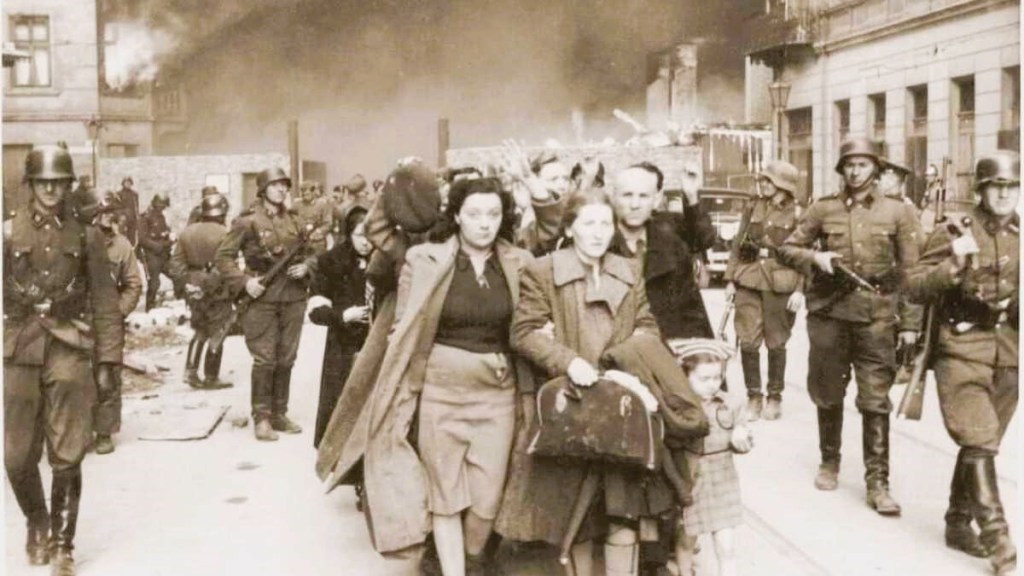
Saturday, 16 October 1943, began before sunrise. At approximately 5:30 a.m., German security forces launched the operation against Rome’s Jewish population. The date would become known as Sabato Nero — Black Saturday.
German troops and police moved through the former ghetto and other neighbourhoods, using lists and addresses to find Jewish residents. Doors were knocked on or forced open. Families were ordered to gather their belongings and prepare to leave. People who had been sleeping only moments earlier were suddenly confronted by armed men demanding their immediate compliance.
The operation was not confined to the ancient Jewish quarter. Jewish people throughout Rome were targeted, but the densely populated streets of the former ghetto became one of its principal scenes.
Imagine the terror of those first hours. A family is awakened in the darkness. Parents try to understand what is happening while children cling to them, frightened by unfamiliar voices and the presence of armed strangers in their home. Elderly people, some of them frail or ill, struggle to dress and gather whatever possessions they can carry. Questions are asked, but answers are not forthcoming. There is little time to think, let alone plan an escape.
The German authorities made no meaningful distinction between the generations. Children, parents and grandparents were caught in the same operation. Their citizenship, professions, personal histories and loyalty to Italy offered no protection. Under Nazi racial ideology, their Jewish ancestry was sufficient to condemn them.
By approximately 2 p.m., the main roundup had ended. A total of 1,259 people had been arrested and taken to the Military College on Via della Lungara, close to the Vatican. They included men and women of all ages, from young children to the elderly.
For the people detained there, the uncertainty must have been unbearable. They had been removed from their homes without knowing where they were going or whether they would ever see their families again. Some may still have believed that the arrests were temporary, that an official might intervene, or that their Italian citizenship would eventually be recognised.
The reality was far worse.
Two days of waiting
The Military College became a temporary holding place for the arrested Jews. Families were crowded together while German authorities sorted and processed their captives. They had been seized from their homes, stripped of their freedom and placed under armed guard, with little information about their fate.
Among those arrested were people who had done nothing to bring themselves to the attention of the authorities. They were not political insurgents or armed opponents of the occupation. They were ordinary civilians whose lives had revolved around work, family, religious observance and the familiar routines of their neighbourhoods.
Yet the Nazi regime had transformed Jewish identity itself into a death sentence.
Of the 1,259 people detained during the roundup, 237 were eventually released. The German authorities classified them as falling outside the categories targeted in this particular deportation, including some people from mixed Jewish-Christian families and others who were not considered Jewish under the regime’s discriminatory rules. The remaining prisoners were kept in custody.
The release of some prisoners offered no reassurance to those who remained. Families had been separated, and nobody could be certain what the Germans would do next. Even those who were allowed to leave had been forced to confront the terrifying reality that the authorities could seize them at any moment.
On the morning of Monday, 18 October, the prisoners were taken to the railway station and loaded onto a train bound for Auschwitz-Birkenau in German-occupied Poland.
They were being deported to a place many would never have heard of, and whose true purpose most could scarcely have imagined.
The journey to Auschwitz
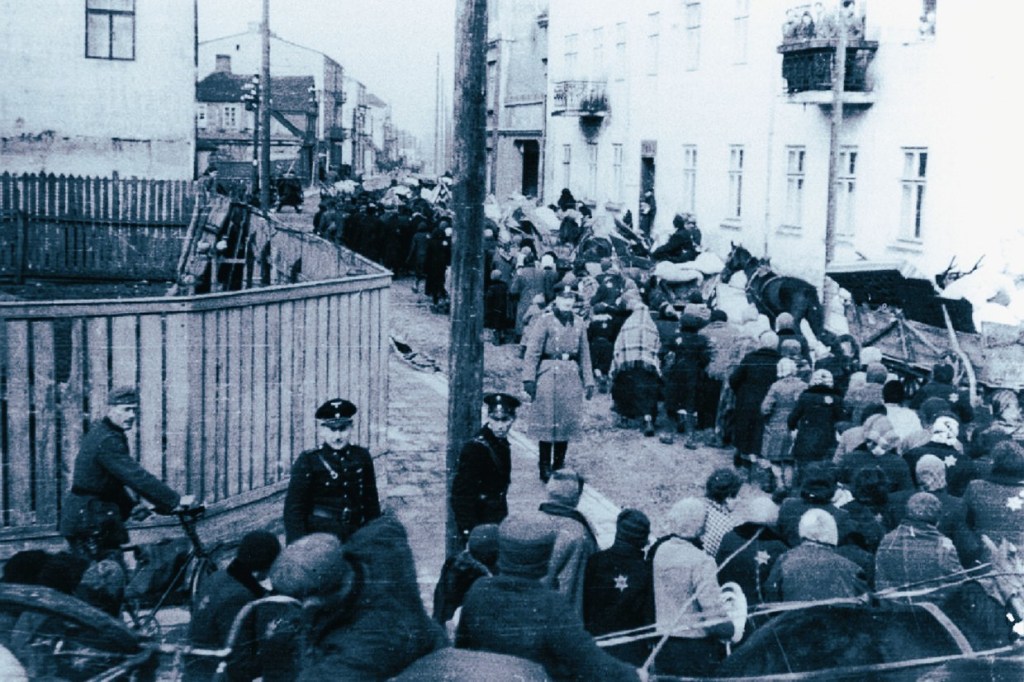
The train carrying the Jews of Rome departed on 18 October 1943. Approximately 1,020 to 1,022 people were deported, with slight variations in the figures reported by historical sources. The journey took several days. The passengers were transported in freight cars under conditions that denied them dignity, comfort and control over their own fate.
For those aboard, the journey represented the destruction of everything familiar. The streets of Rome, the homes in which generations had lived, the synagogue and the neighbourhood’s small shops were left behind. Parents were still with their children, husbands with their wives, and brothers and sisters with one another — but no one could know how long those fragile bonds would survive.
The train moved north and then east, carrying its human cargo away from Italy and towards the Nazi killing system. Behind it lay a city whose Jewish community had existed since antiquity. Ahead lay Auschwitz-Birkenau, a complex of concentration and extermination facilities in occupied Poland.
Auschwitz was not merely a prison. Birkenau had become one of the principal centres of the Holocaust, where Jews from across German-occupied Europe were deported and murdered. Upon arrival, deportees faced selection. Some were temporarily assigned to forced labour; others, particularly those considered unable to work, were sent directly to their deaths.
The people from Rome were not arriving in a place where their individual stories mattered to the perpetrators. Their identities were reduced to categories imposed by the Nazi state. A child who had played in the streets of Rome, an elderly woman who had spent her entire life in the city, a shopkeeper, a student or a father of three — all could be treated as interchangeable members of a population marked for destruction.
The exact moment when the deportees understood the danger they faced is impossible to reconstruct for every individual. Some may have heard rumours. Others may have clung to the hope that they were being taken away for labour or temporary detention. The full reality of Auschwitz could not easily be imagined by someone who had never encountered the Nazi extermination system.
But whatever they believed during the journey, the destination was the same.
Sixteen survivors
The outcome of the deportation was devastating. Of the approximately 1,022 Jews deported from Rome on 18 October 1943, only 16 survived the Holocaust: 15 men and one woman. Almost everyone else was murdered.
Sixteen survivors.
The number is almost impossible to comprehend when set against the ordinary complexity of the lives that had been taken. Each of those who died had a personal history, a family, a name, a voice and a future that would never come to pass. Some had children; others were children themselves. Some had been married for decades, while others had only recently begun their adult lives.
The deportation did not merely remove individuals from Rome. It tore holes through families and extinguished entire branches of family trees. Parents disappeared, leaving children orphaned. Children vanished, leaving parents with no certainty of their fate. Brothers, sisters, cousins and grandparents were lost together.
For the survivors, returning to Rome meant confronting a city that had continued to exist while their own lives had been shattered. Their survival did not restore the people who had been murdered, nor could it undo the experience of persecution, deportation and the destruction of their community.
The figure of 16 is therefore more than a statistic. It is a measure of the catastrophe that befell those taken in the roundup. Out of a trainload of people, only a tiny number lived to tell what had happened.
Those who escaped the roundup
The tragedy of 16 October must also be understood alongside the thousands of Roman Jews who escaped deportation.
The German authorities had hoped to seize a far larger proportion of the city’s Jewish population. Yet many Jews were warned, fled their homes or found hiding places with the assistance of non-Jewish Italians and Catholic institutions. Some took refuge in convents, monasteries, schools and private homes. Others were sheltered within the Vatican or in its surrounding institutions.
Their survival depended on a combination of warning, courage, luck and the willingness of others to help. A neighbour who opened a door, a religious institution that accepted a family, or a person who provided false papers or a hiding place could mean the difference between life and death.
The risks were considerable. Helping Jews evade German authorities could expose those providing assistance to arrest and punishment. Yet many Italians chose to help, despite the dangers.
The contrast between the roundup and these acts of rescue is essential to understanding the history of occupied Rome. The Nazis possessed the weapons and the power to arrest, deport and murder. They did not, however, control every decision made by the people around them. Even in a city under occupation, individuals retained the ability to choose whether to collaborate, remain silent or help those being hunted.
More than 10,000 Jews survived in Rome, many of them by hiding until the German occupation ended. American forces liberated the city on 4 June 1944. Jews emerged from hiding and returned to the streets of their city, although liberation could not restore the relatives and friends who had been murdered.
The Vatican and the question of silence
The roundup took place only a short distance from the Vatican, the centre of the Roman Catholic Church and the residence of Pope Pius XII. The geographical proximity has made the events of October 1943 an enduring subject of historical debate.
The Vatican was a neutral sovereign entity, and Catholic institutions in Rome provided shelter to many Jews during the German occupation. Convents, monasteries and other religious establishments became places of refuge, sometimes concealing Jewish families or individuals behind the walls of institutions that the Germans were reluctant to enter. Such assistance saved lives.
At the same time, historians have debated the Vatican’s public response to the persecution of Rome’s Jews. Pius XII did not publicly condemn the deportation in the direct terms that critics believe were necessary. Questions remain about the choices made by the papacy, the diplomatic calculations involved and the relationship between quiet assistance and public protest.
These issues should not obscure the actions of those Catholic clergy and institutions that helped Jews survive. Nor should the courage of individual rescuers be used to avoid the difficult historical questions about institutional responsibility and the limits of public opposition to Nazi crimes.
The history is complicated, but one fact is not: the roundup and deportation took place while the Vatican stood nearby, and the victims needed protection that the German occupation authorities were determined to deny them.
The German occupation and the destruction of Rome’s Jews
The raid of 16 October was the most notorious mass roundup of Jews in Rome, but it was not the end of the persecution. German authorities continued to arrest Jews in subsequent operations. Some of those who had escaped the initial roundup were later captured and deported. Others were murdered in Rome itself.
The German occupation lasted until June 1944. During those nine months, Jewish residents lived under the constant threat of discovery, relying on hiding places, false identities and the assistance of people willing to risk their own safety.
The persecution in Rome formed part of a wider campaign against Italian Jews following Germany’s occupation of central and northern Italy. In cities including Milan, Florence, Genoa and Trieste, German authorities organised arrests and deportations. Thousands of Italian Jews were sent to Auschwitz-Birkenau and other camps.
The destruction of the Jewish community of Rome was therefore neither an isolated incident nor an act of spontaneous violence. It was part of the Holocaust: the Nazi regime’s systematic persecution and murder of Europe’s Jews.
The machinery of genocide depended on military occupation, police power, administrative records, railway transport, collaboration and the ideological conviction that an entire population could be condemned because of its ancestry. The roundup exposed how quickly the rights of ordinary citizens could be destroyed when a state decided that they no longer belonged.
Remembering 16 October 1943
Today, the memory of the roundup is embedded in the streets of Rome. The square known as Largo 16 Ottobre 1943, at the heart of the ancient Jewish neighbourhood, commemorates the deportation. The date itself has become a permanent reminder of what happened when German forces turned against a community whose roots in the city stretched back more than two millennia.
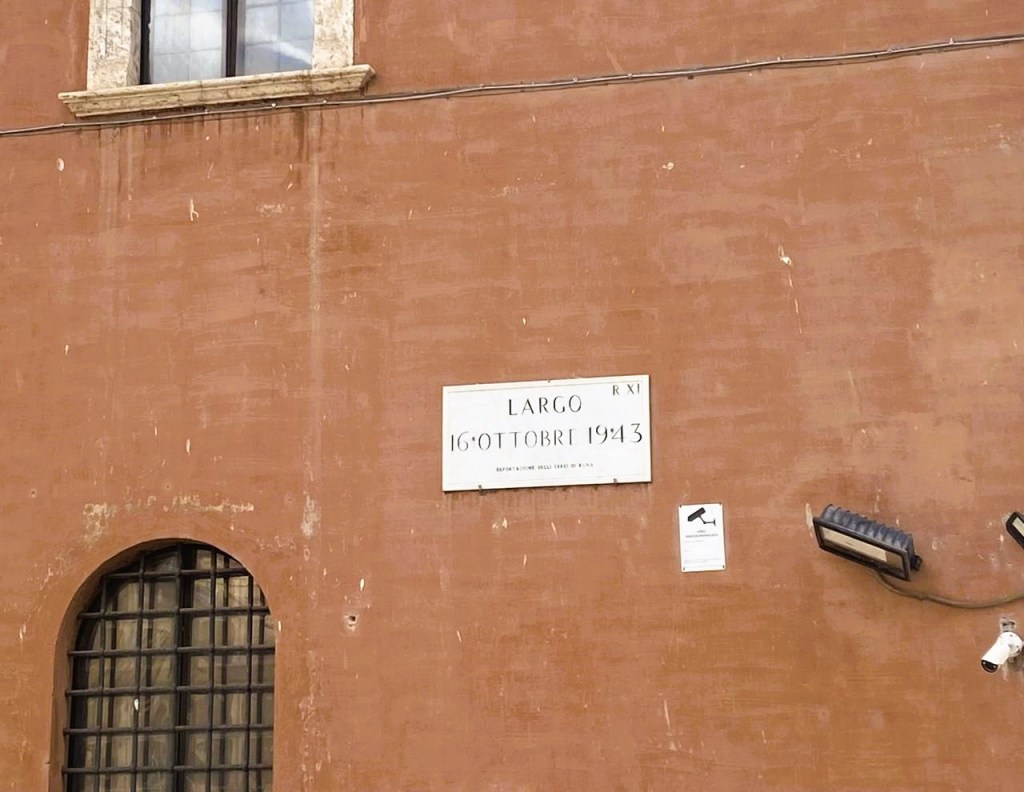
The neighbourhood continues to be a living centre of Jewish life. Its synagogues, restaurants, shops and streets are not simply relics of the past. They belong to a community that survived persecution and continues to preserve its traditions.
Yet the memory of the deportation remains inseparable from the absences it created. Behind the names of the murdered are homes that lost their occupants, families that never reunited and lives whose ordinary possibilities were taken away.
The events of 16 October 1943 are particularly disturbing because of their setting. This was Rome, one of the great historic cities of Europe, a place celebrated for its civilisation, monuments and extraordinary cultural inheritance. Its Jewish population had survived for centuries through changes of empire, government and religion. Nevertheless, in the autumn of 1943, German authorities were able to enter homes, seize families and send more than a thousand people towards a killing centre.
The age of a community did not protect it. Its contribution to society did not protect it. Its citizenship did not protect it. Even the surrender of 50 kilograms of gold could not protect it.
The raid demonstrated the terrible vulnerability of ordinary people when prejudice becomes state policy and state policy is enforced by organised violence. The Nazi perpetrators did not see the people they arrested as individuals entitled to safety and dignity. They saw them as Jews, and that classification was enough.
But the victims were never merely numbers in a deportation record. They were Roman citizens, neighbours, parents, children, friends and relatives. They belonged to families whose histories had unfolded over generations in the same streets through which German soldiers marched that morning.
Their story deserves to be remembered not only because of the enormity of the crime, but because of the lives that existed before it. To remember the Jews of Rome is to remember a community that had endured for centuries, and to recognise the human beings behind the statistics of the Holocaust.
On 16 October 1943, the Nazis came for the Jews of Rome. They arrested more than a thousand people and deported them to Auschwitz. Only 16 of those deported survived.
The city endured. The Jewish community endured. But for the families taken away that morning, the world they had known was destroyed.
And the streets of the old Jewish quarter would forever carry the memory of the day when Rome’s ancient Jewish community was hunted in its own home.
Sources:
https://en.wikipedia.org/wiki/Raid_on_the_Roman_Ghetto
https://www.theguardian.com/books/2015/jul/25/liberation-of-rome-italian-imagination
Please support us so we can continue our important work.
Donation
Your readership is what makes my site a success, and I am truly passionate about providing you with valuable content. I have been doing this at no cost and will continue to do so. Your voluntary donation of $2 or more, if you are able, would be a significant contribution to the continuation of my work. However, I fully understand if you’re not in a position to do so. Your support, in any form, is greatly appreciated. Thank you. To donate, click on the credit/debit card icon of the card you will use. If you want to donate more than $2, just add a higher number in the box left from the PayPal link. Your generosity is greatly appreciated. Many thanks.
$2.00


Leave a Reply