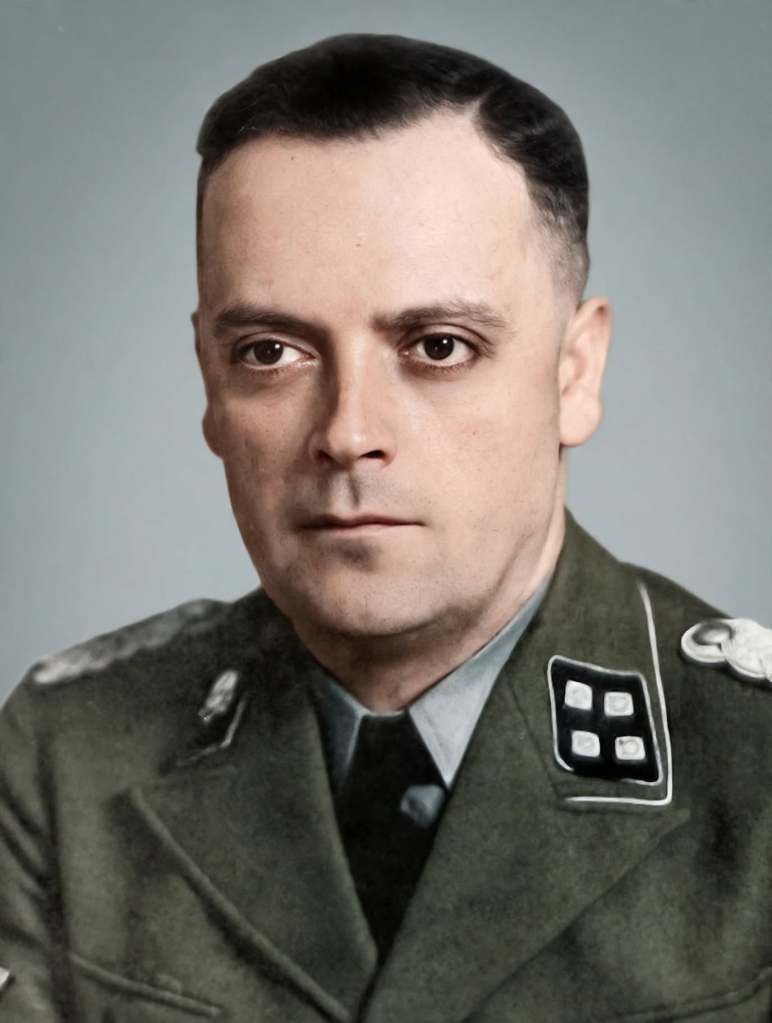
In the popular imagination, the commandants of Nazi concentration and extermination camps are often envisioned as sadistic ideologues who reveled in personal brutality. While men like Amon Göth or Josef Kramer fit that archetype, the machinery of the Holocaust relied equally—if not more—on another type of perpetrator: the efficient, soft-spoken administrator who treated mass murder as a logistical problem to be optimized. Arthur Liebehenschel, who succeeded Rudolf Höss as commandant of Auschwitz I and later commanded the Majdanek camp, exemplified this bureaucratic banality. His career illustrates how administrative competence, careerism, and moral detachment could produce shifts in camp conditions without ever altering the fundamental purpose of the Nazi extermination apparatus
Early Life and Rise in the SS
Born on November 25, 1901, in Posen (now Poznań, Poland), then part of the German Empire, Arthur Liebehenschel grew up in a middle-class family. He studied economics and public administration before serving briefly in the Reichswehr, the Weimar Republic’s armed forces, where he rose to the rank of sergeant major. After leaving the military, he worked as a clerk, developing the meticulous organizational habits that would define his later SS career.
In 1932, as the Weimar Republic collapsed, Liebehenschel joined both the Nazi Party (NSDAP) and the SS. Unlike many early Nazi street fighters, he was not drawn to brawling or ideological fervor; rather, he brought clerical precision to a rapidly expanding paramilitary organization. By 1934, he had entered the Concentration Camps Inspectorate (Inspektion der Konzentrationslager, or IKL) under Theodor Eicke. Liebehenschel served as an adjutant at the Columbia-Haus camp in Berlin and later at Lichtenburg, quickly proving himself an indispensable staff officer.
In 1937, he was transferred to the central headquarters of the IKL in Oranienburg, becoming chief of the political department and later chief of staff to Eicke’s successor, Richard Glücks. When the camp system was integrated into the SS Economic and Administrative Main Office (SS-Wirtschafts- und Verwaltungshauptamt, or WVHA) in March 1942 under Oswald Pohl, Liebehenschel was appointed head of Office Group D I—the central administrative nerve center overseeing all concentration camps across the Reich. From a desk in Oranienburg, he signed directives governing prisoner transfers, labor allocations, rations, and executions, mastering the paperwork of terror long before he ever commanded a major death camp in person.
Commandant of Auschwitz I (November 1943 – May 1944)
By late 1943, Auschwitz had become mired in internal corruption. SS officers were routinely stealing gold, jewelry, and currency looted from murdered Jewish deportees, undermining SS discipline. To clean up the administration, Heinrich Himmler reorganized the sprawling complex into three separate administrative entities—Auschwitz I (the main camp), Auschwitz II-Birkenau (the extermination center), and Auschwitz III-Monowitz (the Buna slave labor camp)—and transferred longtime commandant Rudolf Höss to Berlin. On November 11, 1943, Arthur Liebehenschel took over as commandant of Auschwitz I and senior garrison officer.
Liebehenschel’s six months at Auschwitz produced one of the most paradoxical chapters in the camp’s history. He immediately dismantled several hallmarks of Höss’s terror regime:
- Abolition of the “Standing Cells”: He ordered the destruction of the notoriously cruel Stehbunker in Block 11—tiny brick cells barely large enough for a prisoner to stand in—and declared a general amnesty for prisoners held in the bunker.
- Curbing Arbitrary Brutality: He prohibited SS guards and Kapos from randomly beating prisoners on the camp streets and suspended the dreaded Bunker selections, in which prisoners imprisoned for minor infractions were routinely shot at the Black Wall.
- Improving Basic Conditions: Under his tenure, food distribution became slightly more regular, and lice infestations were more aggressively combated, leading to a measurable drop in the mortality rate among registered prisoners in the main camp.
Survivors of Auschwitz I, including Hermann Langbein—an Austrian communist prisoner who served as a clerk in the SS infirmary and observed Liebehenschel closely—later testified that conditions in the main camp improved noticeably under his command.
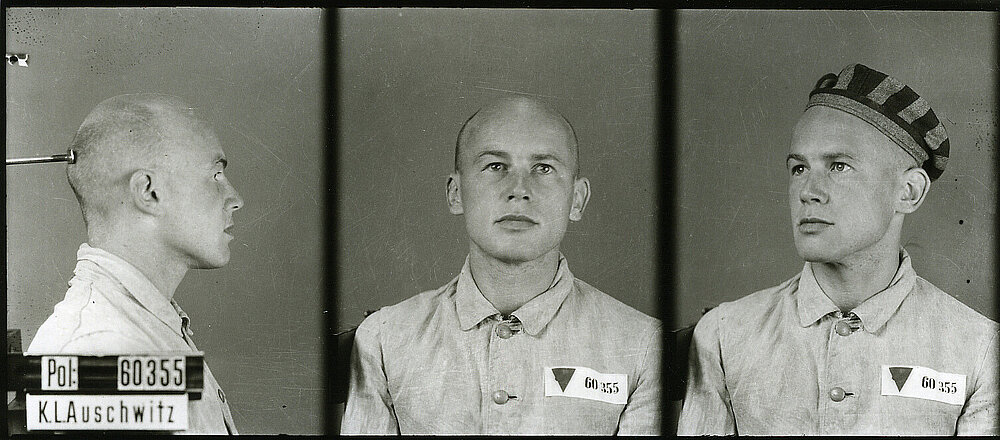
Yet these reforms were driven by Prussian administrative logic rather than humanitarianism. Dead or incapacitated prisoners could not work, and SS officers engaged in unauthorized sadism or black-market theft eroded military discipline. Liebehenschel wanted a clean, orderly, and productive camp.
Crucially, his reforms stopped at the gates of Auschwitz I. While he moderated daily terror in the main camp, the gas chambers and crematoria at Auschwitz II-Birkenau—commanded by Friedrich Hartjenstein, though still under Liebehenschel’s overarching garrison authority—continued to operate at industrial capacity. Furthermore, Liebehenschel’s tenure unraveled due to his personal life. After divorcing his first wife, he began a relationship with Anneliese Hüttemann, a former SS secretary with a politically suspect past. Himmler and Oswald Pohl strongly disapproved of the match, viewing it as unbefitting an SS commandant. Coupled with the impending arrival of hundreds of thousands of Hungarian Jews—for which Himmler wanted Höss’s ruthless efficiency back on site—Liebehenschel was removed from Auschwitz in May 1944.
Majdanek and the End of the War
On May 19, 1944, Liebehenschel was reassigned as commandant of the Majdanek concentration and extermination camp near Lublin, Poland. By then, the Red Army was advancing rapidly westward, and Majdanek’s primary function had shifted from extermination to liquidation and evacuation. Liebehenschel oversaw the dismantling of camp infrastructure and the forced evacuation of the remaining prisoners before Soviet forces liberated the camp in July 1944.
Following the evacuation of Majdanek, Liebehenschel was transferred to Trieste, Italy, where he joined the staff of Odilo Globocnik, the Higher SS and Police Leader for the Operational Zone of the Adriatic Littoral, serving in the personnel office until the collapse of Nazi Germany in May 1945.
Trial and Execution
After the war, Liebehenschel was arrested by the United States Army and extradited to Poland to stand trial before the Supreme National Tribunal in Kraków during the First Auschwitz Trial, which began in November 1947.
Throughout the proceedings, Liebehenschel maintained a calm, understated demeanor. He argued that he was merely a career administrator who had sought to alleviate suffering wherever possible, citing his abolition of the standing cells and his halt to executions at the Black Wall. Several former prisoners indeed confirmed that he had restrained SS brutality in Auschwitz I.
The tribunal, however, rejected the notion that administrative moderation absolved him of responsibility for the larger system. In its verdict, the court emphasized that Liebehenschel had been a senior architect of the concentration camp bureaucracy for a decade, had wielded overall garrison command at Auschwitz while tens of thousands were gassed at Birkenau, and had personally enforced the exploitation and destruction of human beings on a massive scale. On December 22, 1947, Arthur Liebehenschel was sentenced to death. He was executed by hanging at Montelupich Prison in Kraków on January 24, 1948.
Historical Significance
Arthur Liebehenschel remains a troubling figure for historians of the Holocaust because he complicates simple moral binaries. He was neither a raving fanatic nor a hands-on sadist, and his localized reforms at Auschwitz I genuinely saved the lives of a number of registered prisoners. Yet those very actions demonstrate the terrifying adaptability of the Nazi system: a commandant could make a concentration camp more humane by internal standards while remaining a loyal, indispensable executive of genocide. By reducing human lives to ledger entries and administrative regulations, Liebehenschel proved that the machinery of mass murder did not require hatred to function—only obedience and efficiency.
Arthur Liebehenschel, had four children with his first wife, Gertrud: one son and three daughters. The youngest, Barbara Ursula Cherish, was born in 1943 in Oranienburg, Germany, and later settled in the United States.
In 2009, Cherish published My Father, the Auschwitz Commandant, also titled ” The Auschwitz Kommandant: A Daughter’s Search for the Father She Never Knew”a deeply personal account of her father’s life and legacy.
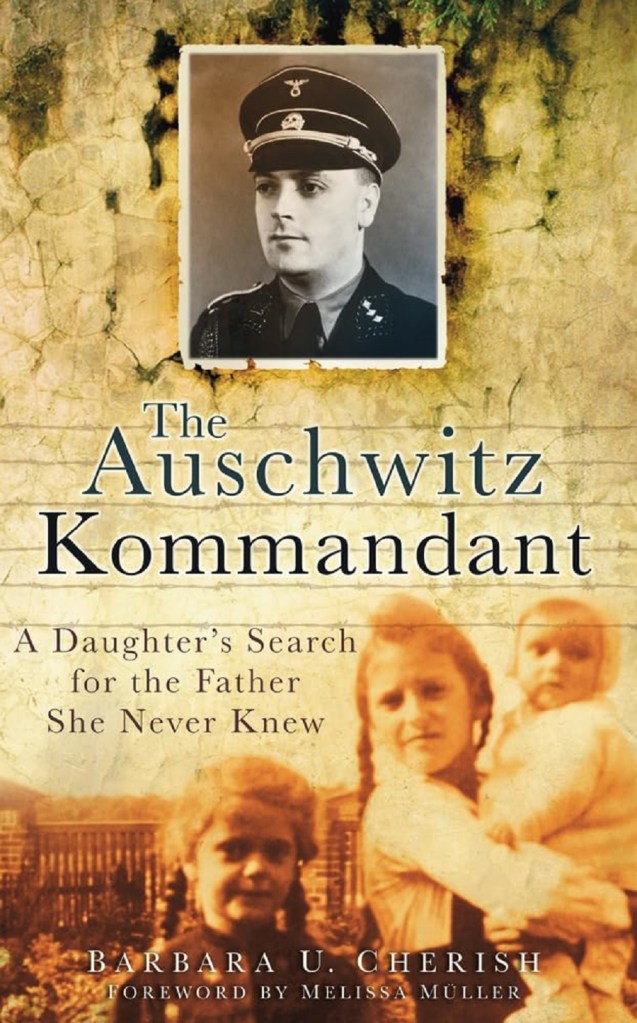
In the book, she described actions by Liebehenschel that reportedly improved conditions for some prisoners, but she also confronted the far greater reality: his role in a genocidal system responsible for the persecution and murder of millions. Whatever individual measures he may have taken, they could not erase his responsibility as a senior SS officer and Auschwitz commandant.
In 2002, Cherish and her sister Antje were interviewed by the German television broadcaster ZDF. They spoke about the difficult experience of growing up with the knowledge that their father had been involved in the Holocaust, and about the burden of living with his guilt and legacy.
Liebehenschel also fathered a son with his second wife, Anneliese. His first marriage had ended during the war, when he left Gertrud. She subsequently suffered from serious mental health problems and, in 1966, died by suicide in a psychiatric hospital.
The story of Liebehenschel’s family illustrates another dimension of the aftermath of Nazi crimes: the legacy inherited by the children of perpetrators. They were not responsible for their father’s actions, but they were left to confront a past that could neither be changed nor easily escaped.
Sources:
https://ausstellung.gedenkstaette-porta.de/en/panel3/hermann-langbein
https://en.wikipedia.org/wiki/Arthur_Liebehenschel
https://www.theguardian.com/lifeandstyle/2009/jun/20/barbara-cherish-auschwitz
https://nuremberg.law.harvard.edu/documents/authors/761-arthur-liebenhenschel
Donation
Your readership is what makes my site a success, and I am truly passionate about providing you with valuable content. I have been doing this at no cost and will continue to do so. Your voluntary donation of $2 or more, if you are able, would be a significant contribution to the continuation of my work. However, I fully understand if you’re not in a position to do so. Your support, in any form, is greatly appreciated. Thank you. To donate, click on the credit/debit card icon of the card you will use. If you want to donate more than $2, just add a higher number in the box left from the PayPal link. Your generosity is greatly appreciated. Many thanks.
$2.00


Leave a Reply