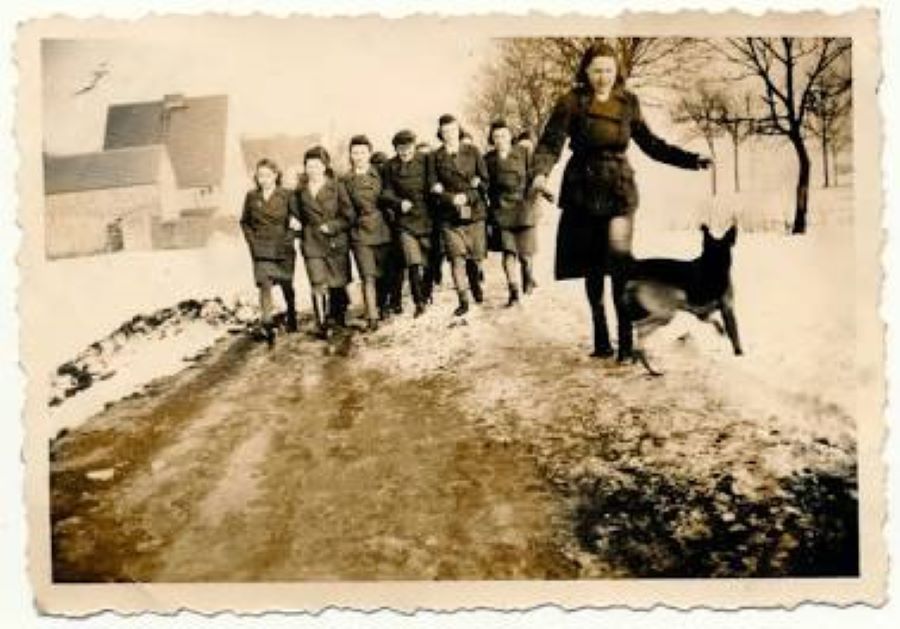
More than 200 women served the SS at the Auschwitz concentration camp. They were divided into three main groups according to the duties they performed.
The largest group consisted of the so-called Aufseherinnen (female guards), whose primary responsibility was to supervise and control female prisoners. They were directly involved in maintaining discipline within the women’s sections of the camp, and some became notorious for their cruelty and brutality.
The second group comprised women employed in administrative and communications roles. Known as SS-Helferinnen, they worked in SS headquarters offices as radiotelegraph operators, stenographers and telephone operators. The third group consisted of nurses who provided medical services within the camp complex.
Dr. Sylwia Wysińska of the Auschwitz-Birkenau State Museum Archives discusses the women who served at Auschwitz and their respective roles in the camp system.
Auschwitz was initially established as a concentration camp for men. However, as the camp expanded, women were also deported there. While male prisoners were generally supervised by male SS personnel, female prisoners were placed under the direct supervision of female guards.
Although the term SS women frequently appears in post-war testimonies and historical accounts, it is important to make a distinction. The female guards, or Aufseherinnen, were not formally members of the SS. They were civilian employees of the SS apparatus, recruited and trained to supervise female prisoners. Nevertheless, they were an integral part of the camp’s machinery of oppression and terror.
Their uniforms may have been different from those of their male counterparts, and their formal status within the Nazi hierarchy was not the same, but their responsibilities placed them firmly within a system built on humiliation, violence and the systematic destruction of human lives.
Female concentration camp guards—officially designated as SS-Aufseherinnen (female SS overseers)—were never formal members of the SS, which remained an exclusively male organization. Instead, they held the legal status of civilian employees attached to the SS-Gefolge (SS retinue or auxiliary corps), operating inside the camp system under SS command while remaining outside the military chain of command.
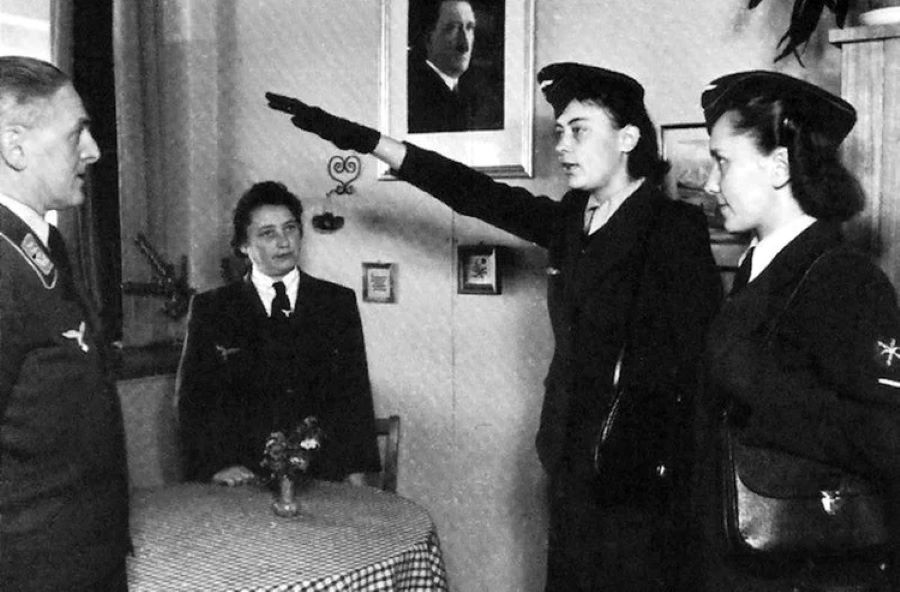
1. Official Legal Status
Because Nazi ideology barred women from bearing arms as combat soldiers or holding full SS membership, the regime created a distinct administrative category for female camp staff:
- Civilian Employees (SS-Gefolge): Women signed standard civil service or wage-labor contracts rather than taking the formal SS blood oath. Technically, they were classified as Gefolgschaftsmitglieder (members of the retinue) under the authority of the SS-Wirtschafts- und Verwaltungshauptamt (WVHA).
- Subordinate Rank Structure: Regardless of seniority, a female overseer could never hold authority over a male SS officer or enlisted man. Even the highest-ranking female official in a camp—the Oberaufseherin (Chief Overseer)—answered directly to the male camp commandant or protective custody camp leader (Schutzhaftlagerführer).
- Postwar Legal Consequences: During postwar trials, many Aufseherinnen argued they were mere civilian state employees rather than members of a criminal organization. Allied courts rejected this defense, ruling that their voluntary contract work and direct participation in camp administration made them fully culpable under war crimes statutes.
2. Recruitment Methods
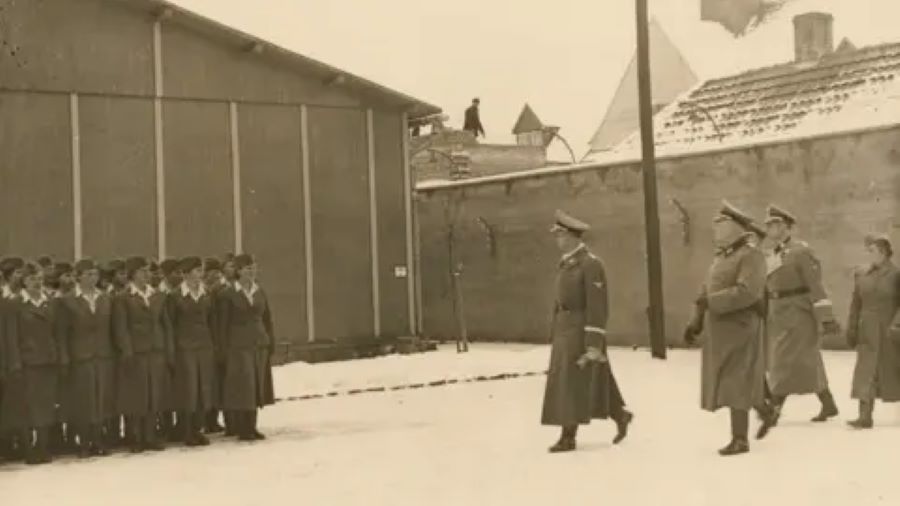
Between 1939 and 1945, approximately 3,500 to 3,700 women served as Aufseherinnen across the Nazi camp network—roughly 10% of the total camp guard force. Recruitment evolved through three main phases as the war expanded:
- Early Voluntary Applications (1939–1942): Initially, women applied voluntarily through local labor exchanges (Arbeitsämter) or responded to newspaper advertisements placed by the SS. The role offered steady pay, housing, uniforms, rations, and social mobility—particularly attractive to working-class women from retail, domestic service, or factory backgrounds.
- Transfer from Armaments Factories (1943–1944): As the camp system grew to supply forced labor to German industry, armaments firms like Siemens, Krupp, and IG Farben built satellite subcamps beside their factories. Companies nominated trusted female supervisors from their own shop floors to be trained as Aufseherinnen so they could oversee female prisoners on the assembly lines.
- Conscription via Labor Service (1944–1945): In the final year of the war, voluntary applications failed to keep pace with labor demands. The Reich Labor Service (Reichsarbeitsdienst, or RAD) began drafting young German women directly into camp guard service under emergency wartime labor decrees.
3. Training and Duties
Nearly all Aufseherinnen underwent training at Ravensbrück, the primary women’s concentration camp north of Berlin, before being dispatched to Auschwitz-Birkenau, Majdanek, Bergen-Belsen, Stutthof, or hundreds of industrial subcamps.
| Responsibility Area | Specific Duties |
|---|---|
| Camp Security & Roll Calls | Conducting morning and evening roll calls (Appell), counting prisoners in all weather conditions, and searching barracks for contraband. |
| Labor Supervision | Escorting prisoner work details (Kommandos) to factories, agricultural fields, or construction sites and enforcing production quotas. |
| Discipline & Punishment | Reporting infractions, administering beatings, withholding rations, or recommending prisoners for confinement in the camp bunker. |
| Selections & Extermination | At killing centers such as Auschwitz-Birkenau and Majdanek, senior Aufseherinnen assisted SS physicians during selections for the gas chambers and oversaw the confiscation of prisoners’ property. |
| Dog Handling (Hundeführerinnen) | Specialized guards trained to patrol perimeters and intimidate work details using attack-trained German Shepherds. |
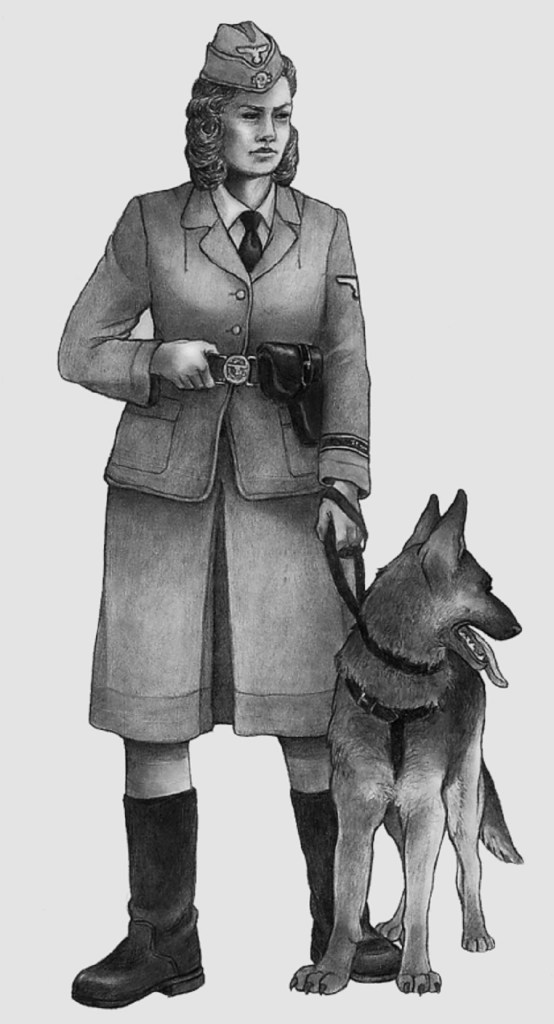
Unlike male SS guards (Totenkopfverbände) who manned exterior watchtowers with rifles and machine guns, Aufseherinnen worked almost exclusively inside the camp perimeter, carrying pistols, wooden clubs, or leather whips rather than long firearms.
Executions
Women who served in the Nazi apparatus—primarily as concentration camp guards (Aufseherinnen), nurses in the T4 euthanasia program, or SS auxiliaries rather than front-line combat soldiers—were executed almost exclusively by hanging following Allied war crimes trials, though a smaller number died by shooting (firing squad) or beheading.
The exact method depended on which Allied jurisdiction tried and sentenced them:
- British and American Zones: Judicial Hanging
In the Western occupation zones, British and U.S. military tribunals executed convicted female war criminals by short-drop or standard-drop hanging.
British Zone (Hamelin Prison): British authorities employed their veteran chief executioner, Albert Pierrepoint, to carry out sentences at Hamelin Prison in Lower Saxony. Following the Belsen Trial in December 1945, Pierrepoint hanged Irma Grese, Elisabeth Volkenrath, and Juana Bormann individually using the British standard-drop method, designed to break the neck instantaneously. He later returned to Hamelin to hang Ravensbrück camp personnel, including Dorothea Binz, Greta Bösel, and Elisabeth Marschall in May 1947.
American Zone (Landsberg Prison): Following the Dachau and Hadamar trials, U.S. military authorities executed women by hanging at Landsberg Prison in Bavaria. Notable examples include Irmgard Huber (commuted, though male co-defendants were hanged) and Greta Bösel’s counterparts in other U.S.-run proceedings, alongside Ilse Koch (who died by suicide in prison rather than execution). In 1946, Herta Oberheuser received a prison sentence, while other female perpetrators convicted of capital offenses in U.S. courts faced the gallows.
- Polish and Soviet Jurisdictions: Public Hanging and Firing Squad
Eastern European courts executed a larger number of female camp guards—particularly those who served at Majdanek, Auschwitz-Birkenau, and Stutthof—often using public or semi-public methods.
Poland (Public Hangings): Polish tribunals conducted public executions by short-drop hanging (strangulation rather than a neck-breaking drop) at or near the sites of the atrocities.
Biskupia Górka (July 1946): Following the first Stutthof Trial in Gdańsk, five female guards—Jenny-Wanda Barkmann, Elisabeth Becker, Wanda Klaff, Ewa Paradies, and Gerda Steinhoff—were hanged simultaneously from gallows mounted on the backs of flatbed trucks. Once the nooses were secured, the trucks drove forward.
Kraków (January 1948): Following the Auschwitz Trial, Maria Mandl (head overseer of the Birkenau women’s camp) and Therese Brandl were hanged at Montelupich Prison.
Soviet Union (Firing Squad and Hanging): Soviet military tribunals executed female Nazi auxiliaries, camp guards, and local collaborators primarily by shooting (a single shot to the back of the head or firing squad) or by hanging in public squares for crimes committed in occupied Soviet territories.
- During the War: Beheading (Guillotine)
Before the war ended, the Nazi regime itself executed several women who worked within its military or administrative structures for treason, espionage, or resistance activities. Under German penal law, civilian and administrative executions were carried out using the guillotine (Fallbeil) at prisons such as Plötzensee in Berlin.
In December 1945, British chief executioner Albert Pierrepoint carried out a series of executions at a special prison in Germany used to hold prisoners sentenced to death by hanging. Among those executed were former Auschwitz guards Irma Grese and Elisabeth Volkenrath.
Before the executions, the condemned women were carefully measured and weighed to determine the appropriate length of rope required for the hangings. British execution procedures were governed by precise calculations and official tables, designed to ensure that the executions were carried out according to established standards. The preparations were conducted discreetly, within the confines of the prison, away from public attention and with minimal exposure to the press.
The Polish executions of former Stutthof concentration camp guards in July 1946 could hardly have been more different.
On July 4, 1946, a vast crowd gathered near Gdańsk to witness the execution of eleven convicted war criminals, including five women who had served as guards at Stutthof. Unlike the British executions, which took place behind prison walls, the Polish authorities organised the hangings in an open, public space. The proceedings unfolded in broad daylight, before thousands of spectators.
Among the women sentenced to death were Jenny-Wanda Barkmann and Gerda Steinhoff. Along with their fellow condemned guards, they were brought to the execution site in vehicles positioned beside an enormous gallows structure. The condemned women were then hanged in full view of the assembled crowd.
The contrast between the two approaches was striking. In Britain, executions were conducted behind closed doors, according to carefully regulated procedures and shielded from public spectacle. In Poland, the authorities deliberately made the executions a public event, turning the punishment of those responsible for atrocities in the concentration camp system into a visible demonstration of post-war justice.
Sources:
https://thefemalesoldier.com/blog/the-aufseherinnen
https://www.auschwitz.org/en/education/e-learning/podcast/women-supervisors-at-auschwitz
https://time.com/3915391/the-forgotten-brutality-of-female-nazi-concentration-camp-guards
https://news.ku.edu/news/article/2015/06/12/holocaust-researcher-details-lives-female-nazi-guards
https://www.quora.com/How-did-female-Nazi-soldiers-get-executed
Donation
Your readership is what makes my site a success, and I am truly passionate about providing you with valuable content. I have been doing this at no cost and will continue to do so. Your voluntary donation of $2 or more, if you are able, would be a significant contribution to the continuation of my work. However, I fully understand if you’re not in a position to do so. Your support, in any form, is greatly appreciated. Thank you. To donate, click on the credit/debit card icon of the card you will use. If you want to donate more than $2, just add a higher number in the box left from the PayPal link. Your generosity is greatly appreciated. Many thanks.
$2.00


Leave a Reply