
Sabotage: a destructive or obstructive action carried out by a civilian or enemy agent to hinder a nation’s war effort.
The Dutch are often criticized for not having done enough to protect their fellow citizens during World War II, especially their Jewish neighbours. To an extent, it is a justified criticism. However, this doesn’t mean there was any resistance, far from it. In February 1941, the Dutch trade unions and communist party organized a nationwide strike. The February strike is considered the first public protest against the Nazis in occupied Europe and the only mass protest against the deportation of Jews to be organized by non-Jews. Afterwards, there were harsh retaliations by the Nazis.
Throughout the war, there were many acts of sabotage. The line at the start of the post is one of the definitions of sabotage, the one most appropriate for the WWII context. Many acts of sabotage were carried out on the railways. However, there are other examples. Below are a few examples.

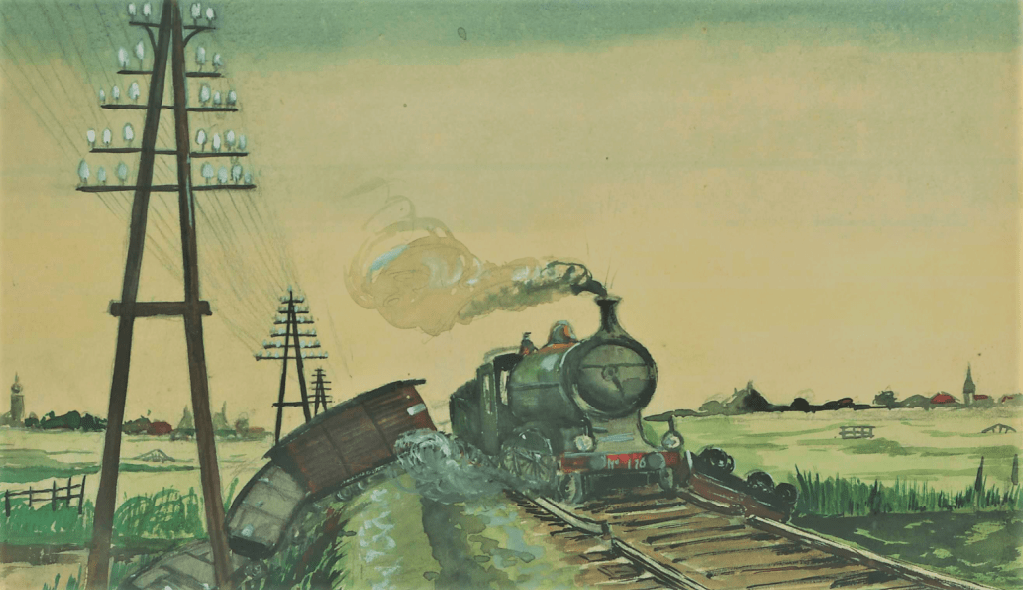
Railway Sabotage between Dronrijp and Deinum
From a series of 12 watercolours (1945) a few days just before the liberation of Friesland. The drawings show various sabotage actions that the Frisian resistance carried out in April 1945, such as opening bridges, removing or destroying signage and barriers and sabotaging the railway.
Sabotage by a resistance group in Weert, Limburg. The sabotage actions were intended to prevent coal transport from Limburg to the west of the Netherlands. The big cities are all in the west. The transport would mainly be done via the waterways.

The saboteurs were punished severely, many were executed or murdered in concentration camps. These are just some of the heroes who paid the ultimate price.
Willem Pahud de Mortanges began to actively resist the German invaders soon after the start of the German occupation. A chemistry student at the Technical University since 1939, he was one of the organizers of the Student Contact in 1942. In addition, he formed a sabotage group with his friends Huurman, Van Raalte, Koenig, Smit and Van der Plas, which mainly targeted railways and ships, making their own explosive devices. Finally, however, an agent provocateur managed to penetrate their ranks, which resulted in their arrest in Rotterdam on the night of 8/9 March 1943. Willem was executed by the firing squad two months later at the age of 22.

Jo Buizer was born on September 11, 1918, in Almkerk as the fifth and youngest child of Jan Buizer and Klaaske Heukels. He grew up in a reformed environment and lived in Rotterdam as an adult. Buizer was a radio operator at the Rijkstelegraafkantoor (State Telegraph office) in Amsterdam during the first months of the German occupation. The Germans ordered him to listen to the British, American and African radio stations, but he resisted. Jo decides to get to Great Britain to participate on the Allied side in the fight against the Germans. Buizer with Jan de Haas and Ab Homburg in mid-February 1942, escaped to Great Britain on the steam trawler Beatrice as stowaways. As soon as the boat was on the high seas, the three emerged and persuaded the skipper to sail to England. After arriving, Jo trained as a secret agent with the Special Operations Executive. On the night of 22-23 June, he and radio operator Jan Jacob van Rietschoten were parachuted into Holten, Drenthe, to train resistance groups on how to commit sabotage. However, it would not come to that for Jo. The Nazis were waiting for him on the ground and arrested him immediately. As a result of the German counterintelligence operation Nordpol (the ‘Englandspiel’ in which the Germans order a captured radioman to continue signalling with the English), they were aware of his arrival. Jo was taken to the SD-Polizeigefängnis in Haaren for questioning. On 27 November 1943, he was transported to Mauthausen Concentration Camp in Austria, where he was shot on 6 September 1944, five days before his 26th birthday.
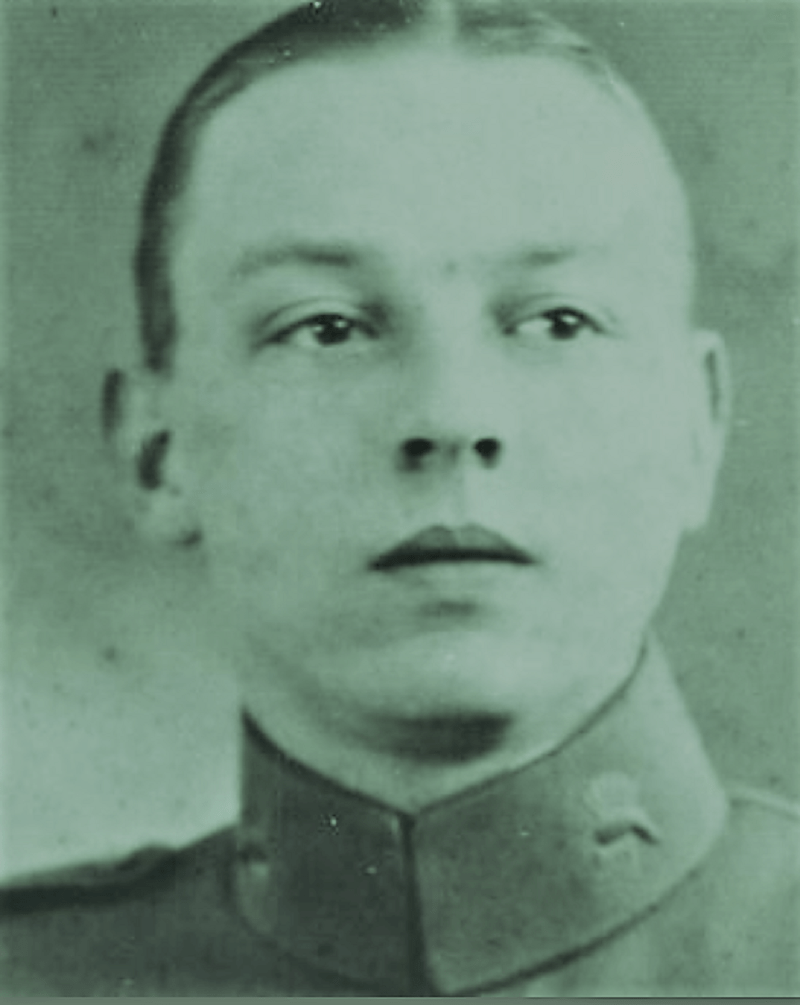
Jacob Smeer worked at Hollandia-Kattenburg, a clothing factory in Amsterdam. On charges of having distributed the illegal magazine ‘De Waarheid'(the Truth) in the company and of having called for sabotage of the production of raincoats intended for the German army by working slowly or disabling the assembly line, Jacob Smeer was arrested and in January 1943 a lawsuit was filed against him and four other employees of Hollandia-Kattenburg in Utrecht. Bernard Luza was considered the leader of the group. The death penalty was demanded against all members of the group. Luza and Mijer Konijn were sentenced to death, and the three others received a prison sentence. Jacob Smeer belonged to these three.
On 25 May 1943, Jacob Smeer was transported from Camp Westerbork to Sobibor. He was murdered there on 28 May 1943.

Sources
https://oorlogsgravenstichting.nl/personen/114469/willem-theodoor-pahud-de-mortanges
https://www.oorlogsbronnen.nl/tijdlijn/Johannis-Jan-Cornelis-Buizer/02/22920
https://www.oorlogsbronnen.nl/tijdlijn/Jacob-Smeer/01/25777
https://map.stolpersteine.app/nl/amsterdam/locaties/formosastraat-13

 History of Sorts
Leave a comment