
The Holocaust remains the darkest period in human history. Among the stories of unspeakable horror and loss, there are also tales of survival that seem almost miraculous. One such story is that of Fania Fénelon, a French Jewish musician whose extraordinary life was spared because of her involvement in a concentration camp orchestra. Her story, which she later recounted in her memoir Playing for Time, highlights the brutal ironies of survival in the Holocaust, where art, meant to express humanity and beauty, was weaponized by the Nazis for the dehumanization of prisoners. Fénelon’s survival is often regarded as miraculous, not only because she managed to live through Auschwitz, but because she emerged with her spirit intact, able to recount her experience to the world.
Early Life and Deportation
Fania Fénelon, born Fania Goldstein in Paris in 1918, was a professional singer and pianist before the war. She was an ardent antifascist and involved in political activism, which, coupled with her Jewish heritage, made her a target for the Nazi regime. In 1943, Fénelon was arrested by the Gestapo in Paris for her resistance activities. She was deported to Auschwitz-Birkenau, the notorious concentration and extermination camp, where her life would take an unexpected and harrowing turn.
The Orchestra at Auschwitz
Upon arrival at Auschwitz, Fénelon faced the same dehumanizing conditions as other prisoners: starvation, overwork, and the constant threat of death. Yet, in a twisted use of art, the Nazis had established an orchestra in Auschwitz made up of female prisoners. This orchestra, under the command of the camp authorities, played for various purposes, including to accompany prisoners being led to their deaths in the gas chambers and to entertain the SS officers. The sheer cruelty of this arrangement was unbearable; the orchestra’s music was a grotesque juxtaposition of beauty amid suffering.
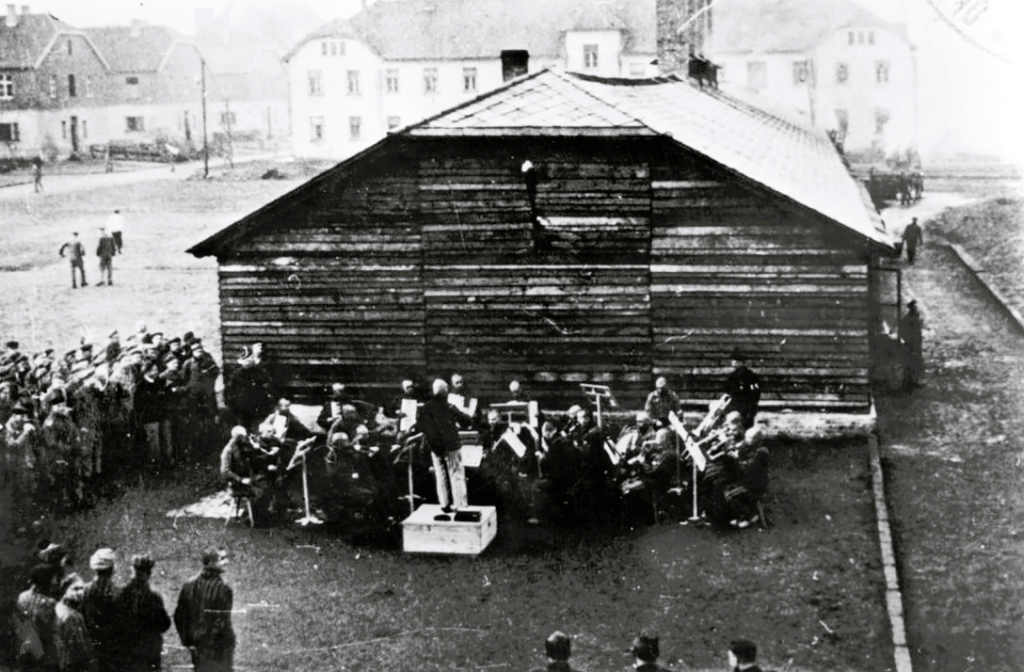
Fénelon’s musical abilities were her lifeline. She was chosen to join the orchestra, where she played the piano and sang. This placement spared her from some of the more grueling physical labor in the camp and likely saved her from being sent to the gas chambers. But while her position in the orchestra allowed her a certain degree of survival, it came at a significant psychological cost. Fénelon later recounted the inner torment she felt playing music in such horrific circumstances, knowing that her performances were being used as a tool of Nazi propaganda and sadistic control.
The Cruel Irony of Survival
Fania Fénelon’s survival is often viewed as miraculous, not just because she escaped physical death, but because she survived the moral and emotional devastation of Auschwitz. The orchestra’s music was meant to pacify prisoners on their way to execution and entertain their oppressors. Fénelon was forced to watch fellow inmates, some of them her friends, march to their deaths while she played music. The tension between her role as an artist and the inhumanity surrounding her was a constant burden.
Fénelon’s survival, in many ways, was based on the cruelest of ironies: that her musical talent, something she loved and had dedicated her life to, was now being exploited by the very regime that sought to destroy her. Yet, this very talent gave her a better chance at survival. The orchestra members were given slightly better living conditions compared to other prisoners, including access to slightly more food and shelter. Still, this privileged position within the camp came with immense emotional suffering, as they were acutely aware of the death and destruction happening around them.
Liberation and Life After Auschwitz
Fénelon’s miraculous survival was not only due to her place in the orchestra but also her resilience in enduring the emotional toll of her experience. In 1945, as the Nazis evacuated Auschwitz in the face of advancing Allied forces, Fénelon was transferred to the Bergen-Belsen camp, where she remained until liberation. After the war, she returned to her musical career, but the trauma of her time in Auschwitz stayed with her for the rest of her life.
In her memoir, Playing for Time, Fénelon described the complex emotions she experienced as a member of the Auschwitz orchestra. She detailed the contradictions of being a musician in such a place—creating beauty while surrounded by death. Her memoir was later adapted into a controversial film, which further spread her story. Through her writing and public speaking, Fénelon bore witness to the atrocities of the Holocaust, ensuring that future generations would not forget what happened in Auschwitz.
Below some recollections:
Kramer and Maria Mandel, both of whom loved music and yet were vicious killers. For example, Kramer cried when we played the ‘Traumerei’ by Schubert. Kramer gassed 24,000 people. When he was tired from his work, he came to us and listened to music.
Indeed, for all of the musicians, we had never played so much and so often before. We gave up to three concerts every Sunday. During the day and at night as well, SS officers came to our blocks and demanded their allowance of music. Music, again and again and again. In Birkenau, music was both the best and the worst. The best: it swallowed the time and allowed us to forget, like a drug; afterward, you were numbed and sucked dry. The worst: our public – on the one hand, the murderers, and on the other, the victims. And us, would we also become executioners in the hands of the murderers?
The Legacy of Fania Fénelon’s Story
Fania Fénelon’s story is not just one of survival but of the endurance of the human spirit in the face of unimaginable horror. Her experience as a member of the Auschwitz orchestra symbolizes the grotesque perversion of art by the Nazi regime. Yet, it also highlights the capacity for resilience and hope, even in the darkest circumstances.
Her survival is often regarded as miraculous because it seemed almost impossible that anyone could live through such horror and emerge with the ability to speak, create, and reflect on the experience. Fénelon’s post-war career as a musician and writer demonstrates that, despite the Nazis’ attempts to destroy her, she retained her identity, her voice, and her passion for music.
Fania Fénelon’s survival in Auschwitz is a testament to the cruel paradoxes of life in the concentration camps. Her story reflects both the depths of human cruelty and the power of the human spirit to endure and resist. Though Fénelon survived due to her musical talents, her real victory lay in her ability to transcend the trauma she endured and to share her story with the world. Her life and legacy remind us of the importance of memory, art, and testimony in the aftermath of unimaginable suffering.
Sources
https://holocaustmusic.ort.org/places/camps/death-camps/birkenau/fenelonfania/
Donation
Your readership is what makes my site a success, and I am truly passionate about providing you with valuable content. I have been doing this at no cost and will continue to do so. Your voluntary donation of $2 or more, if you are able, would be a significant contribution to the continuation of my work. However, I fully understand if you’re not in a position to do so. Your support, in any form, is greatly appreciated. Thank you. To donate, click on the credit/debit card icon of the card you will use. If you want to donate more than $2, just add a higher number in the box left from the PayPal link. Your generosity is greatly appreciated. Many thanks.
$2.00
 History of Sorts
Leave a comment