
The Nazi occupation of the Channel Islands, beginning in 1940, marked a dark chapter in British history, as these small territories—Jersey, Guernsey, Alderney, and Sark—became the only British lands occupied by Nazi Germany during World War II. Though the Channel Islands’ geographical proximity to mainland Europe made their defense difficult, the way local British authorities responded to the occupation, particularly in relation to the persecution and deportation of Jews, remains a deeply controversial issue. The collaboration of local authorities in enforcing anti-Jewish policies highlights the moral complexities and difficult choices faced by those under occupation. This essay explores how the British authorities on the Channel Islands, through compliance with Nazi demands, aided the deportation of Jewish residents and facilitated the implementation of anti-Semitic policies.
The Occupation of the Channel Islands
The Channel Islands, with a total population of around 90,000 people, were left strategically indefensible after the fall of France in 1940. The British government made the decision to demilitarize the islands, evacuating troops and leaving them open to German invasion. By the summer of 1940, the Nazis had taken control of the islands, establishing an occupation regime that lasted until the end of the war in 1945. For the most part, the occupation was not characterized by the same level of violence seen in other parts of Europe. Still, it did lead to the imposition of harsh Nazi laws, including those aimed at persecuting the small Jewish population.
The Implementation of Anti-Jewish Laws
One of the mosNazit shocking aspects of the Nazi occupation of the Channel Islands was the enforcement of anti-Semitic policies by local British authorities. Under Nazi rule, the islands were expected to adopt the racial laws and regulations imposed in mainland Europe, including those aimed at the isolation, disenfranchisement, and eventual deportation of Jewish citizens.
As early as 1941, the German occupiers began requesting information about Jewish residents on the islands, and local authorities complied by registering and identifying Jews within their jurisdictions. Guernsey and Jersey, the two largest islands, required Jews to register their businesses and identify themselves. The local officials who managed the registration did so with little or no resistance, facilitating the Nazi racial classification system. Jewish businesses were marked, and their owners were stripped of their ability to operate freely.
This cooperation highlights a broader issue: although the British administration was still functioning on the Channel Islands, it quickly became subordinate to the Nazi occupation forces. Many island authorities viewed compliance with German demands as a pragmatic choice, believing that cooperation was necessary to maintain a semblance of normality and avoid harsher reprisals. However, this accommodationist stance ultimately meant that British authorities became complicit in Nazi crimes.
The Deportation of Jews from the Channel Islands
In 1942, following Adolf Hitler’s directive to deport Jews from Western Europe to concentration camps in the East, the Nazis turned their attention to the Channel Islands. Although the Jewish population on the islands was small, numbering fewer than 20 individuals, the deportation of these Jews was carried out with the assistance of local authorities.
One of the most infamous cases was that of three Jewish women—Auguste Spitz, Therese Steiner, and Marianne Grunfeld—who were living in Jersey and Guernsey.

They were arrested, interned, and subsequently deported to Auschwitz, where they perished. The deportation process was conducted with the cooperation of local administrators, who provided the necessary documentation, approved the arrests, and facilitated the Nazi orders.
The night before their deportation Therese Steiner and Auguste Spitz visited their friend Elisabet Duquemin, a fellow registered Jewish refugee from Vienna. Elisabet Duquemin remembered:
“They had a paper with them from the Germans that they had to report the next morning to be taken away to France and were in a terrible state of anxiety. They borrowed a suitcase from me and I never saw the poor girls again.”
There were no efforts made by island authorities to prevent the deportation of these women, despite the clear evidence of the Nazi regime’s genocidal intentions. In some cases, local officials were even instrumental in rounding up Jews and ensuring their compliance with deportation orders. While some British citizens on the islands attempted to shield Jewish residents or provide them with false papers, these acts of resistance were isolated and did not reflect the broader stance of the administration.
Moral Responsibility and Complicity
The deportation of Jews from the Channel Islands raises difficult questions about the moral responsibility of those living under occupation. While the Channel Islands’ authorities may have felt that resistance to the Nazis would lead to harsher punishments or reprisals against the general population, their compliance with Nazi racial laws made them complicit in the persecution and murder of Jews.

Historians have debated the degree to which local British authorities could have resisted these measures, given the islands’ vulnerable position. Nonetheless, the fact remains that the authorities did not take any significant action to protect Jewish residents from Nazi persecution. The bureaucratic machinery of the local government became an extension of the Nazi occupation, and in doing so, it facilitated one of the gravest crimes of the war—the deportation of Jews to the death camps.
Post-War Reflection and Accountability
After the war, the Channel Islands’ role in the deportation of Jews became a subject of controversy and reflection. While many on the islands were hailed for their endurance and suffering under occupation, the treatment of the Jewish population was largely overlooked. It was not until decades later that the deportations were fully acknowledged as a moral failing.
In recent years, the Channel Islands governments have expressed regret for their role in the deportation of Jews and the implementation of Nazi racial policies. Memorials have been erected, and efforts have been made to commemorate the victims. However, the scars of this dark chapter remain.
The deportation of Jews from the Channel Islands during the Nazi occupation exemplifies the complex nature of collaboration and complicity under occupation. While local authorities may have seen their actions as pragmatic, their cooperation with Nazi demands facilitated the persecution and eventual deaths of Jewish residents. The small number of Jews deported from the islands does not diminish the significance of this tragedy, which stands as a reminder of the moral dangers inherent in accommodationist policies. The story of the Channel Islands during World War II forces us to reflect on the choices made by individuals and governments in times of crisis, and the far-reaching consequences of compliance with evil regimes.

Louisa Gould: A Heroine of the Nazi Occupation of the Channel Islands
Louisa Gould, a courageous and selfless woman from the British Channel Islands, is remembered as a shining example of moral courage during one of the darkest periods of World War II. Living under the brutal Nazi occupation of Jersey and Guernsey, Gould made a conscious decision to risk her life to protect a fugitive Russian slave laborer. This decision led to her arrest, deportation, and eventual death in a concentration camp. Her story, largely untold until recent years, exemplifies the quiet heroism of ordinary people in extraordinary times. This essay explores Louisa Gould’s life, her act of defiance against the Nazi regime, and the enduring legacy of her bravery.
The Nazi Occupation of the Channel Islands
In June 1940, following the fall of France, the Channel Islands—Jersey, Guernsey, Alderney, and Sark—were occupied by Nazi forces. This marked the only instance of British soil being under German control during the war. Although small and isolated, the islands’ occupation was harsh, with residents subject to German laws, curfews, and rationing. Worse still, many residents had to comply with oppressive measures imposed by the occupiers, including forced labor and anti-Semitic policies.
Louisa Gould, a shopkeeper on the island of Jersey, was one of many who initially tried to live a quiet life under occupation. However, her strong sense of justice and empathy for those suffering under the Nazis ultimately pushed her to take action, even at the risk of her own life. Her decision to resist was born out of a profound sense of morality, placing her in direct opposition to the Nazi regime.
The Decision to Shelter Feodor Burriy
In 1942, a young Soviet prisoner of war named Feodor Burriy escaped from a Nazi labor camp on the Channel Islands. The Germans had brought thousands of forced laborers from Eastern Europe to the islands, where they were subjected to brutal conditions while building fortifications, bunkers, and military installations. These laborers were treated as expendable, and many died from malnutrition, overwork, or physical abuse. Burriy’s escape was an act of desperation, and finding shelter was crucial for his survival.
When Feodor Burriy found his way to Louisa Gould’s doorstep, she faced a profound moral dilemma. Helping him meant defying the Nazis, risking not only her own life but also the lives of her family and friends. However, Gould’s compassion outweighed her fear. She took Burriy in, hid him in her home, and cared for him as if he were part of her family. Over the next 18 months, she provided him with shelter, food, and even English lessons, all the while knowing that discovery would likely lead to her execution or deportation.
Her decision was not made in isolation. Gould’s family and friends were aware of Burriy’s presence. They supported her in this act of resistance, showing that small networks of defiance existed even in the most dangerous of circumstances. But this support network was fragile, and the looming threat of betrayal always hung over them.
Betrayal and Arrest
In 1944, Louisa Gould’s worst fears were realized. She was betrayed by a local neighbor, who informed the Nazis of the Russian laborer she was hiding. This betrayal led to a raid on her home, and she was arrested for harboring a fugitive. Her act of humanity, which had sustained Burriy for nearly two years, became the basis for her prosecution by the German military authorities.
Gould was tried in a Nazi military court and sentenced to deportation to a concentration camp. She was one of several Channel Islanders arrested for aiding fugitives and resisting the occupation in various ways. Her arrest underscored the brutal reality of living under Nazi control, where even the most minor acts of defiance could result in the harshest punishments.
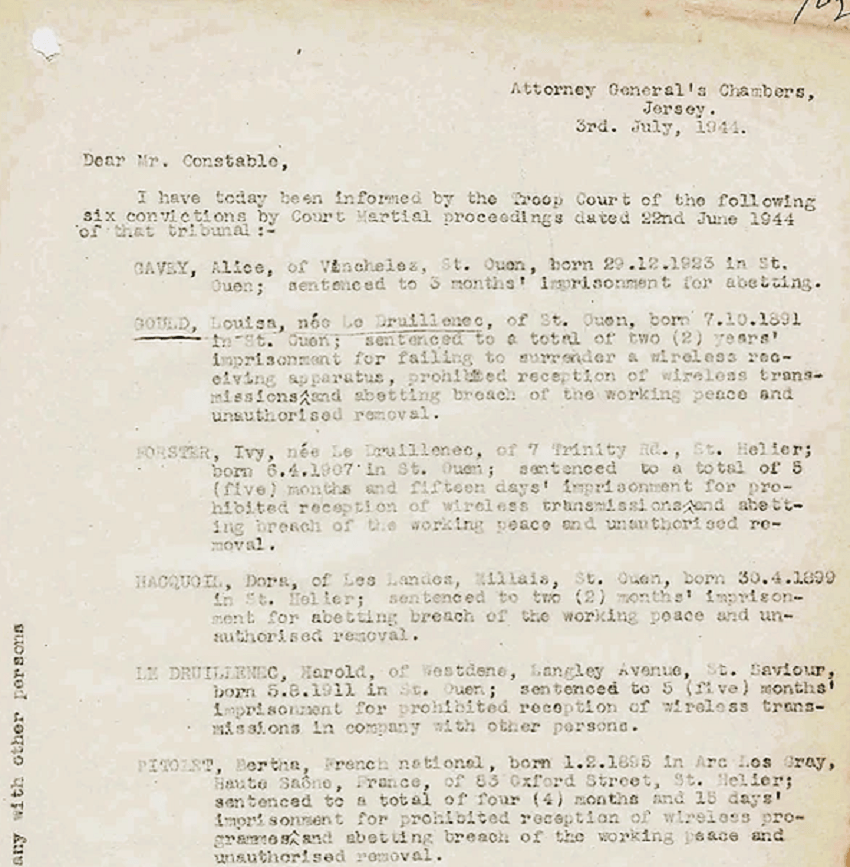
Deportation to Ravensbrück
Following her arrest, Louisa Gould was deported to Ravensbrück, the infamous Nazi concentration camp for women in Germany. Ravensbrück was known for its horrific conditions, where women were subjected to forced labor, medical experiments, and arbitrary executions. Gould’s time in the camp was marked by deprivation and suffering, but she continued to display remarkable courage. Though the exact details of her final days are not entirely clear, it is known that she perished in the camp in early 1945, just months before the end of the war. Like so many others, her life was extinguished in the vast machinery of the Nazi death camps.
Legacy and Commemoration
Louisa Gould’s death at Ravensbrück was a tragic end to a life defined by compassion and bravery. However, her story did not immediately become widely known. In the years following the war, many of the personal stories of resistance in the Channel Islands were overshadowed by broader narratives of suffering and survival under occupation. It was not until decades later that her actions began to receive the recognition they deserved.
In 2010, Louisa Gould was posthumously awarded the title of “British Hero of the Holocaust” by the British government, a recognition of her bravery in the face of Nazi tyranny. Her story was also the subject of the 2017 film Another Mother’s Son, which brought her sacrifice to a broader audience and highlighted the quiet but powerful resistance of Channel Islanders like her.
Today, memorials on the Channel Islands honor Gould and others who risked everything to resist the occupation. She is remembered as a symbol of moral courage, representing the many ordinary people who made extraordinary sacrifices during World War II.
Louisa Gould’s story is a powerful testament to the strength of human compassion and the moral courage required to resist tyranny. At significant personal cost, she chose to shelter a fugitive from the Nazi regime, knowing full well the dangers she faced. Her eventual arrest, deportation, and death at Ravensbrück highlight the immense cruelty of the Nazi occupation. Still, her legacy endures as an example of selflessness and bravery.
In a time when fear and oppression dominated daily life, Louisa Gould’s actions remind us of the profound impact one person can have in the fight against injustice. Her story serves as an enduring lesson in the power of individual courage, even in the face of overwhelming adversity. Today, she stands as a heroine of the Channel Islands, a symbol of resistance, and a beacon of hope in the darkest of times.
Sources
https://www.hmd.org.uk/resource/louisa-gould
https://www.jersey.com/inspire-me/inspiration/the-true-story-of-louisa-gould/
https://www.cam.ac.uk/stories/channel-islands-victims
https://www.bbc.com/news/world-europe-guernsey-38744583
Donation
Your readership is what makes my site a success, and I am truly passionate about providing you with valuable content. I have been doing this at no cost and will continue to do so. Your voluntary donation of $2 or more, if you are able, would be a significant contribution to the continuation of my work. However, I fully understand if you’re not in a position to do so. Your support, in any form, is greatly appreciated. Thank you. To donate, click on the credit/debit card icon of the card you will use. If you want to donate more than $2, just add a higher number in the box left from the PayPal link. Your generosity is greatly appreciated. Many thanks.
$2.00

 History of Sorts
Leave a comment