
“I witnessed the most terrible thing, something which no-one else knows about in this country because no-one else is alive to remember it. One day, the Auschwitz guards brought in between 400 and 600 Roma from Germany. Many of the men were former German soldiers who had fought in Poland during the First World War. Some of them were still wearing their medals: the Knight’s Cross, if you’re familiar with it. They were decorated soldiers — German soldiers — and yet one night the guards came and took them to the gas chambers to be killed.” this a testimony of Artur Radvansky, a Jewish survivor of the Holocaust.
On November 15, 1943, Heinrich Himmler issued a public order declaring that Romani people (often referred to as “Gypsies”) were to be treated “on the same level as Jews” and deported to concentration camps.
Himmler was resolute in implementing Nazi racial policies, which sought to eliminate all groups deemed “racially inferior” or “asocial” from Germany and German-controlled territories. The Romani people, classified by Nazi ideologues as belonging to both categories, faced widespread persecution. Many had already been executed en masse in Poland and the Soviet Union.
The November 15 order represented a more systematic effort, extending these genocidal policies to include the deportation of Romani individuals already held in labor camps to Auschwitz, where they faced extermination. This marked a critical escalation in the Nazis’ campaign against the Romani people during the Holocaust.

When we reflect on the atrocities of the Holocaust, our minds often focus on the immense suffering endured by the Jewish community. However, another devastating chapter of the Holocaust—the Porajmos, or “The Devouring”—remains less acknowledged in the broader narrative of World War II history. This term, used by some Romani communities, refers to the genocide of the Romani people at the hands of the Nazi regime and its collaborators. Between 220,000 and 500,000 Romani men, women, and children were murdered, representing a catastrophic loss for a vibrant and diverse community.
Historical Context and Nazi Ideology
The roots of the Romani genocide lie in the Nazis’ perverse racial ideology. The Romani people, who had lived in Europe for centuries, were viewed by the Nazis as both a racial and cultural threat. They were falsely portrayed as “racially inferior” and “asocial,” unfit to belong in the “Aryan” racial hierarchy. Heinrich Himmler, one of the chief architects of the Holocaust, initially showed some interest in classifying certain Romani groups as “racially pure.” However, this distinction was soon abandoned, and the Nazis began targeting all Romani people for persecution and extermination.

“Humor behind the lines.
In a village in Poland, these tank drivers encountered a Gypsy woman whose chatter was a humorous diversion for them.”
The Nazi regime’s oppression of the Romani began with systematic discrimination and exclusion. By 1936, Romani families in Germany were forcibly relocated to designated camps, such as the Marzahn camp in Berlin, where they faced deplorable conditions. The Nuremberg Laws of 1935, designed initially to strip Jewish citizens of their rights, were expanded to include the Romani people. They were banned from schools, public spaces, and most forms of employment.
Escalation to Genocide
The onset of World War II marked a horrifying escalation in the Nazis’ treatment of the Romani. In occupied Eastern Europe, the Einsatzgruppen (mobile killing units) executed thousands of Romani people alongside Jewish communities. Mass shootings, deportations, and forced labor became everyday realities for the Romani population.
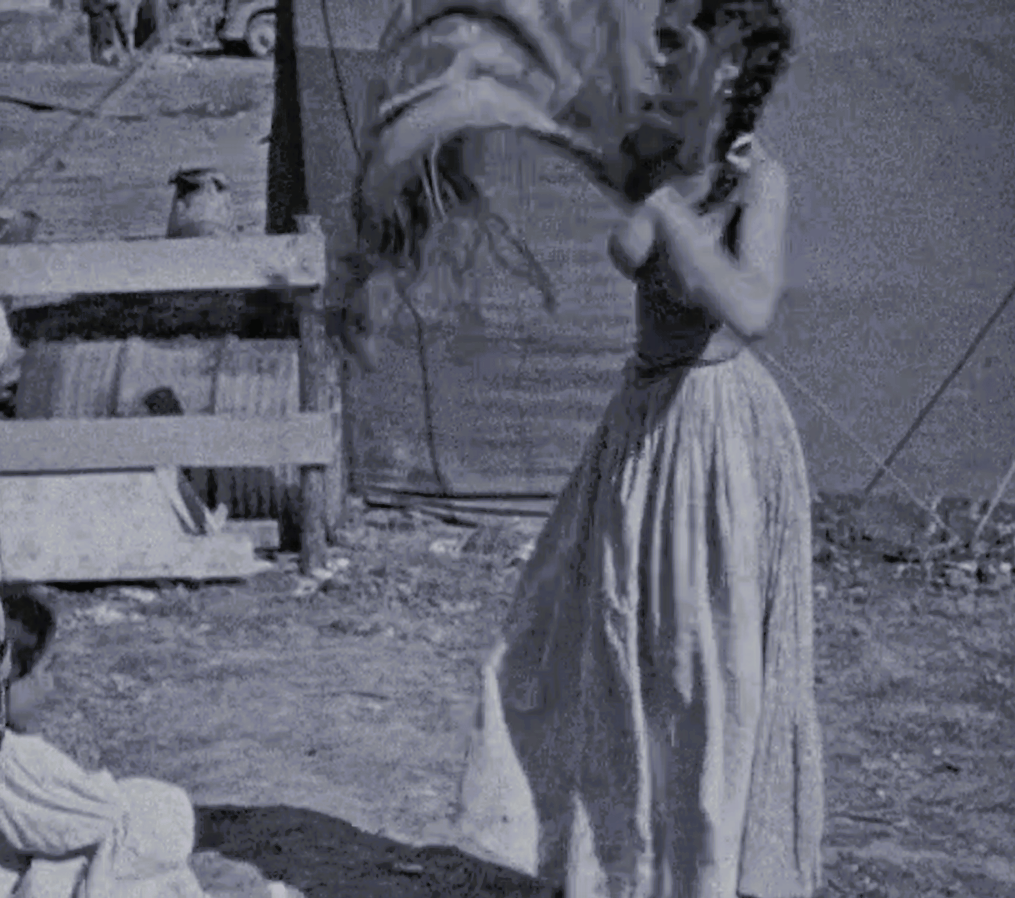
One of the most infamous examples of their suffering occurred in Auschwitz-Birkenau. The Nazis established a separate “Gypsy Family Camp” in Auschwitz in 1943. While some families were initially allowed to stay together, this did little to mitigate their suffering. Conditions were appalling, and many prisoners succumbed to starvation, disease, and brutal treatment by guards. On the night of August 2, 1944—later commemorated as Roma Holocaust Memorial Day—the Nazis liquidated the camp, killing an estimated 4,300 men, women, and children in the gas chambers.
The Aftermath and Struggle for Recognition
Unlike the Jewish community, which received some measure of recognition and reparations in the post-war years, the Romani people faced continued marginalization. Survivors of the Porajmos were often reluctant to speak out, fearing further discrimination. For decades, their suffering was largely ignored in historical accounts and public memorials of the Holocaust. It wasn’t until the late 20th century that governments and scholars began to acknowledge the Porajmos as an integral part of the Holocaust narrative.
Today, the struggle for recognition continues. The Romani community remains one of Europe’s most marginalized groups, often subject to discrimination and poverty. Efforts to educate the world about the Porajmos are crucial, not only to honor the memory of those who perished but also to combat ongoing prejudice and ensure that such atrocities are never repeated.

Why the Porajmos Matters
Remembering the Porajmos is not just about acknowledging a historical injustice—it is about confronting the ways prejudice and dehumanization can spiral into unimaginable violence. The story of the Romani genocide is a stark reminder that no community is immune to the dangers of scapegoating and systemic discrimination.
As we commemorate the lives lost in the Holocaust, we must ensure that the Romani victims of the Porajmos are not forgotten. Their voices, silenced by hatred, demand to be heard. Through education, remembrance, and advocacy, we can honor their memory and reaffirm our commitment to a world where all people are valued and protected from persecution.
Let the legacy of the Porajmos be a call to action: to remember, to educate, and to stand against hate in all its forms.
In the grim history of the Holocaust, even the extermination camps were segregated. At Auschwitz II-Birkenau, one notorious section, known as Section Blle, was designated the ‘Zigeunerlager’ or the Gypsy Camp. This was where Roma men, women, and children were imprisoned together—brutally forced into slave labor and subjected to unspeakable cruelty. Among those responsible for their suffering was Dr. Josef Mengele, who took a particularly horrifying interest in the Roma. He subjected them to cruel, inhumane medical experiments that left lasting scars on those who survived.
August 2nd: Roma Holocaust Memorial Day
August 2nd is recognized as Roma Holocaust Memorial Day, marking the night in 1944 when the remaining 2,897 Roma men, women, and children from the “Zigeunerlager” were murdered in the gas chambers of Auschwitz. This brutal massacre claimed the lives of every Roma and Sinti held in the camp, leaving no survivors from Auschwitz.
The true scale of the Roma genocide has often been obscured. Nazi records sometimes categorized them under dehumanizing terms such as “remainder to be liquidated,” “hangers-on,” or even “partisans.” As a result, the number of Roma victims has often been underestimated. It is estimated that between one-third and two-thirds of Europe’s Roma population at the time—around 500,000 individuals—were exterminated. In addition, at least another 500,000 were displaced, stripped of their possessions, or had their identities erased forever.

Dina Gottliebová, later known as Dina Babbitt, was a Jewish artist who survived the Auschwitz concentration camp and became known for her remarkable story of survival and art. Born in 1923 in Czechoslovakia, Dina was a talented painter and illustrator. She was deported to Auschwitz during World War II, where her artistic skills became both a blessing and a curse.
While in Auschwitz, Dina was selected by the infamous Dr. Josef Mengele to create portraits of Roma women with whom Mengele was experimenting. These portraits were used as part of Mengele’s pseudo-scientific studies, and they served to document the “racial characteristics” he was obsessed with. Although Dina was forced to create these drawings, she later recounted how she tried to subtly alter the depictions to soften the brutal reality of women’s suffering.
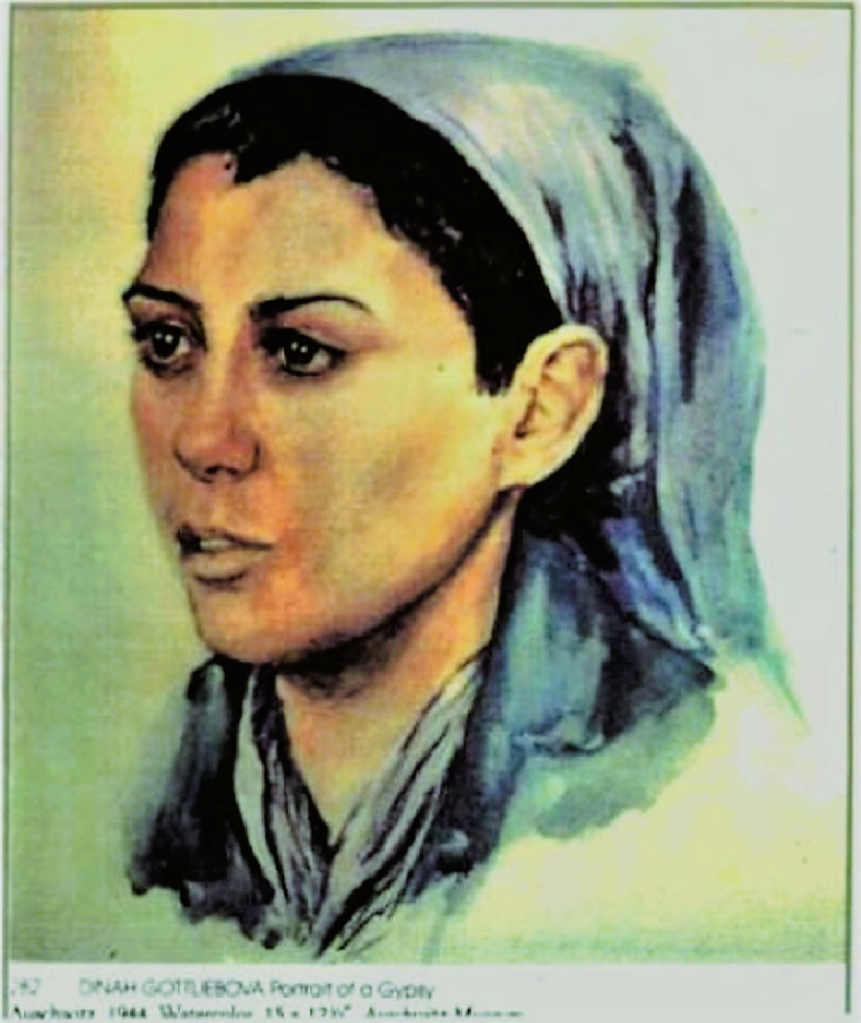
After surviving Auschwitz, Dina immigrated to the United States, where she changed her name to Dina Babbitt after marrying Art Babbitt. Art Babbitt was an artist who worked at Disney, where he became one of the studio’s top animators. He worked on many of Disney’s early classic animated films, contributing his talents to:
“Snow White and the Seven Dwarfs” (1937): Babbitt was one of the critical animators behind the character of Grumpy, one of the seven dwarfs. His skill in conveying character and emotion through animation became a hallmark of his work. Ironically, this was Hitler’s favorite movie.
Sources
https://www.pbs.org/show/lost-home-movies-nazi-germany/
https://english.radio.cz/artur-radvansky-remembering-roma-war-veterans-murdered-auschwitz-8074712
https://english.radio.cz/devouring-a-look-romani-holocaust-8095293
https://encyclopedia.ushmm.org/content/en/article/genocide-of-european-roma-gypsies-1939-1945
https://arolsen-archives.org/en/news/dinah-babbitt/
https://www.waltdisney.org/education/talks/artist-auschwitz-incredible-survival-story-dina-babbitt
Donation
Your readership is what makes my site a success, and I am truly passionate about providing you with valuable content. I have been doing this at no cost and will continue to do so. Your voluntary donation of $2 or more, if you are able, would be a significant contribution to the continuation of my work. However, I fully understand if you’re not in a position to do so. Your support, in any form, is greatly appreciated. Thank you. To donate, click on the credit/debit card icon of the card you will use. If you want to donate more than $2, just add a higher number in the box left from the PayPal link. Your generosity is greatly appreciated. Many thanks.
$2.00

 History of Sorts
Leave a reply to tzipporahbatami Cancel reply